
Public Expected to Help Monitor National Defence Governance
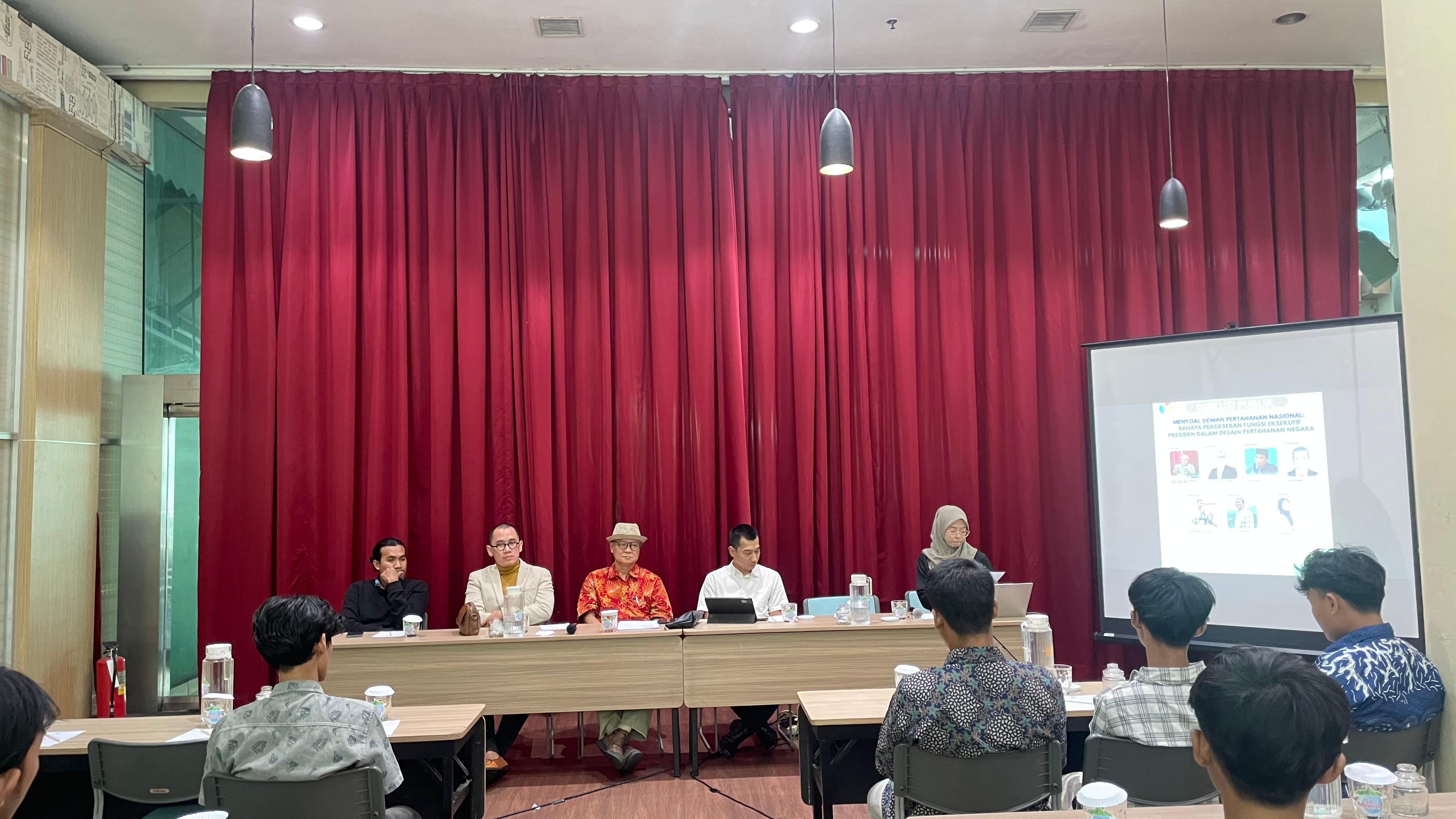
The establishment of the National Defence Council (DPN) as part of efforts to strengthen the national defence system has drawn critical notes from several public policy and law researchers. The presence of this new institution is regarded as requiring thorough scrutiny to avoid governance problems, ranging from potential inter-agency overlap to the limits of executive function.
These notes emerged during a discussion entitled “Questioning the National Defence Council: The Dangers of Shifting Presidential Executive Functions in the Design of National Defence” held in Jakarta on Wednesday, 20 May 2026.
Public Policy and Governance researcher, Gian Kasogi, assessed that the structure and institutional design of the DPN require clear articulation so its functions operate optimally without creating a new power centre that could blur the President’s executive authority.
“The issue with the DPN lies not only in its institutional design, which is not yet fully clear, but also in the potential for overlapping powers, provisions open to multiple interpretations, and the risk of politicising defence institutions,” Gian said.
Gian warned of the need for caution to prevent a dualism in strategic decision-making between the President, the Ministry of Defence (Kemenhan), the Indonesian Armed Forces (TNI), and Lemhannas if the DPN’s powers were drafted too broadly.
In particular, the position of Defence Minister Sjafrie Sjamsoeddin, who has been mandated as the DPN’s Acting Secretary, also drew scrutiny. Gian argued that such a large responsibility requires strict oversight mechanisms and firm limits on authority to keep within a balanced governance framework. Moreover, the strategic defence sector often intersects with national political dynamics ahead of major political events such as the 2029 Presidential Election.
“While the DPN may be formed in the name of strengthening national defence, if in practice it opens space for concentration of power, politicisation of institutions, and shifting of the President’s executive functions, the public has the right to question and even correct it,” added Gian.
At the same time, Legal and Strategic Litigation Researcher, Syaiful Hidayatullah, highlighted the post-reform institutional phenomenon prone to overlapping functions. He stated that strategic functions related to geopolitics, geo-economics, and the challenges of technological warfare are already accommodated by existing ministries and agencies.
“The emergence of the DPN will extend the overlap of powers among state institutions in Indonesia’s constitutional system. Looking at the mandate given, the DPN will shift the functions of Lemhannas,” Syaiful said.
He argued that if the focus is on geostrategy studies, Indonesia already has the Ministry of Defence, the Ministry of Foreign Affairs, the TNI High Command (Mabes TNI), BIN, and Lemhannas. For cyber security and technology, there is Kemkominfo (Ministry of Communication and Information Technology), BSSN, and the cyber units of the TNI and Polri.
Syaiful also offered his view on the overlapping role of Defence Minister Sjafrie Sjamsoeddin as Acting Executive Chair of the DPN. He believes this broadens the scope of defence sector development at scale, including programmes expanding its role touching civilian areas in various regions.
“I think only President Prabowo can halt the expansion of the role undertaken by Defence Minister Sjafrie, because all the positions held by Defence Minister Sjafrie represent divisions of political power from the President,” concluded Syaiful. (H-2)
Fauzan Ohorella highlighted the need for strict oversight mechanisms and transparency within the DPN to ensure civilian supremacy in a democratic climate is maintained.
One of the most notable concerns is the potential overlap of powers with existing ministries and agencies.
The Ministry of Defence confirms protection of Indonesian soldiers in Lebanon through the UN command system, with intensified mitigation steps amid escalated security.
There is alignment in momentum between the plan to transfer management of TMPNU and the legislature’s ongoing agenda.
In addition to providing a borehole for daily needs, the government has installed RO water purification machines.