
PTPN Prepares 10,000 Hectares of Land in West Java to Boost Garlic Self-Sufficiency
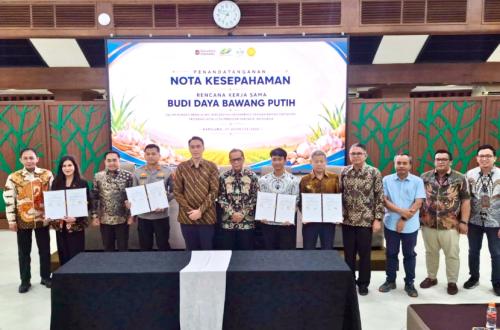
PTPN Group is supporting the national garlic self-sufficiency programme through the development of a 10,000-hectare cultivation area in West Java in 2026. The development involves strategic partners, farmer groups, and local communities.
PTPN III President Director Denaldy Mulino Mauna said the programme reflects PTPN Group’s commitment to supporting the national food security and sovereignty agenda through the development of strategic commodities and the building of a sustainable business ecosystem.
“Overall, PTPN Group is targeting garlic development of 24,000 hectares over the 2026-2029 period,” Denaldy said in a written statement in Jakarta on Monday (24/8/2026).
Denaldy said garlic development is increasingly strategic given that the gap between domestic production and national demand remains very large. Based on Ministry of Agriculture data, domestic garlic production ranges from only 39,000 to 40,000 tonnes per year, while national demand reaches around 600,000 tonnes per year.
“This condition shows there is still significant room to increase domestic production while reducing dependence on imports,” Denaldy said.
PTPN Group has signed a Memorandum of Understanding with 14 strategic partners in Bandung, with a commitment to develop 6,500 hectares of garlic in the first phase. This step is in line with the determination to build a healthy and sustainable national garlic industry and improve farmer welfare.
“With the gap between production and demand still very large, we need to build the ecosystem seriously and measurably,” Denaldy added.
Denaldy explained that the initial phase of development will be directed at accelerating the supply of quality garlic seed as the main foundation for increasing production. Once seed availability is stronger, subsequent development will be directed at meeting national consumption needs for garlic.
“PTPN Group is also committed to helping address various implementation challenges on the ground, including the need for suitable land,” Denaldy continued.
PTPN Group is also encouraging the development of an integrated garlic ecosystem, from seed production, cultivation, cultivation technology, processing, to marketing, involving central and regional governments, farmers, academics, state-owned enterprises, and business actors. In West Java, PTPN Group has coordinated with the regional government regarding the readiness of development areas.
In addition, a more environmentally friendly garlic cultivation concept is being developed together with the Bogor Agricultural University and PT Riset Perkebunan Nusantara, including strengthening cultivation technology and testing varieties that are adaptive to land characteristics.
“The programme is expected to make a real contribution to increasing national garlic production while creating a stronger business ecosystem for farmers and business actors along the supply chain,” Denaldy said.
PTPN I Regional 2 Regional Head Desmanto said the garlic development areas in West Java are spread across several regencies and will be implemented with the involvement of business partners, communities, farmer groups, and the Joint Farmer Groups. The programme is targeted to increase garlic productivity sustainably, from around 10.8 tonnes of dried garlic per hectare in the initial year to 12.1 tonnes of dried garlic per hectare in the fourth year.
PTPN I Marketing and Asset Management Director Arif Budiman added that as of mid-August 2026, the area identification and ground checking process had reached 100 percent. Meanwhile, the stages of seed preparation, land clearing, and permitting continue to be accelerated.
“We are ensuring that field preparations and administrative processes run in parallel. Support from the Nusantara Plantation Holding and regional governments through policies that simplify the process is an important factor in maintaining the speed of implementation on the ground,” Arif said.