
PTPN III and Unila Strengthen Cassava Development for Food and Energy Security
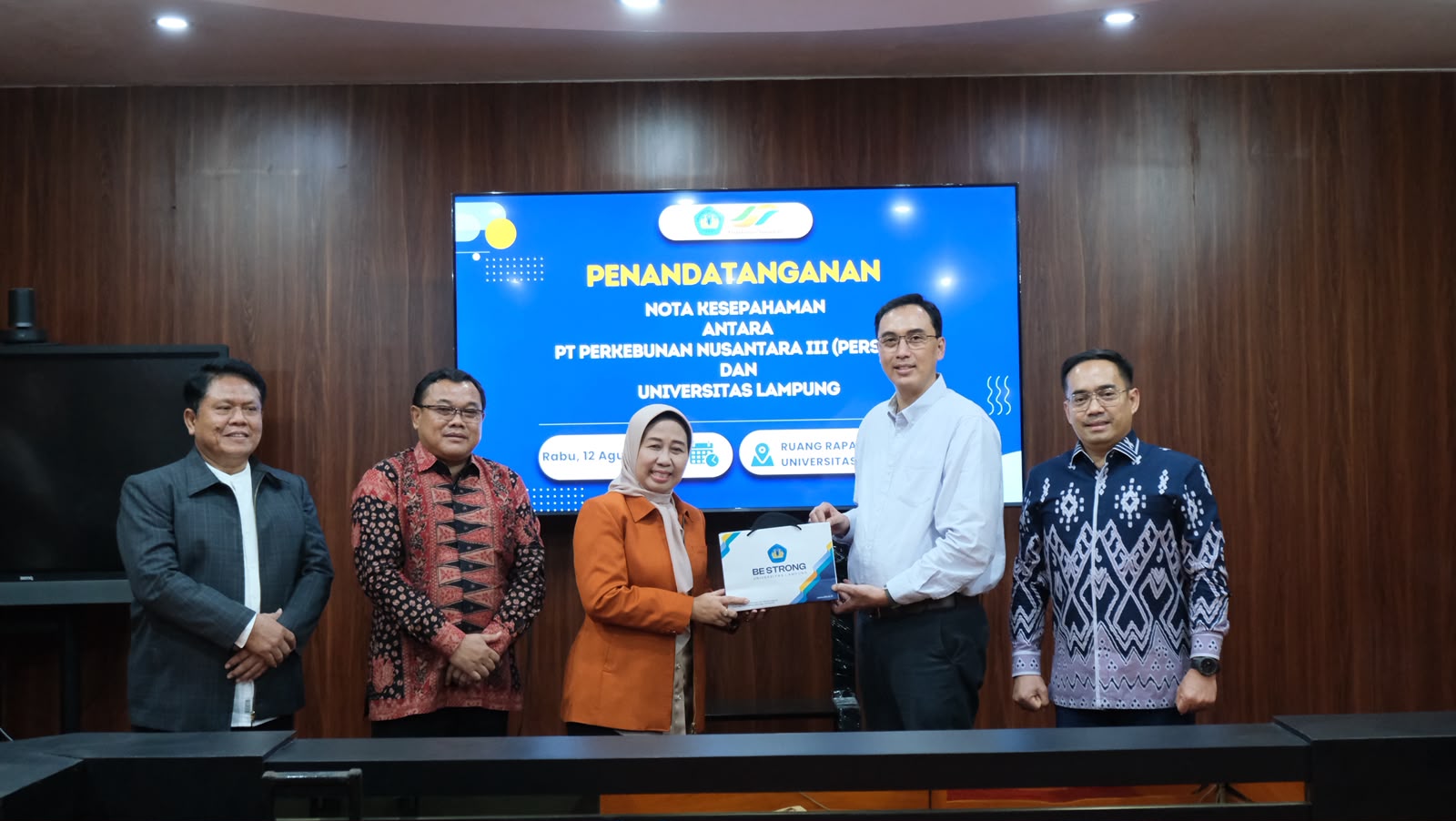
PT Perkebunan Nusantara III (Persero) and the University of Lampung (Unila) have entered into a partnership to strengthen the development of cassava as a strategic commodity for national food and energy security.
The collaboration was marked by the signing of a memorandum of understanding (MoU) in Bandar Lampung on Wednesday (12/8) by PTPN III President Director Denaldy Mulino Mauna and Unila Rector Lusmeilia Afriani.
The partnership covers education, research, community service, and human resource development. It is also directed at research and development of superior varieties, productivity improvement, cultivation assistance, and technical support for developing cassava as a raw material for bioethanol.
PTPN III President Director Denaldy Mulino Mauna said the collaboration with Unila has strategic value because the university hosts the National Cassava Center (NCC), a centre for cassava study and development.
“This collaboration is in line with the mandate we carry to strengthen national food and energy security through the development of strategic commodities. The University of Lampung has highly relevant strengths through its National Cassava Center,” Denaldy said.
According to Denaldy, cassava development will be directed towards supporting the bioethanol industry. The use of cassava as a feedstock is expected to complement the supply of bioethanol raw materials without disrupting sugarcane development, which is part of the sugar self-sufficiency programme.
PTPN III and Unila will develop cassava varieties with high productivity and starch content. One cultivation technology under study is the Mukibat planting system, which is considered to have the potential to increase yields.
Based on research by the Malang Research Institute for Legume and Tuber Crops, grafted cassava, or Mukibat, has the potential to increase production by up to 65.1% and starch content by 52.4% compared with conventional methods.
Lampung is one of the main regions for developing the commodity. Data from the Lampung Provincial Agriculture Office show that cassava production in Lampung in 2025 reached 7.52 million tonnes, or about 45.9% of the total national production of 16.4 million tonnes.
PTPN III is targeting the development of 10,000 hectares of cassava land in Lampung. Land productivity is targeted to increase from an average of about 20 tonnes to 30–60 tonnes per hectare.
The development will be carried out through the provision of superior varieties, the application of research-based Good Agricultural Practices (GAP), and cultivation assistance. PTPN III is also encouraging the development of a downstream ecosystem, including processing cassava into bioethanol.
Denaldy said support from the Lampung Provincial Government is an important factor in accelerating the development of this ecosystem, including land preparation for the construction of a cassava-based bioethanol plant.
Meanwhile, Unila Rector Lusmeilia Afriani said the university is ready to support cassava development through its research and innovation capabilities, including through the National Cassava Center.
“We greatly appreciate this collaboration because it provides broad space for the academic community to develop research and innovation relevant to the needs of industry and society,” Lusmeilia said.
She assessed that developing cassava for bioethanol has economic potential while also supporting national food and energy security.
Through this partnership, PTPN III and Unila are targeting the establishment of a cassava development ecosystem connecting universities, industry, and communities. The development includes variety research, productivity improvement, farmer assistance, and downstream processing into bioethanol as a renewable energy source.