
PTPN III and Unila Sign MoU to Develop Cassava for Bioethanol Industry
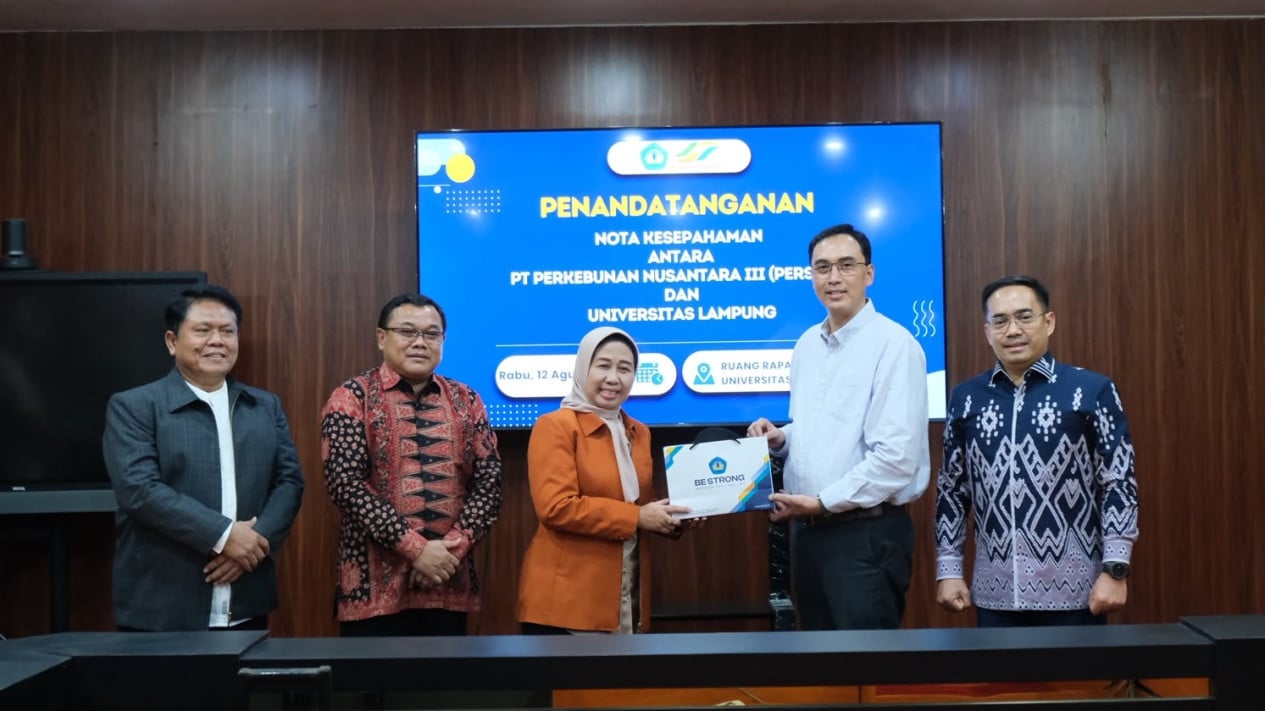
PT Perkebunan Nusantara III (Persero) and the University of Lampung (Unila) have signed a Memorandum of Understanding (MoU) concerning cooperation in the fields of education, research, community service, and human resource development.
PTPN III President Director Denaldy Mulino Mauna explained that this collaboration aims to support the government’s assignment to PTPN III in developing cassava as a pillar of national food and energy security.
“The main focus of the cooperation includes strengthening research, developing superior varieties, increasing productivity, cultivation assistance, and technical support for the development of cassava as a raw material for bioethanol,” said Denaldy in his statement on Friday, 14 August 2026.
He emphasised that the partnership with Unila holds strategic value because the university already has the National Cassava Center (NCC), a national centre for cassava study and development that will serve as a reference for innovation and technology in Indonesia.
“This collaboration is in line with the assignment we carry, to strengthen national food and energy security through the development of strategic commodities. We are therefore optimistic that this cooperation can produce applicable innovations and deliver tangible impact on the ground,” he said.
Denaldy stated that cassava development will be directed towards supporting the bioethanol industry, as part of strengthening national renewable energy.
Unlike raw materials that have largely used sugarcane molasses, the development of cassava-based bioethanol is being pursued so as not to disrupt the stability of sugarcane commodity supply, which is currently the government’s focus in supporting sugar self-sufficiency.
PTPN III and Unila will focus development on cassava varieties suited to the needs of the bioethanol industry. This includes development through the Mukibat planting system, which has high productivity potential, high starch content, and characteristics suitable for industrial needs.
Based on research findings from researchers at the Research Institute for Legume and Tuber Crops in Malang (Budhi S. Radjit, Nila Prasetiaswati, and E. Ginting), in terms of accelerating production achievement, grafted cassava (Mukibat) has good prospects for meeting industrial and food needs.
Economically, grafted cassava is viable to develop, as it can produce 65.1 percent higher yields with 52.4 percent greater starch content. Grafted cassava can be harvested at 10 months of age without reducing the dry matter content of the tubers or total sugar content. If this system is implemented at PTPN, it could increase the current national average productivity.