
PTPN adjusts coffee harvest amid climate anomalies to maintain quality
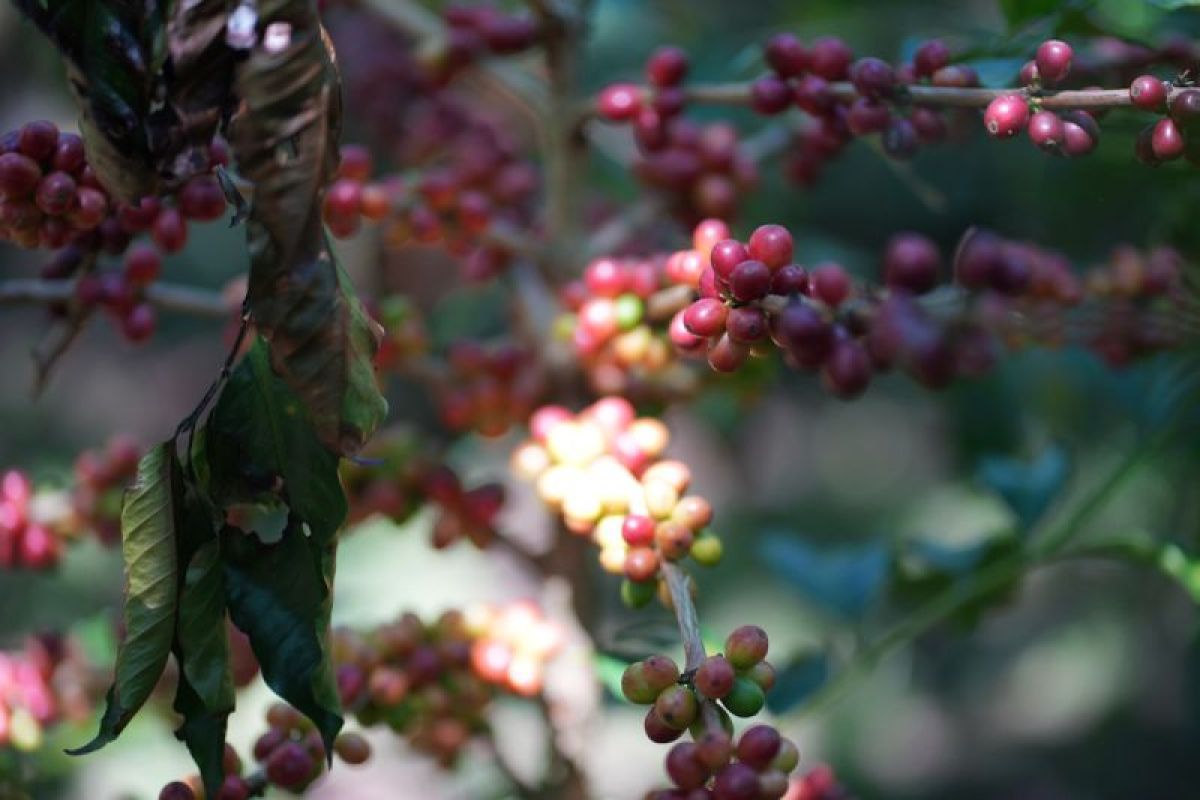
Jakarta (ANTARA) - PT Perkebunan Nusantara (PTPN) IV PalmCo has adjusted its coffee harvest due to climate anomalies characterised by high rainfall in early 2026, yet it continues to record positive performance through strategies to maintain production quality and standards.
PTPN IV PalmCo’s President Director, Jatmiko K. Santosa, stated that the climate, marked by high rainfall in early 2026, necessitated adjustments in plantation management to regulate production rhythms in order to preserve quality.
“However, this situation does not hinder the financial performance of our coffee segment from continuing to record positive results,” Jatmiko said in a statement in Jakarta on Thursday.
This sub-holding of PTPN III (Persero) recorded a pre-tax profit from coffee commodities of Rp3.43 billion in the first quarter of 2026. This achievement was attained amid management’s decision to delay the main harvest to safeguard coffee bean quality.
He explained that the improved performance was primarily supported by a significant surge in sales at the beginning of the year.
“Sales increased substantially. At the same time, we continue to maintain healthy operational cash flow,” he said.
Company data shows that net coffee sales nearly doubled year-on-year. In the first quarter of 2025, sales were recorded at Rp10.94 billion, while in the same period this year, they rose to Rp21.78 billion.
Nevertheless, the sales increase was not entirely matched by a surge in operational profit. EBITDA was recorded at Rp3.70 billion as of March 2026, slightly down from Rp3.82 billion in the same period last year.
“Despite this, the company assesses that its cash generation capability remains relatively stable,” he added.
Behind this financial achievement, Jatmiko continued, the company faces challenges upstream. High rainfall has reduced sunlight intensity needed by coffee plants for photosynthesis and fruit ripening.
As a result, coffee cherries develop more slowly than usual. This condition has occurred in several key operational areas.
He cited an example in the Java Coffee Estate (JCE) area on the slopes of the Ijen Plateau in East Java, where rainfall reached 120 millimetres with 21 rainy days throughout the first quarter. Meanwhile, in the Jambi region, rainfall was 57 millimetres with 10 rainy days.
Java Coffee Estate Joint Operations Manager, Hastudy Yunarko, explained that this situation required the company to take anticipatory measures.
“If the harvest is forced when the fruit is not fully mature, the coffee brew quality will decline. This poses a risk to product quality standards,” Hastudy said.
Therefore, management decided to shift the main harvest schedule to May 2026, in line with the potential for natural ripening of red coffee cherries. This step is seen as providing additional time for the coffee fruit to reach optimal maturity.
According to Hastudy, this decision is part of a strategy to maintain quality amid weather pressures.
“We choose to wait so that quality remains intact when the product enters the market,” he said.
Amid increasingly unpredictable climate dynamics, plantation industry players are required to be more adaptive. For PTPN IV, balancing production quantity and output quality is key to sustaining performance while maintaining the competitiveness of coffee in the market.