
PTP Nonpetikemas Optimises All Ports to Support National Logistics
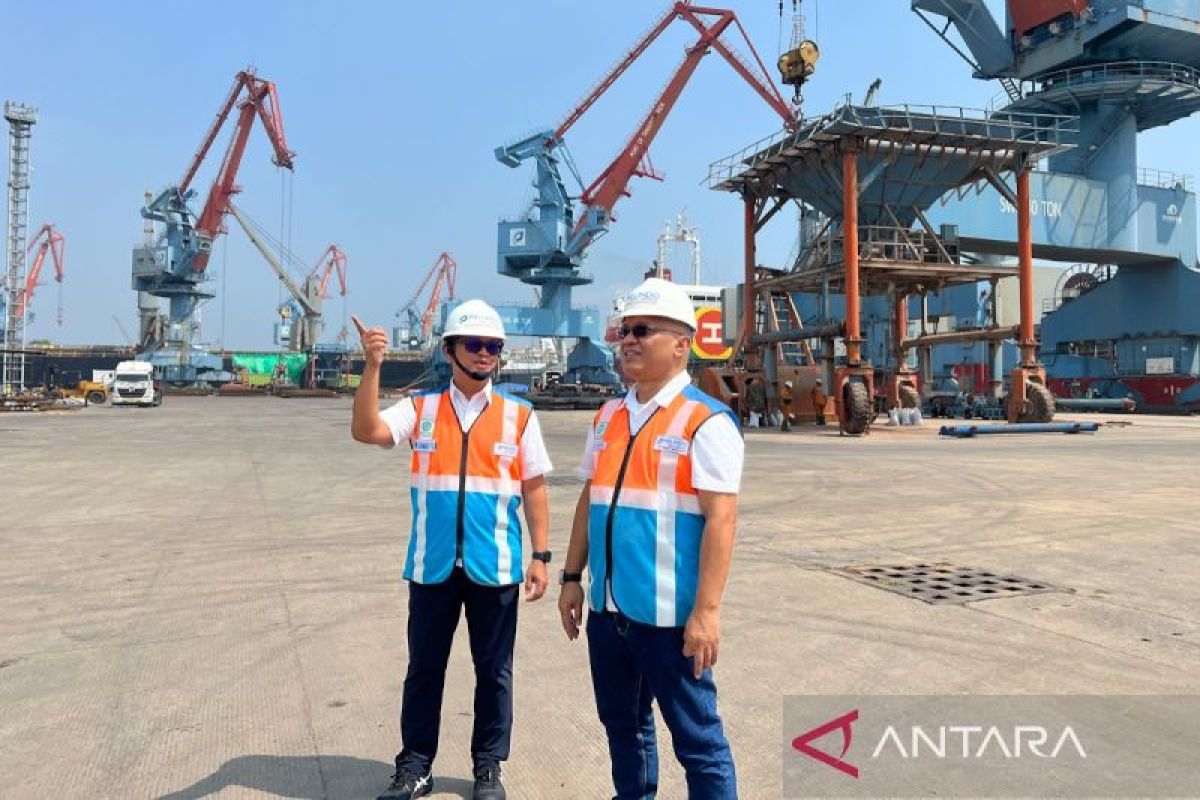
Jakarta (ANTARA) - PT Pelabuhan Tanjung Priok (PTP Nonpetikemas), part of the Pelindo Group and a subsidiary of PT Pelindo Multi Terminal (SPMT), is optimising port operations across Indonesia to strengthen the smooth flow of national logistics and economic competitiveness.
“We continue to strengthen our role as a multipurpose terminal operator in supporting the smooth flow of national logistics,” said Dwi Rahmat Toto, Director of Commercial and Business Development as well as Acting Director of Operations of PTP Nonpetikemas, during the PTP Nonpetikemas Tanjung Priok Branch Media Visit in Jakarta on Wednesday.
He stated that this is demonstrated through various service developments, digital transformation, and improvements in operational performance across the company’s entire working areas.
As Indonesia’s first multipurpose terminal operator, he said PTP has experience in handling various types of cargo, from dry bulk, liquid bulk, to general cargo. The company’s operations are currently spread across 11 port branches throughout Indonesia, which serve as important nodes in the national supply chain.
Commitment to digital transformation is embodied through the implementation of the Pelindo Terminal Operating System Multipurpose (PTOS-M), an end-to-end process-based terminal service system that integrates planning, operations, to host-to-host payment systems with banking and customs systems.
“This innovation drives improvements in efficiency, transparency, and service speed at ports,” he said.
Toto conveyed that the transformation carried out by the company is part of ongoing efforts to enhance the competitiveness of port services.
“PTP Nonpetikemas continues to strive to provide more efficient, integrated, and adaptive services to customer needs. Digital transformation and operational strengthening are key in supporting the smooth national supply chain,” he said.
PTP Nonpetikemas’s operational performance shows a positive trend. In the first quarter of 2026, the total non-containerised throughput, covering general cargo, dry bulk, liquid bulk, and bag cargo, was recorded at 12.84 million tonnes, indicating performance that remains stable amid the dynamics of national logistics flow.
Of the total throughput, dry bulk still dominates with a 46 percent share, followed by liquid bulk at 25 percent, general cargo at 24 percent, and bag cargo at 5 percent. That composition, according to him, shows that the dry bulk segment dominates in packaged services.
Up to the first quarter of 2026, liquid bulk realisation was recorded at 3.09 million tonnes, or a 16 percent growth compared to the same period in 2025 at 2.67 million tonnes.
That realisation also shows good performance because it successfully exceeded 23 percent of the 2026 target of 2.52 million tonnes.
The increase was driven by crude palm oil (CPO) export activities in Teluk Bayur, the sustainability of loading and unloading in Pontianak, as well as increased commodity activities in Tanjung Priok.
Meanwhile, dry bulk as the operational backbone recorded a realisation of 5.76 million tonnes, which increased compared to 2025 and aligned with the set targets.
For other segments, general cargo was realised at 2.92 million tonnes and bag cargo at 656 thousand tonnes, or a slight annual decrease of 3.3 percent.
He mentioned the achievement of competitive T/S/D performance at the SPMT Group level. In the General Cargo segment, the Tanjung Priok Branch ranks first with a cumulative realisation of 4,024 or about 130 percent of the target of 3,097, making it the main contributor to that line.
The Banten and Tanjung Pandan Branches also recorded good performance with achievements of 1,752 and 1,627 respectively.
In the liquid bulk segment, the Teluk Bayur Branch is in first place with a realisation of 5,287, exceeding the target of 4,912 or about 108 percent. Meanwhile, the Pontianak Kijing Branch ranks fourth with an achievement of 3,550 or about 138 percent of the target.
In the Dry Bulk segment, the Bengkulu Branch showed outstanding performance with a realisation of 6,902, exceeding the target of 4,050 or about 170 percent, and ranking third at the group level.
One of the strategic projects being continuously developed is the Kijing Terminal in West Kalimantan. Since its inauguration in 2022, this port has transformed into a centre for international logistics activities supporting exports-imports as well as national strategic projects, including mineral downstreaming.
In addition, PTP Nonpetikemas is also developing shorebase services in four strategic locations, namely Lhokseumawe, Tanjung Priok, Cirebon, and Banyuwangi.
Those services are intended to support the needs of the oil and gas industry with international standard facilities covering material storage, chemicals, to integrated logistics management.
From the operational innovation side, the company introduces portable drop tank technology with submersible pump that can increase loading and unloading productivity while reducing operational costs and environmental impact. The use of this technology allows the loading and unloading process to proceed more effectively and efficiently.
PTP Nonpetikemas also implements various Environmental, Social, and Governance (ESG) initiatives, such as electrifying loading equipment, utilising overhead cranes, and using LED lights for energy efficiency.
Those efforts, he continued, align with the company’s commitment to creating more environmentally friendly and sustainable port operations.
Meanwhile, SM Company Secretary of PTP Nonpetikemas Fiona Sari Utami added that the company also continues to open opportunities for collaboration with various stakeholders.
She said that as a port service business actor, PTP Nonpetikemas not only focuses on operational performance but is also committed to implementing TJSL programmes that provide real benefits to the surrounding community.
With various developments and innovations that continue to be carried out, PTP Nonpetikemas