
PTMA Professors’ Communication Forum at UMY Proposes ‘Muhammadiyah United’
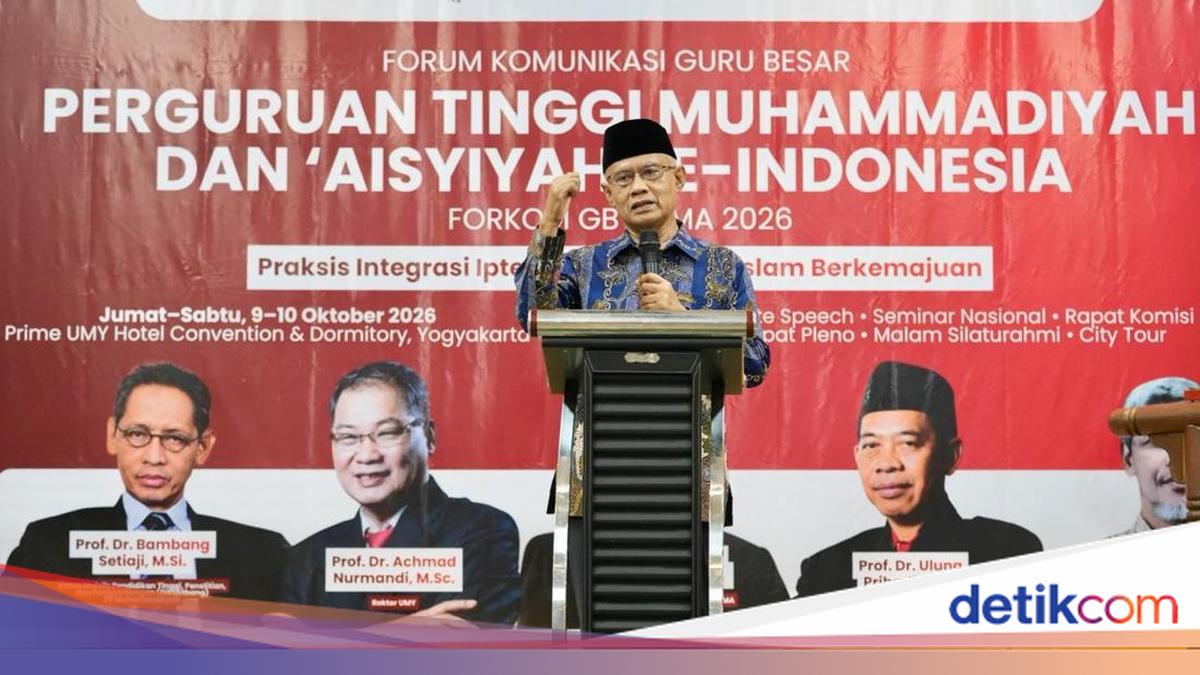
The 2026 PTMA Professors’ Communication Forum (Forkom GB-PTMA) was held at Universitas Muhammadiyah Yogyakarta (UMY) today. The forum proposed ‘Muhammadiyah United’, a network of professors from different campuses.
Forkom GB-PTMA 2026 organising committee chair Sidik Jatmika presented the forum’s findings and proposals to more than 100 professors attending its opening at the Prime UMY Hotel Convention & Dormitory.
Muhammadiyah United was proposed in view of the fact that 117 of the 162 Muhammadiyah and ‘Aisyiyah’ universities (PTMA) have no professors. Sidik said around 480 professors are based at PTMA institutions, but only 45 campuses have any. The distribution is considered uneven, and ensuring more equal access to their expertise remains a major task.
The challenge is not only the number of professors but also the time needed to distribute their support more evenly. Sidik said that if 10 campuses were assisted each year, the process would take a very long time.
“That means it would take at least 12 years to ensure that every campus has a professor. It is certainly not an easy task,” Sidik said in his presentation at the opening of Forkom GB-PTMA 2026 at the Prime UMY Hotel Convention & Dormitory on Friday (9 October 2026).
For this reason, Sidik said the forum could bring in campuses that do not yet have professors. They could take part in benchmarking to help build an ecosystem that accelerates the development of professors.
Sidik said the solution was to pool the expertise of existing professors. He called the proposal ‘Muhammadiyah United’.
“One of the aims of this forum is to establish what we call Muhammadiyah United. It is intended as a forum for Muhammadiyah professors from all PTMA institutions,” Sidik said.
Sidik expressed confidence that around 500 professors across PTMA could thereby be put to better use collectively.
The first step would be to map professors’ expertise, which has not yet been comprehensively identified. They would be grouped by broad discipline, including Islamic studies, education, humanities, natural sciences and social sciences.
Based on this mapping, Sidik proposed that professors visiting campuses should do more than teach as guest lecturers. He said a single visit could serve five or six functions.
Professors could act as second lecturers, supporting local staff who would remain the lead lecturers. According to Sidik, this model could also enhance a campus’s reputation. Professors could also take part in research, community service and publishing.
“Another role is to serve as academic consultants to the 162 PTMA institutions,” Sidik said.
The UMY professor specialising in human security added that professors’ expertise was also needed by other bodies within the Muhammadiyah organisation. He said he had been told that the Majelis Tarjih was seeking professors’ input on contemporary issues such as Bitcoin and halal labelling.
At the opening of Forkom GB-PTMA 2026, Muhammadiyah Central Board chairman Haedar Nashir also stressed the importance of professors in reforming Indonesia’s national framework, which he said needed to be addressed from the ground up.
Haedar said professors should understand how Indonesia’s national framework is constructed. For example, a professor of political science should understand the foundations of Indonesia’s political system before seeking to resolve political problems.
“Therefore, we should not jump straight to the problems. I think this nation often lacks patience, including in the way it builds systems,” Haedar said in his address.
Haedar said that when one part failed, the entire structure was often dismantled and replaced. In his view, this had led democracy, human rights and pluralism to develop in a liberal direction.
“After expanding widely, the nation became unable to manage all those changes and focused only on partial issues,” he added.
He said a similar pattern could be seen in natural resource management. Debate over mining, Haedar argued, was concentrated downstream, while the upstream issue was the earth and its resources, which were used to sustain human life.
Haedar said those resources should be managed for shared prosperity and that people had a role as stewards of the earth. However, he said, the underlying concept needed to be put right.
“In managing natural resources for prosperity, they should neither be exploited to exhaustion nor left unmanaged,” he concluded.
The outcomes targeted by the Forkom GB-PTMA meeting include a joint statement, strategic recommendations, an action-plan matrix for 2026–27, and the appointment of the forum’s leadership for 2026–30. Cross-PTMA programmes could be developed through consortia or special working groups.
Forkom GB-PTMA commission meetings are scheduled to continue until Saturday (10 October). The Social Sciences and Humanities Commission will discuss politics, government and public policy, while the Science Commission will consider energy, natural resources and environmental sustainability.
Source: jawawa.id (https://jawawa.id/newsitem/ptma-professors-communication-forum-at-umy-proposes-muhammadiyah-united-1791553897)
Originally published by detikJogja (https://www.detik.com/jogja/jogja-kerta/d-8700174/forum-komunikasi-guru-besar-ptma-digelar-di-umy-gagas-muhammadiyah-united), translated from Indonesian