
PTBA CEO Outlines Coal Industry Challenges Amid Global Volatility
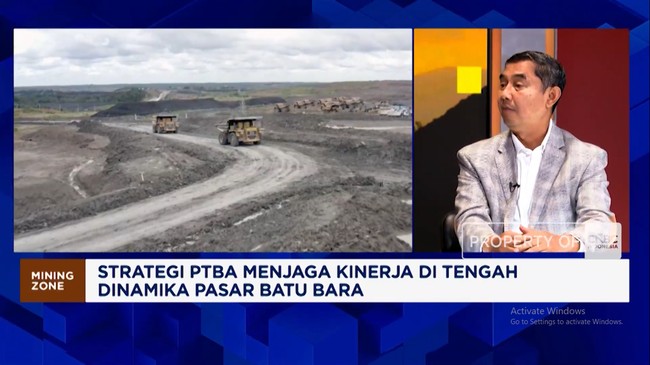
The President Director of PT Bukit Asam Tbk (PTBA), Bambang Ismawan, has revealed several challenges facing the coal industry, particularly amidst ongoing global geopolitical volatility.
Despite these challenges, he stated that PTBA’s performance in the first half of 2026 remained positive. The company’s profit was recorded at approximately Rp2.65 trillion, representing an increase of about 215% compared to the same period the previous year.
“Alhamdulillah, as mentioned, our profit rose significantly by approximately 21 and a half percent to Rp2.65 trillion. In my view, this increase is not merely due to ordinary circumstances, but is certainly the result of the hard work of all employees at PT Bukit Asam,” said Bambang during the CNBC Indonesia Closing Bell event, as reported on Monday (14/9/2026).
Bambang explained that there are at least three main factors that serve as both challenges and cost drivers in the coal industry: fuel prices, the stripping ratio (SR), and overburden management.
According to him, fuel prices are one of the cost components that are difficult for the company to control because they are heavily influenced by external conditions. “When discussing the coal industry, our high costs are driven by three factors. The first is fuel. Fuel prices are what we would call uncontrollable,” he noted.
Meanwhile, the stripping ratio and overburden management are factors that can still be controlled through careful mining planning and operational management. “These two are things we manage well. That is why I tell my colleagues at PT Bukit Asam that we must have long-term mining plans. We must not only think about the present, as it could become a burden in the following year. That is what I always emphasise,” said Bambang.
Nevertheless, he acknowledged that the company’s coal demand is currently increasing, which has also been a driver for improved corporate performance.
“Geopolitical situations are unavoidable. Conflicts in various parts of the world inevitably affect energy needs in many countries, especially those requiring coal supplies. Therefore, to date, coal demand remains very high. At PT Bukit Asam, you could say buyers are queuing up to purchase coal from us. There are no issues regarding the market. We are confident because we maintain our quality and performance, ensuring that buyers receive both quality and certainty,” he explained.
Furthermore, with the current trend of rising coal prices—which even touched US$150 per tonne last week—this serves as a momentum for the company to increase profits.
“With the rise in coal prices, the company will achieve better profit margins. This is an opportunity for PT Bukit Asam to maximise sales, especially exports, to take full advantage of this favourable situation. This momentum may not last forever; it could change at any time. When it does, our strategy will change accordingly. Therefore, when prices are good, we maximise our sales to increase company profits,” he added.
As previously reported, PTBA’s Finance and Risk Management Director, Una Lindasari, explained that the company successfully booked revenue of Rp22.03 trillion, an 8% growth in the first half of 2026 compared to the same period last year. She emphasised that the company’s sales strategy and efficiency programmes were key to maintaining profitability amidst market dynamics.
“This performance was supported by operational recovery in the second quarter, strengthened export sales, and an improvement in the average coal selling price,” Una Lindasari stated during PTBA’s online public expose on Monday (7/9/2026).
The company noted that the strengthening of global coal prices had a positive impact, with the Newcastle Index increasing by 25% and ICI 3 rising by 15% year-on-year. This triggered a 10% increase in the company’s average selling price (ASP), which was the primary reason for the strengthening net profit margin.
“We are leveraging the momentum of strengthening global coal prices through adaptive sales strategies accompanied by efficiency programmes to maintain cost discipline,” she said.
From an operational perspective, PTBA produced 19.45 million tonnes of coal, with total sales volume reaching 21.1 million tonnes. Export sales grew by 5% to 10.33 million tonnes, with primary destinations including Vietnam, Bangladesh, Cambodia, India, and Thailand, while the domestic sales portion reached 51%, or 10.77 million tonnes.
“This achievement serves as a foundation for the company to continue growth through the strengthening of core businesses and the development of new growth sources,” she added.