
PT Timah states Presidential Regulation 79/2026 will optimise state revenue
Jakarta (ANTARA) - PT Timah (Persero) Tbk has expressed appreciation for Presidential Regulation (Perpres) Number 79 of 2026, noting that the improvement of tin mining governance from upstream to downstream can optimise state revenue, including royalties.
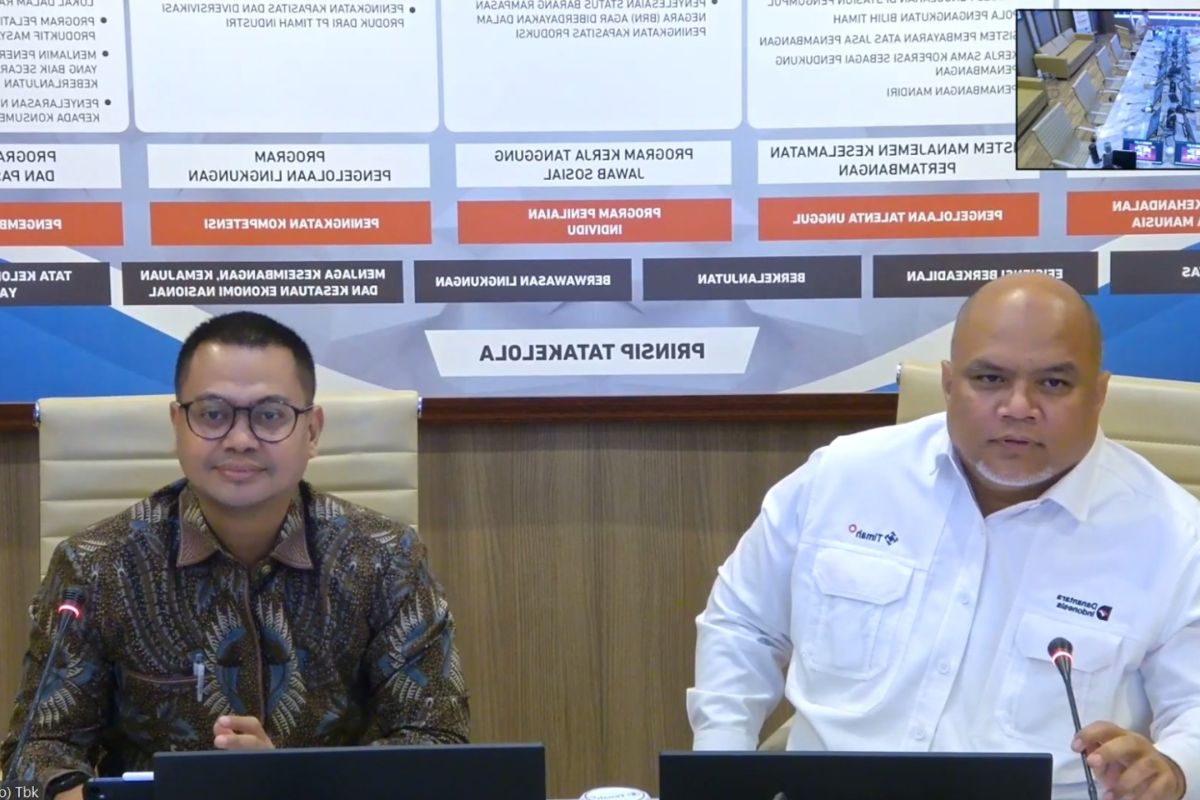
Director of Corporate Strategy and Business Development at PT Timah, Harry Budi Sidharta, stated that the regulation strengthens efforts to overhaul mining governance comprehensively. “We appreciate the government’s efforts and drive to improve overall governance, as this will certainly impact the increase in state revenue, income, and royalties,” Harry said during the 2026 Public Expose Live conference held online in Jakarta on Thursday.
Presidential Regulation Number 79 of 2026, concerning the Acceleration of Tin Mining Governance Improvement in the Bangka Belitung Islands Province, was enacted on 31 August 2026. According to Harry, these governance improvements cover the entire mining value chain, including exploration, production, processing, refining, and sales.
“Not only from the exploration side, but also from the production, processing, refining, and sales sides; this is also the focus of the governance improvements within this Presidential Regulation,” he said.
He added that the company also views the regulation as part of an effort to update and validate tin resources and reserves, particularly in the Belitung region. Based on the company’s presentation, as of the first semester of 2026, PT Timah possesses tin mineral resources of 798,000 tonnes of tin content (Sn) and reserves of 312,000 tonnes of Sn. The company holds 127 tin mining business permit areas (WIUP) with a total area of 473,558 hectares.
Of these, 120 WIUPs are located in the Bangka Belitung Islands, while seven are in the Riau Islands and Riau groups. Of the total WIUP area, 288,860 hectares are land-based and 184,672 hectares are maritime.
Harry stated that securing mining areas is a vital component of the governance overhaul. The company is collaborating with task forces and law enforcement agencies to suppress illegal mining within PT Timah’s IUP and to prevent tin ore from being smuggled out of Indonesia illegally.
“This means PT Timah must be able to optimise its security strategies for containment within its own IUP, through both internal efforts and collaboration with Task Forces and law enforcement, to ensure that tin ore production within this IUP does not leave the area,” he said.
According to Harry, this strengthened security also supports the optimisation of the company’s operations and production. He noted that illegal mining activities, including those related to the outflow of tin ore abroad, have decreased, though he did not specify the exact reduction.
In the first semester of 2026, PT Timah’s tin ore production was recorded at 12,232 tonnes of Sn, an increase of 75 per cent compared to the same period the previous year. Tin metal production reached 10,865 metric tonnes, up 58 per cent year-on-year.
The company will continue its collaboration with task forces and law enforcement agencies while increasing the use of technology in its internal security systems. “Therefore, the collaboration with the Trisakti Task Force, law enforcement, and the strengthening of strategies and the use of technology in PT Timah’s internal security system will be maintained and enhanced,” Harry noted.
These efforts align with the responsible mining governance outlined by the company. PT Timah incorporates traceability and due diligence through mineral supply chain audits and the monitoring of illegal mining activities as part of its responsible mining practices.
In addition to security, the company is including the improvement of mining partnership governance in its strategy to increase operations and production, alongside the enhancement of resources and reserves and the optimisation of primary tin processing.
Harry believes that comprehensive governance improvements can strengthen the economic benefits of managing tin resources while supporting the development of downstream industries. “The hope is that with overall improvements from upstream to downstream—from exploration and refining to sales—state revenue can be optimised,” he concluded.