
PT Freeport Indonesia Commits to Planting 2,000 Hectares of Mangroves in NTB
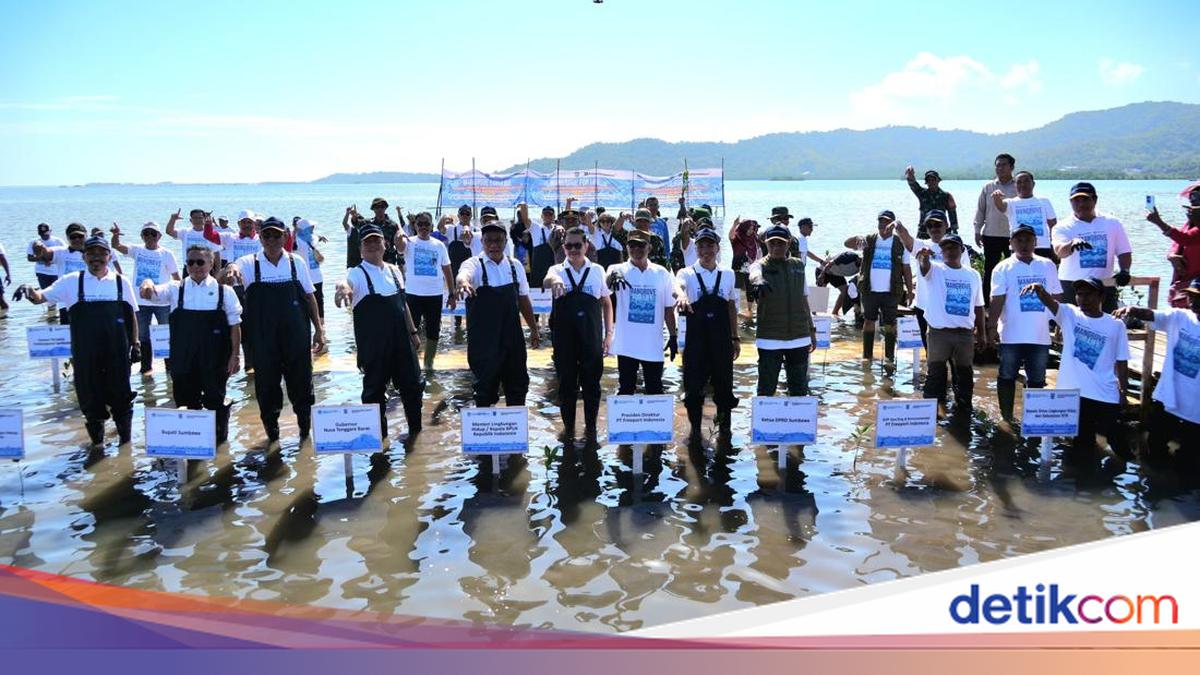
As a form of commitment to reducing carbon emissions and preserving the environment, PT Freeport Indonesia (PTFI) has carried out mangrove planting along the coast of Labuhan Alas village, Alas subdistrict, Sumbawa regency, West Nusa Tenggara (NTB). NTB is now the region with the largest mangrove planting area outside Papua.
PTFI President Director Tony Wenas said the mangrove planting reflects the company’s commitment to environmental protection. The planting is also intended to maintain ecosystem balance and reduce carbon emissions.
“In our operations, we certainly do not think solely about production, but also about the environment, particularly climate change and reducing carbon emissions comprehensively,” Tony said on Tuesday (7/7/2026).
PTFI is targeting mangrove planting across 10,000 hectares in Papua and 2,000 hectares outside Papua. Of that target, NTB is the largest planting area outside Papua. To date, PTFI has realised 484 hectares of mangrove planting in NTB, comprising 445 hectares in Sumbawa regency and 39 hectares in East Lombok regency.
“This planting programme in NTB is part of our grand plan to support coastal ecosystem rehabilitation while increasing carbon absorption,” Tony said.
He explained that NTB was chosen as the main mangrove planting location outside Papua because the region strongly supports mangrove ecosystem growth. Tony considers NTB to have great potential for mangrove development besides Papua.
“We conducted studies in various regions such as East Kalimantan, Bangka Belitung and Java. The result was that NTB has enormous potential because its natural conditions and ecosystem are highly suitable for mangrove development,” he explained.
Tony added that the programme’s success is measured not only by the number of seedlings planted, but also by the mangroves’ growth success rate. Based on monitoring, Freeport’s mangrove survival rate is around 90 per cent, both in Papua and NTB.
“After planting, we continue to monitor until the mangroves grow well. We also work with regional governments, academics and experts to ensure the programme’s success,” he said.
The marine ecosystem restoration movement through mangrove planting has been welcomed by Environment Minister Mohammad Jumhur Hidayat, who described it as everyone’s responsibility.
“This mangrove planting movement is already part of a national movement. All parties, all organisations, business and non-business alike, have a responsibility to repair our nature, one way being through mangrove planting. We very much welcome this movement,” Jumhur said.
According to Jumhur, mangroves can absorb carbon emissions at five times the rate of ordinary trees. Beyond that, the plants can benefit marine life and the local economy.
“It should be noted that the carbon absorption capacity is around four to five times that of an ordinary tree. So it is truly essential. It can become a habitat for fish and shellfish, and it can also become ecotourism. There are so many economic activities that can be generated,” Jumhur said.