
PT DSI, Article 33 of the 1945 Constitution, and Strengthening National Export Governance
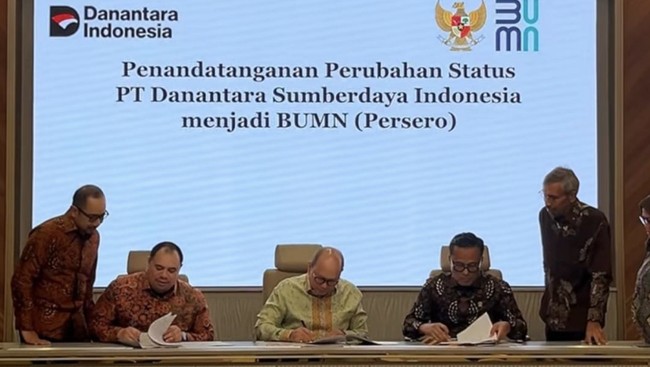
The establishment of PT Danantara Sumberdaya Indonesia (DSI) as a state-owned enterprise (SOE) to manage national strategic commodity exports is one of the most significant economic moves in President Prabowo Subianto’s administration. This policy should not be viewed merely as creating a new company but as part of a broader agenda to reform trade governance and strengthen Indonesia’s economic sovereignty.
For decades, Indonesia has been known as a resource-rich nation, being a top global producer of coal, crude palm oil (CPO), nickel, and other strategic commodities. However, in international trade, it still faces a classic issue: weak control over the national export value chain. Consequently, despite high export volumes, the economic benefits reaped by the country often remain suboptimal.
Rosan Roeslani, CEO of BPI Danantara and Minister of Investment and Downstreaming/Head of the Investment Coordinating Board, stated that PT DSI’s formation aims to refine national trade governance and reduce persistent export data distortions.
This statement is crucial as export data distortion is no minor issue. In global trade, under-invoicing and transfer pricing have long been serious challenges for commodity-producing nations, including Indonesia.
Under-invoicing occurs when export values are reported lower than actual prices, leading to reduced tax, royalty, and foreign exchange revenues. Transfer pricing, often used via cross-border affiliated companies to shift profits to specific jurisdictions, causes resource-rich nations to lose substantial potential revenue.
In this context, PT DSI’s establishment is relevant as a move to build a more transparent, consolidated, and data-driven national trade system. The government notes that Indonesia’s strategic commodity exports, including CPO, coal, and ferroalloys, amount to approximately $65 billion annually.
This figure underscores that export governance is not merely a trade issue but affects foreign exchange stability, government revenue, and Indonesia’s bargaining position in the global economy.
Indonesia has long been a price taker, selling raw commodities in large volumes while global pricing and distribution chains are predominantly controlled by external parties.
A major nation is not merely one rich in natural resources but one capable of controlling its own economic value chain. Therefore, President Prabowo’s move to build a more consolidated national export system deserves appreciation as part of the broader agenda to strengthen Indonesia’s economic sovereignty.
However, the policy’s implementation must be professional, transparent, and efficient. The business sector requires regulatory certainty and logistical efficiency to ensure PT DSI does not create new bureaucratic hurdles that slow national trade.
PT DSI must be built with modern governance based on digitalisation, data integration, and accountable oversight to enhance global market confidence in Indonesia’s trade system.
In modern economic terms, trade transparency is a crucial foundation for national competitiveness. Developed nations are strengthening their trade monitoring systems using data analytics, artificial intelligence, and digital trade monitoring technologies.
Therefore, a modern approach to export governance must be part of Indonesia’s future economic transformation. This policy should also be seen as aligned with the government’s ongoing push for downstreaming and national industrialisation.
Indonesia must not only improve raw material export governance but also bolster domestic industrial capacity to create greater value addition.
For years, Indonesia’s economic structure has been overly reliant on raw material exports and domestic consumption. In contrast, developed nations are built on industrialisation, technological mastery, and strong national production chains.
Thus, strengthening export governance must go hand in hand with developing manufacturing, processing industries, national logistics, and empowering domestic entrepreneurs.
From the perspective of HIPMI and young entrepreneurs, this agenda presents significant opportunities for new entrepreneurs in productive and strategic national sectors.
Indonesian young entrepreneurs must enter mineral downstreaming, food processing, renewable energy, logistics, global digital trade, and industrial technology sectors.
We need more productive entrepreneurs capable of building industries and strengthening national economic capacity. Amid current global geopolitical uncertainties, Indonesia has a significant opportunity to become a new global economic power.
We have a demographic dividend, a large domestic market, and strategic natural resources. However, these will remain potential only if managed through robust, disciplined, and integrated economic governance.
Therefore, PT DSI’s establishment should be seen as a pivotal moment to reform national export governance and a first step toward strengthening Indonesia’s position in global trade chains. Indonesia must not merely be a raw material seller but a nation capable of controlling its own strategic trade, bolstering domestic industries, and building a stronger bargaining position in the global economy.