
Psychology Education Discusses Impact and Opportunities of AI in Special Colloquium in Bandung
Indonesian higher education psychology institutions are being encouraged to harness Generative Artificial Intelligence (AI) adaptively and responsibly, without compromising academic integrity, quality of services, professional ethics, and the security of psychological data.
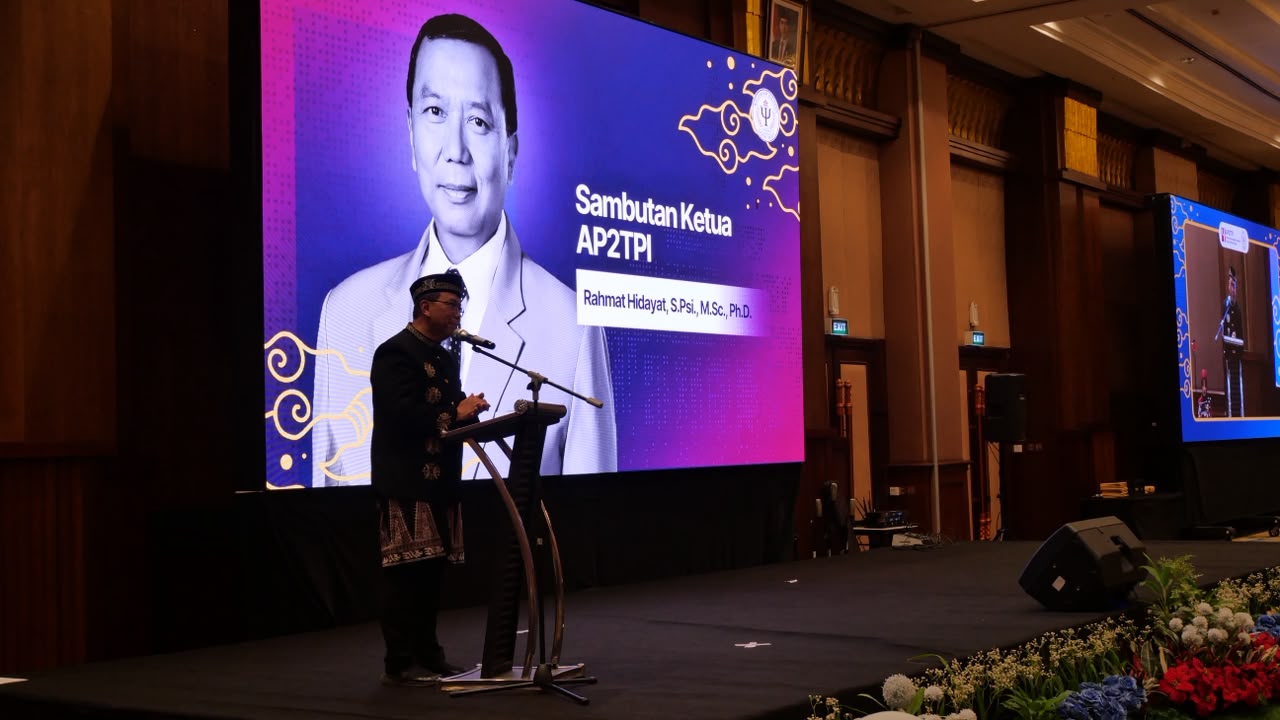
This issue was the main topic of discussion at the 32nd Special Colloquium of the Indonesian Association of Psychology Higher Education Providers (AP2TPI), held from 22 to 24 July 2026 at éL Hotel Bandung.
Under the theme ‘Impactful and Impacted Psychology Higher Education: Opportunities and Challenges in the Era of Generative AI’, the event brought together university leaders, deans, programme managers, academics, researchers, and psychologists from across Indonesia.
The Chair of AP2TPI, Rahmat Hidayat, S.Psi., M.Sc., Ph.D., said that the development of Generative AI has transformed the way students learn, lecturers teach, researchers work, and practitioners deliver psychological services.
‘The question is no longer whether Generative AI will be used in higher education, but how to ensure the technology is used critically, ethically, responsibly, and remains human-oriented,’ he said.
According to Rahmat, AI can assist learning, research, information processing, and the efficiency of academic processes. However, academic and professional decisions remain in the hands of humans who possess competence, integrity, empathy, and ethical responsibility.
MENTAL HEALTH
The first day’s programme concluded with a Gala Dinner attended by the Regional Secretary of West Java Province, Dr Herman Suryatman.
‘I appreciate the holding of the AP2TPI Special Colloquium in the city of Bandung. This gathering of academics, university leaders, and psychologists is highly strategic because mental health issues are increasingly pressing and felt across various community settings,’ said the Regional Secretary.
He emphasised that psychologists are increasingly needed to help address mental health problems among children and adolescents, families, educational environments, workplaces, and society at large.
Local governments cannot work alone. Genuine collaboration is therefore required between government, universities, professional organisations, healthcare facilities, psychologists, and communities so that mental health services become more accessible and their benefits more widely felt.
The main agenda featured the Minister of Higher Education, Science, and Technology of the Republic of Indonesia, Prof Brian Yuliarto, who discussed ‘The Contribution of Indonesian Psychology Higher Education in the Era of Generative AI’.
An international perspective was delivered by Prof James W Pennebaker on the theme ‘The Future of Psychological Science’, addressing the future of psychological science, research developments, methodological innovation, and the use of technology.
Meanwhile, Dr Retno Hanggarani Ninin, M.Psi., Psychologist, also announced the launch of the Master’s Curriculum in Psychology and introduced the education section of the colloquium.
The agenda continued with a talk show featuring Rahmat Hidayat, S.Psi., M.Sc., Ph.D., on the challenges of psychological services amid Generative AI disruption, and Prof. Dr Henndy Ginting, S.Psi., M.Si., Psychologist, on the transformation of psychology higher education for impactful education.
COLLABORATION OF 14 UNIVERSITIES
The colloquium discussed a number of strategic agenda items, including curriculum standards for psychology education at bachelor’s, master’s, and doctoral levels, evaluation of the Psychologist Professional Education programme, implementation of Recognition of Prior Learning (RPL), improvement of the quality of psychology education, strengthening of accreditation, and laboratory development.
Previously, seven workshops were also held, covering topics such as standards for psychology education laboratories, the use of AI in learning, study programme accreditation, psychometrics curriculum development, Gottman Method Couples Therapy, and Rational Emotive Behavior Therapy (REBT).
The colloquium was organised through the collaboration of 14 universities providing psychology education in West Java. Its outcomes are expected to serve as recommendations and joint policy directions for building an Indonesian psychology higher education sector that is high-quality, adaptive to technology, ethical, and human-centred.
For the public, strengthening psychology education is expected to improve the quality of mental health services, protect the confidentiality of psychological data, and produce competent, professional psychologists and psychology graduates capable of meeting society’s needs in the digital era.
Source: jawawa.id (https://jawawa.id/newsitem/psychology-education-discusses-impact-and-opportunities-of-ai-in-special-colloquium-in-bandung-1785039615)
Originally published by Media Indonesia (https://mediaindonesia.com/jabar/berita/914884/-pendidikan-psikologi-bahas-dampak-dan-peluang-ai-dalam-kolokium-khusus-di-bandung), translated from Indonesian