
Psychologists Ready to Strengthen Mental Health Services at Community Health Centres
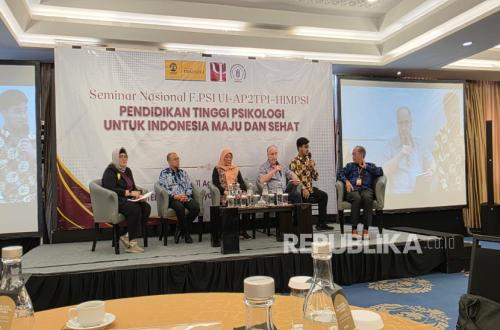
The national need for mental health workers at primary healthcare facilities can be met more quickly if the competencies of psychologists graduating from professional psychology education programmes are optimised.
This emerged during a National Seminar themed ‘Higher Education in Psychology for an Advanced and Healthy Indonesia’, organised by the Faculty of Psychology at the University of Indonesia together with the Association of Indonesian Psychology Higher Education Providers (AP2TPI) and the Indonesian Psychological Association (HIMPSI) at the Artotel Gelora Senayan Hotel, Jakarta, on Tuesday (11/8/2026).
The seminar featured the Minister of Higher Education, Science, and Technology, Prof Brian Yuliarto, as keynote speaker, and brought together universities offering psychology education, professional organisations, relevant ministries and agencies, and representatives of service user communities.
AP2TPI Chairman, Rahmat Hidayat PhD, explained that the delivery of professional psychology education has undergone a fundamental transformation since the enactment of Law Number 23 of 2022 on Psychology Education and Services.
The professional programme is now a distinct educational pathway that produces graduates with the title of psychologist, and every student is required to undertake supervised practice across four service settings simultaneously: health, school, workplace, and community.
The curriculum design, he said, is directed to align with the characteristics of services at Puskesmas. Primary healthcare services do not solely address mental disorders, but encompass mental health promotion, prevention, early detection and assessment, clinical intervention, and cross-professional collaboration — all of which are competencies trained directly within professional psychology education.
‘Practice data from students in health service settings at 19 universities that have become providers of the professional psychologist programme show that graduates have carried out these functions,’ he said in a statement in Jakarta on Wednesday (12/8/2026).
Prof Harry Minas, a psychiatrist and global mental health expert from Australia who was one of the speakers, reminded that determining the type of psychology workforce needed should begin with an analysis of needs and the scope of tasks in primary care first, before establishing the appropriate competencies and qualifications.
Within that framework, psychologists and clinical psychologists exist in a complementary relationship — analogous to general practitioners and specialist doctors — where psychologists carry out most primary care functions, while clinical psychologists handle complex cases and serve as referral recipients and supervisors.