
PSR Seen as Key to Safeguarding National Palm Oil Production
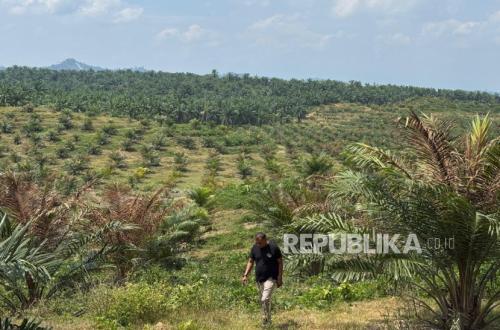
Republika.co.id, Jakarta — The government is pressing ahead with the smallholder replanting programme (PSR) as a key to maintaining the sustainability of the palm oil commodity amid land constraints and growing global pressure on plantation expansion. The government is encouraging higher productivity on smallholder estates as a primary step to meet domestic palm oil needs, including supporting the implementation of biodiesel B50.
Director of Oil Palm Plants and Various Palma at the Ministry of Agriculture (Ministry), Iim Mucharam, said most smallholder palm oil estates still have low productivity, so PSR becomes an important strategy to safeguard national palm oil supply in the long term. He stated that land expansion for palm oil now faces increasing difficulty due to global pressures and land constraints.
“Expansion is no longer possible due to limited land and international pressure and global issues. That’s why PSR is the key,” Iim said during a discussion at the Agricultural Journalists Forum (Forwatan) at the Ministry’s Building D, Jakarta, quoted on Wednesday (20 May 2026).
He reminded that since 2017 the government has highlighted around 14 million hectares of national palm oil plantations, most of which have low productivity. The government initially targeted PSR at 180,000 hectares per year, then lowered it to 150,000 hectares and now around 50,000 hectares to be more realistic.
Government data records national palm oil plantation area in 2025 at 16.8 million hectares. About 51 per cent is controlled by private companies and 41 per cent are smallholders. The share of smallholders is considered to hold great potential for increasing national palm oil production.
“Imagine 41 per cent of 16 million hectares—that is a very large potential,” said Iim.
Despite the large potential, PSR realisation is considered to still face various obstacles. The government records total technical PSR recommendations reaching 423,305 hectares, with the realisation of clearing and chipping at 316,359 hectares and planting at 295,691 hectares.
The government also increases funding support from the Plantation Fund Management Agency (BPDP). PSR assistance, which was Rp25 million per hectare from 2017–2019, rose to Rp30 million per hectare in 2020 to August 2024, then rose to Rp60 million per hectare since September 2024.
“If it’s mandatorily implemented outright, it cannot be done yet because of regulatory and other issues,” Iim said.
He said PSR funds are actually available at BPDP, but various field problems have kept the programme from operating optimally. Land legality and overlapping forest areas are still major obstacles to accelerating PSR.
According to him, the government also faces limitations in detailed data on smallholder palm oil farmers. This condition means accelerating smallholder productivity will require a long time, especially as the government pushes the biodiesel B50 programme.
“When the President pushes the biodiesel B50 target and the productivity of smallholder estates, compared with opening new land this is a long-term homework. We are even still struggling to obtain truly detailed data on smallholders,” Iim said.
Head of Policy and Socialisation Division of PSR GAPKI, Muhammad Iqbal, said national palm oil governance involves many ministries and agencies, thus requiring comprehensive coordination. He noted that the Past model of Core-Periphery Estate (PIR) was the most successful as it created synergies between companies and farmers.
Iqbal explained that various technical requirements on the ground also remain challenges. Coordinate points, support for spatial data, and validation of farmer data require significant cost and time, especially in areas with limited access.
“To access PSR funding is very hard. For example, the coordinate points must be accurate, aerial photos are required, and in areas with limited access the costs are high. BPDP does not fund that,” decried Iqbal.
Chairman of the Indonesian Palm Oil Growers Association of Core-Peripheral Farmers (Aspekpir) Indonesia, Setiyono, says many plasma estates, particularly in Riau, have long since been due for replanting as they were planted since the 1980s. He regards regulatory reform and strengthening farmer institutions as key factors so PSR acceleration can operate more effectively and provide certainty for smallholder palm oil farmers.
Source: jawawa.id (https://jawawa.id/newsitem/psr-seen-as-key-to-safeguarding-national-palm-oil-production-1779545970)
Originally published by Republika (https://ekonomi.republika.co.id/berita/tfb6r1522/psr-dinilai-jadi-kunci-menjaga-produksi-sawit-nasional), translated from Indonesian