
PRR Task Force Urges Regional Governments to Proactively Prepare Land and Infrastructure for Permanent Housing
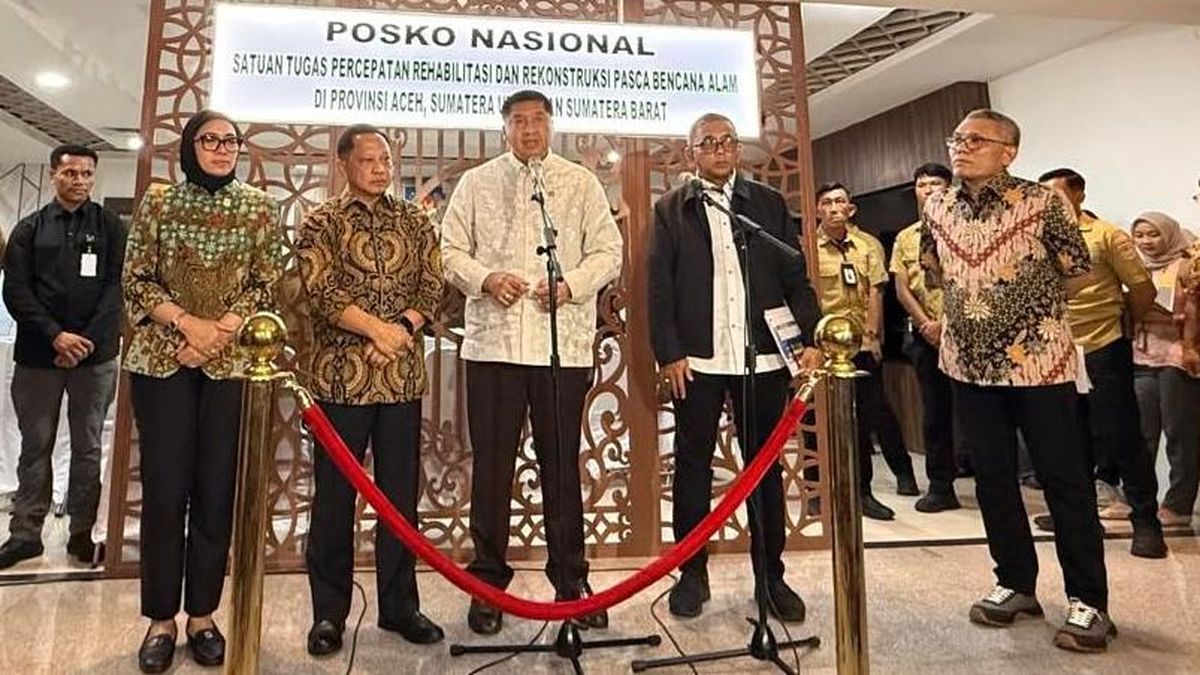
The Sumatra Post-Disaster Rehabilitation and Reconstruction Task Force (Satgas PRR) has urged regional governments in Aceh, North Sumatra, and West Sumatra to be proactive in finalising land preparation to accelerate the construction of permanent housing (huntap) for hydrometeorological disaster survivors. In addition to securing locations, regional governments must also ensure land legality and the availability of basic infrastructure so that affected communities can immediately occupy safe and decent housing.
Land readiness is one of the main requirements for the communal ex-situ permanent housing development to be carried out by the Ministry of Housing and Settlement Areas (PKP). For 2026, the ministry has obtained a budget of Rp2.22 trillion to build communal permanent housing along with infrastructure, facilities, and public utilities.
The Ministry of PKP is targeting the construction of 7,952 permanent housing units in 2026. The development land has been mapped across 54 locations with a total area of 198.21 hectares and a capacity for 7,973 units. Field surveys and technical studies for these locations were conducted from December 2025 to March 2026.
A total of 6,220 units will be built in 45 locations in Aceh, 919 units in four locations in North Sumatra, and 813 units in five locations in West Sumatra. The largest distribution is in Gayo Lues with 2,454 units and Aceh Tamiang with 2,212 units, followed by South Tapanuli with 872 units, North Aceh with 708 units, Central Aceh with 533 units, and Agam with 360 units. Development is also planned in Lima Puluh Kota, Padang City, Pidie, Pidie Jaya, Pesisir Selatan, Lhokseumawe, Bireuen, and Humbang Hasundutan.
Minister of PKP Maruarar Sirait has requested that all affected regional governments immediately ensure the communal permanent housing land is ready for use before physical construction begins. He stated that the acceleration of procurement must be balanced with the resolution of land status so that tendered works are not delayed due to issues beyond the ministry’s authority.
‘Do not let this go to tender, but the land and location are not under our authority. We ask regional governments to immediately resolve land matters and ensure the location is conducive,’ Maruarar said during a Coordination Meeting on Permanent Housing Development at the National PRR Task Force Post, Ministry of Home Affairs, Jakarta, on Tuesday (21/7).
Maruarar also reminded regional governments not merely to provide a plot of land, but to select locations that are safe from flooding, landslides, and the threat of recurring disasters. The permanent housing locations must be connected to schools, workplaces, markets, places of worship, health facilities, and other community centres.
‘Choose a location that is truly good for the people. Do not place it at the end of the world, far from their children’s schools or their workplaces,’ he said.
Meanwhile, Chairman of the PRR Task Force Muhammad Tito Karnavian stated that regional governments need to accelerate land settlement while also preparing road access, drinking water networks, drainage, and other basic necessities. Regional government support must align with the housing construction by the Ministry of PKP and the proactive provision of electricity networks by PT PLN.
‘We ask regional governments to help so that development is not hampered. The Ministry of PKP has explained in detail what will be done in 2026, the exact locations, and the districts and cities. Please assist with land matters. For electricity, PLN will also move proactively to match the development by the Ministry of PKP,’ Tito said.
Tito acknowledged that each region has different fiscal capacities, especially for land acquisition, road access construction, and drinking water network provision. If a regional government truly lacks the budgetary capacity, the PRR Task Force will coordinate central government support, including with the Ministry of Public Works, to ensure that basic needs leading to the permanent housing areas can still be met.
Overall, the plan for permanent housing development across the three provinces reaches 46,521 units. Data collection by name and address has recorded 33,929 families, consisting of 8,714 families under the in-situ scheme, 8,627 families under the independent ex-situ scheme, and 16,588 families under the communal ex-situ scheme. This data needs to be continuously updated and aligned with land readiness to ensure the development is on target and does not result in overlapping programmes.