
PRR Task Force Oversees Accelerated Post-Disaster School Recovery in Sumatra
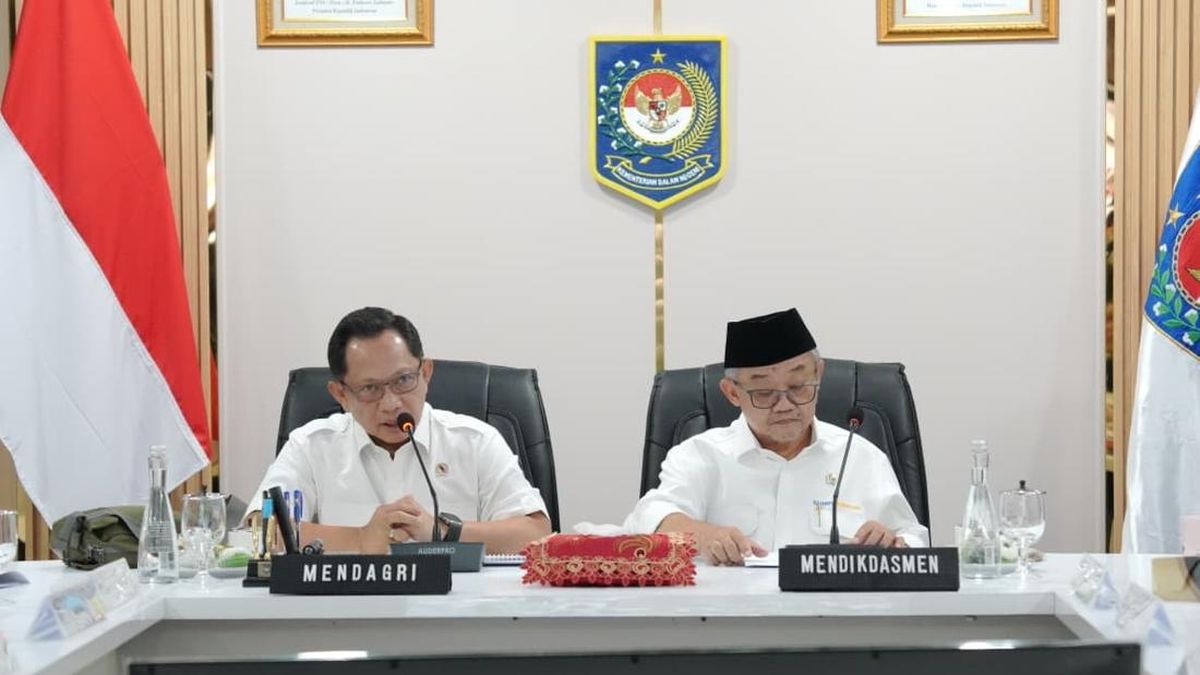
The Minister of Home Affairs, Muhammad Tito Karnavian, in his capacity as the Chairman of the Task Force for the Accelerated Rehabilitation and Reconstruction (PRR) of Post-Disaster Sumatra, is overseeing the accelerated recovery of educational facilities in Aceh, North Sumatra, and West Sumatra. As of 22 September 2026, 4,922 affected schools have resumed learning, although some are still utilising temporary classrooms or alternative buildings.
He shared this information during a Coordination Meeting on the Progress of Accelerated Post-Disaster Rehabilitation and Reconstruction in the Field of Education for the provinces of Aceh, North Sumatra, and West Sumatra. The meeting took’ place at the PRR Task Force Post in Jakarta on Wednesday (23/9).
During the session, Tito listened to a briefing from the Minister of Primary and Secondary Education, Abdul Mu’ti, regarding the progress of educational recovery in the three affected provinces. Tito noted that the continuity of the teaching and learning process is a significant achievement in post-disaster educational recovery.
He stated that despite the thousands of affected schools, the learning process has resumed in all impacted institutions. According to him, only two schools remain where some students are still studying in tents.
“The good news is that not everyone is entirely in tents as before. It is mostly resolved, with only two schools left where some students are still in tents due to insufficient space,” Tito said in a written statement on Wednesday (23/9).
He noted that the acceleration of rehabilitation and reconstruction must continue, as several schools still face construction hurdles. Differences in geographical conditions, damaged access, availability of materials, and aftershocks have all influenced the speed of recovery in each region.
Tito emphasised that the massive scale of the affected schools means the recovery process cannot be completed in a short period. He requested all parties to understand the complexity of the handling process.
“The sheer number is massive—4,922 schools—so it is impossible to resolve this very quickly,” he added.
To accelerate the completion of these schools, Tito requested intensive assistance, particularly for schools with physical progress below 50 per cent. The PRR Task Force will also coordinate the various obstacles faced by local governments with relevant ministries and agencies.
He also highlighted 97 schools that require relocation because their previous locations are no longer viable or are situated in disaster-prone areas. He urged local governments to accelerate land provision so that school construction can proceed immediately.
“This once again requires support from regional heads, as 97 schools need to be relocated,” he asserted.
Furthermore, Tito requested that local governments identify access routes to schools that are still experiencing damage, including roads and bridges. The results of these identifications will be coordinated with relevant ministries and agencies to ensure access to schools can be repaired promptly.
On the other hand, Abdul Mu’ti reported that as of 22 September 2026, 4,922 affected schools have resumed learning. Of that number, 4,821 schools have returned to their original buildings.
Meanwhile, 99 schools are still using temporary classrooms while awaiting the construction of permanent classrooms or the relocation process. Additionally, two other schools are currently utilising alternative buildings.
Mu’ti explained that among the 99 schools using temporary classrooms, some are still using learning tents to compensate for the shortage of available temporary classrooms.
“Of the 99 schools learning in temporary classrooms, there are two schools that are still using learning tents to supplement the shortage of prepared temporary classrooms,” he said.
He stated that educational recovery focuses not only on rebuilding school facilities but also on ensuring that students’ rights to education are met during the recovery period.
Mu’ti mentioned that the government has allocated a total educational recovery budget for the three provinces of approximately Rp5.6 trillion to date. This budget is used for various recovery needs within the education sector.
The budget covers the revitalisation of educational units, the provision of school facilities and equipment, and the construction of temporary classrooms. Additionally, funds have been allocated for psychosocial support, disaster preparedness, and assistance for affected students and educators.