
Protests Against Azerbaijan’s Hijab Ban Spread to Tehran
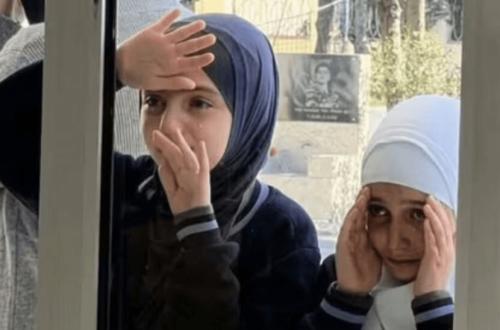
TEHRAN — New restrictions on wearing hijab in educational institutions in the Republic of Azerbaijan have sparked a reaction in Iran, following protests in Turkey. Students from the University of Tehran staged a protest by displaying a banner outside the Azerbaijani Embassy.
The WANA news agency reported that Ayatollah Mohammad Javad Fazel Lankarani, a prominent cleric in Qom, condemned the restrictions and urged people in Azerbaijan to continue their protests. Users on X have also criticised the measure, sharing images and videos of female pupils and teachers in Azerbaijan wearing hijab.
The Basij student organisation at the University of Tehran responded to the hijab restrictions in Azerbaijani schools and universities by putting up a banner outside the country’s embassy. It linked the restrictions to the forced unveiling policy implemented in Iran under Reza Shah Pahlavi.
The banner read: “Open confrontation with Muslims will ultimately pave the way for the Islamic Revolution.”
Amir Mohammad Marzani, head of the University of Tehran Basij student organisation, said the action was intended to express Iranian students’ opposition to the new restrictions. Referring to anti-hijab policies under Reza Shah, he argued that opposing a nation’s religious beliefs could not be done without consequences.
Ayatollah Mohammad Javad Fazel Lankarani, head of the Ahl al-Bayt Jurisprudence Centre and a member of the Qom Seminary Teachers’ Association, also condemned restrictions on wearing hijab in Azerbaijan’s educational institutions and urged the government in Baku to learn from Iran’s experience during the Pahlavi era.
Responding to reports that hijab-wearing pupils were being barred from educational institutions, forcing them to choose between receiving an education and wearing an Islamic head covering, Fazel Lankarani said the policy was inconsistent with the religious identity of much of Azerbaijan’s population.
He stressed that hijab and education were not incompatible. He also voiced support for the protests in Azerbaijan and called on demonstrators to continue their movement. In addition, he urged Iranian officials to respond to the restrictions and press the Azerbaijani government to reconsider its policy.
Opposition to the restrictions has also spread on social media. Users in Iran and abroad have shared images of pupils reportedly barred from school for wearing hijab, while criticising the new dress rules.
Key themes in their responses include freedom of religious expression, equal access to education, and the view that hijab is not incompatible with academic achievement.
One user shared a video showing rows of hijab-wearing pupils waiting outside a school, describing the situation as discriminatory and asking whether secularism means banning and suppressing people, and denying girls access to education.
Another user highlighted what they described as growing solidarity between women who wear hijab and those who do not in Azerbaijan. The user posted a video showing unveiled pupils supporting their hijab-wearing classmates, portraying the solidarity as opposition to preventing students from receiving an education because of how they dress.
A statement by the daughter of a Nagorno-Karabakh war veteran also attracted attention. She said she wanted to serve her country but was unwilling to abandon her beliefs in order to continue working as a teacher. She questioned how wearing a head covering could lessen someone’s love for their homeland.