
Protection for Migrant Workers Must Be Strengthened at Village Level
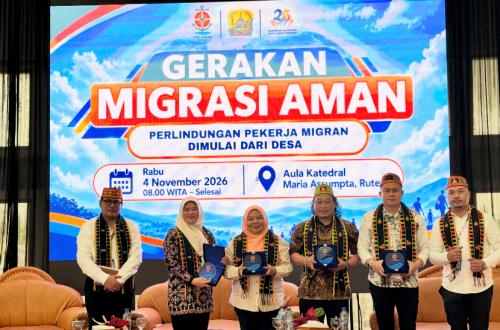
JAKARTA — Protecting migrant workers requires the involvement of many parties, from village governments and families to communities and labour-placement agencies. Better information, skills training and assistance are among the key elements needed to build a safe migration system.
Stella Maris Batam director Father Ansensius Guntur said migrant worker protection must be built through sustained cooperation. The issue was discussed at a Safe Migration Movement seminar, entitled “Migrant Worker Protection Starts in the Village”, held jointly with the Manggarai Regency Government at St Maria Asumpta Cathedral Hall in Ruteng, East Nusa Tenggara, on Wednesday (4 November).
The seminar brought together government representatives, police, the Church, workers’ organisations and recruitment industry representatives. Discussions covered the provision of information to prospective workers, skills development, placement procedures, and assistance while working overseas and after returning to Indonesia.
Father Ansensius, commonly known as Father Yance, stressed that everyone has the right to migrate. “That right must be accompanied by protection so that workers are safe from fraud, violence and exploitation,” he said in a press release on Friday (6 November 2026).
Deputy Minister for the Protection of Indonesian Migrant Workers Dzulfikar Ahmad Tawalla said in a video presentation that village governments had an important role in providing information and assistance. “Protection for Indonesian migrant workers must begin at the source, namely in the village,” he said.
Manggarai Regent Herybertus Geradus Laju Nabit said limited job opportunities were one reason residents sought livelihoods elsewhere in Indonesia or overseas. Economic conditions, limited land and the challenges of post-disaster recovery also influenced those decisions.
Herybertus said the government needed to ensure that people working elsewhere in the country or abroad received adequate protection. “Our task today, particularly that of the government, together with the various stakeholders, is to reduce the risks,” he said.
From a law-enforcement perspective, Manggarai Deputy Police Chief Mei Charles Sitepu outlined several human trafficking methods, including job scams, document forgery and debt bondage. He said village governments, families and communities needed to help identify and report signs of recruitment that did not comply with regulations.
Nurhayati, director of entrepreneurship and productive business development at the Ministry of the Protection of Indonesian Migrant Workers, highlighted the importance of educating prospective workers about placement procedures, preparedness and managing their earnings. Support should also extend to families, so that migrant workers’ income can be used to strengthen household economies.
East Nusa Tenggara BP3MI head Suratmi Hamida said many migrant workers from the province went to Malaysia, including to work in the domestic sector. She emphasised improving skills through partnerships with educational and training institutions, giving residents access to better jobs.
A humanitarian perspective was offered by Father Marthen Jenarut of the Indonesian Bishops’ Conference Commission for Justice, Peace and Migrant and Itinerant Pastoral Care. He said assistance for migrant workers should include support for their families, economic empowerment and help with repatriation for those who encounter problems.
Indonesian Fisheries Workers’ Union (SPPI) chairman Ilyas Pangestu proposed that Manggarai adopt a regional regulation on the protection and empowerment of migrant workers. He said the officially sanctioned departure process, which some residents consider complicated and expensive, needed to be reviewed. “The illegal route is not a choice, but a necessity,” he said.
Ilyas urged the local government to establish integrated services, expand skills training and certification, and involve village governments in supporting prospective workers. He also proposed channelling migrant workers’ remittances into productive economic activities such as cooperatives, livestock, coffee businesses and tourism.
From the destination country’s perspective, Malaysian National Human Resources Association (PUSMA) president Zarina Binti Ismail urged Indonesian jobseekers to ensure their documents were complete before departure. “Do not leave without a work visa,” she said.
She also stressed the importance of using licensed agents, understanding employment contracts, and knowing their rights to wages, rest periods, healthcare and workplace safety.
Meanwhile, Hengky Wijaya of the Indonesian Manning & Crewing Agencies Association (IMCAA) emphasised recruitment transparency. Prospective workers should be given information about procedures, costs, contracts and placement companies. He also urged village governments to facilitate access to information and monitor prospective workers’ documents.
Stella Maris Batam said it hoped the seminar would lead to continued cross-sector collaboration to broaden access to safe-migration information, improve skills and strengthen protection services. The proposal for a regional regulation in Manggarai was among the measures discussed to reinforce migrant worker protection from the village level.
Source: jawawa.id (https://jawawa.id/newsitem/protection-for-migrant-workers-must-be-strengthened-at-village-level-1794016267)
Originally published by Republika (https://news.republika.co.id/berita/to37mz416/perlindungan-pekerja-migran-perlu-diperkuat-sejak-tingkat-desa), translated from Indonesian