
Protection for journalists in international maritime operations
Thus, the protection of journalists on international seas is a multilayer issue. After all, there are maritime law, humanitarian law, diplomacy, and security politics that overlap. There is no single instrument that is truly dominant.
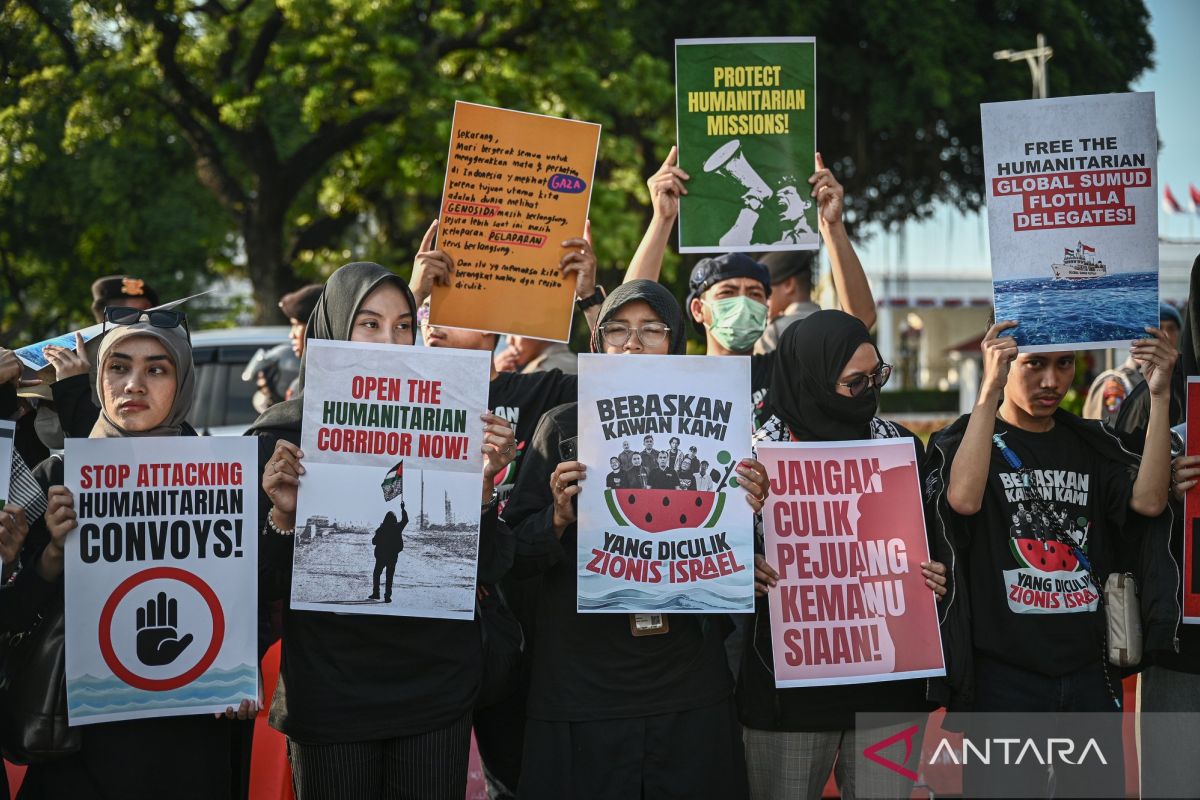
Jakarta (ANTARA) - Four Indonesian journalists have reportedly been abducted and detained by the Israeli military on Monday (18 May). The four journalists are Thoudy Badai and Bambang Noroyono of Republika, Rahendro Herubowo of Inews, and Andre Prasetyo Nugroho of TV Tempo.
They were covering a humanitarian mission with the Global Sumud Flotilla fleet sailing toward Gaza.
The incident involving these four Indonesian journalists shows that international journalism can no longer be understood simply as a reporting activity. It has also become part of the global political ecosystem that is prone to friction.
Question: who needs to protect journalists when they are out of the reach of their home countries’ jurisdiction?
Dependent on political calculation
In the perspective of international relations realism, international law has limited influence in shaping state behaviour. Law operates to the extent that it does not conflict with the strategic interests of actors who have dominant military power.
In that context, protection of journalists is not solely determined by international norms, but highly dependent on the power calculus and political interests.
Journalists occupy a unique and vulnerable position. Normatively, they are protected by the global principle of freedom of the press. However, they do not have the coercive power to ensure that this protection actually operates in practice. When norms confront security imperatives, the security approach is almost always more dominant, especially in conflict or crisis situations.
Legally, the Geneva Conventions provide protection for journalists in armed conflicts, wherever they are. However, that rule is essentially designed for land battlefields with clearer conflict structures. At sea, the situation is much murkier and difficult to classify definitively.
The high seas, as referred to in the United Nations Convention on the Law of the Sea (UNCLOS), do indeed guarantee freedom of navigation. However, that freedom does not automatically mean full protection for individuals aboard ships. When, for example, interception by a party occurs, interpretations of law often become a battleground for legitimacy.
That is where what is called in international law literature an enforcement gap emerges. There are norms, there are rules, but there is no mechanism of enforcement that is truly effective in real time. States can violate or reinterpret the rules without immediate consequences on the ground.
Through frameworks such as UNCLOS, the UN has provided the legal basis for international maritime law. But the body does not have enforcement apparatus to stop military actions in the middle of the sea. Consequently, international maritime law so far tends to function more as normative reference than as a preventative instrument.
In such a situation, journalists find themselves in a position of ‘principled protection, but vulnerable in practice’. They possess civil status recognised, but do not have physical protection when interceptions occur. The gap between norms and reality becomes very wide.