
Protecting Micro and Small Businesses or Chasing the Global Stage? Delaying Mandatory Halal Certification Is Not Cost-Free
On Thursday a few weeks ago (15 October), I represented the National Committee for Sharia Economy and Finance (KNEKS) at a discussion forum in Bandung with speakers from the National Development Planning Agency (Bappenas), Bank Indonesia, the Financial Services Authority (OJK) and the Coordinating Ministry for Economic Affairs. Around 50 participants from ministries, authorities and Islamic industry associations attended. The agenda was to examine Indonesia’s performance in SGIE 2025/2026 and devise a strategy to prevent its ranking from falling again.
There was hope and enthusiasm in the room. Indonesia remains the world’s top performer in modest fashion, and its halal food score has risen. The challenges are also clear, from strengthening Islamic finance to developing downstream halal industries. But that optimism was unsettled when the government postponed mandatory halal certification until 18 October 2028 — the second delay, after the deadline for micro and small businesses (UMK) was shifted from 2024 to 2026. The question is whether protecting UMK and pursuing a place on the global stage can go hand in hand, or whether one is being sacrificed for the other.
Two more years of breathing space
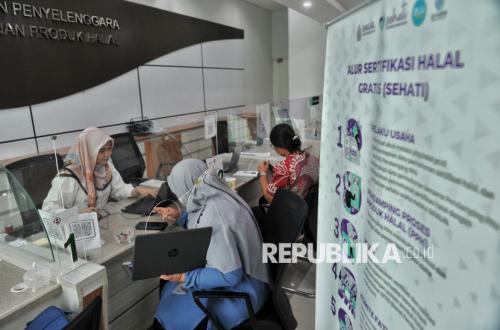
The case for a delay is compelling, and the data support it. As of mid-October 2026, BPJPH’s One Data platform recorded 15.15 million products from 3.52 million businesses as halal-certified, with nearly all certificates held by micro-enterprises. Almost all new certificates issued this year came through the self-declaration scheme, which requires a business identification number (NIB), assistance and verification. The government has provided 1.35 million free certificates and more than 111,000 facilitators.
However, UMK businesses outside the allocated quota have to find their own financing, while Islamic financial inclusion stands at only about one-eighth of the population, far below financial literacy, which is close to half. Enforcing the requirement in these circumstances would create distribution barriers and penalties capable of putting small businesses out of operation. The Islamic legal principle al-masyaqqah tajlib at-taysir (hardship begets facilitation) supports such flexibility.
The policy is also being phased in and is not open-ended. The 2024 postponement gave UMK time to obtain NIBs; the main categories are now subject to the 2028 deadline, with the schedule taking into account the completion of mutual recognition agreements (MRAs). Over-the-counter medicines are due in 2029, and prescription medicines in 2034.
But the world is not waiting. In SGIE 2025/2026, Indonesia fell to fourth place with a score of 96.0. The United Arab Emirates (UAE) surged by more than 40 points and overtook Indonesia, Saudi Arabia pulled further ahead, Malaysia led with a score nearly twice as high, and Bahrain was close behind, 20 points away. In Through the Looking-Glass, Lewis Carroll has the Red Queen say that one must run as fast as possible just to stay in the same place (“all the running you can do, to keep in the same place”).
Our analysis indicates that halal certification was not the main reason for the ranking decline. Islamic finance, the largest-weighted sector alongside halal food, fell by 22 points. Indonesia performs well in financial literacy and retail sukuk, but its markets and investment are shallower than those of Saudi Arabia and the UAE. Halal food, by contrast, rose by around five points, although structural problems remain: domestic consumption is strong, but upstream manufacturing geared towards exports is weak, while the UAE is building AI-powered halal logistics hubs and digital traceability systems. It is not waiting for the market to arrive; it is building it.
Source: jawawa.id (https://jawawa.id/newsitem/protecting-micro-and-small-businesses-or-chasing-the-global-stage-delaying-mandatory-halal-certification-is-1793778748)
Originally published by Republika (https://opini.republika.co.id/berita/tnyurg502/melindungi-umk-atau-mengejar-panggung-global-penundaan-wajib-halal-tidak-gratis), translated from Indonesian