
Protecting Habitat, Caring for Siamang and Hornbills in South Solok
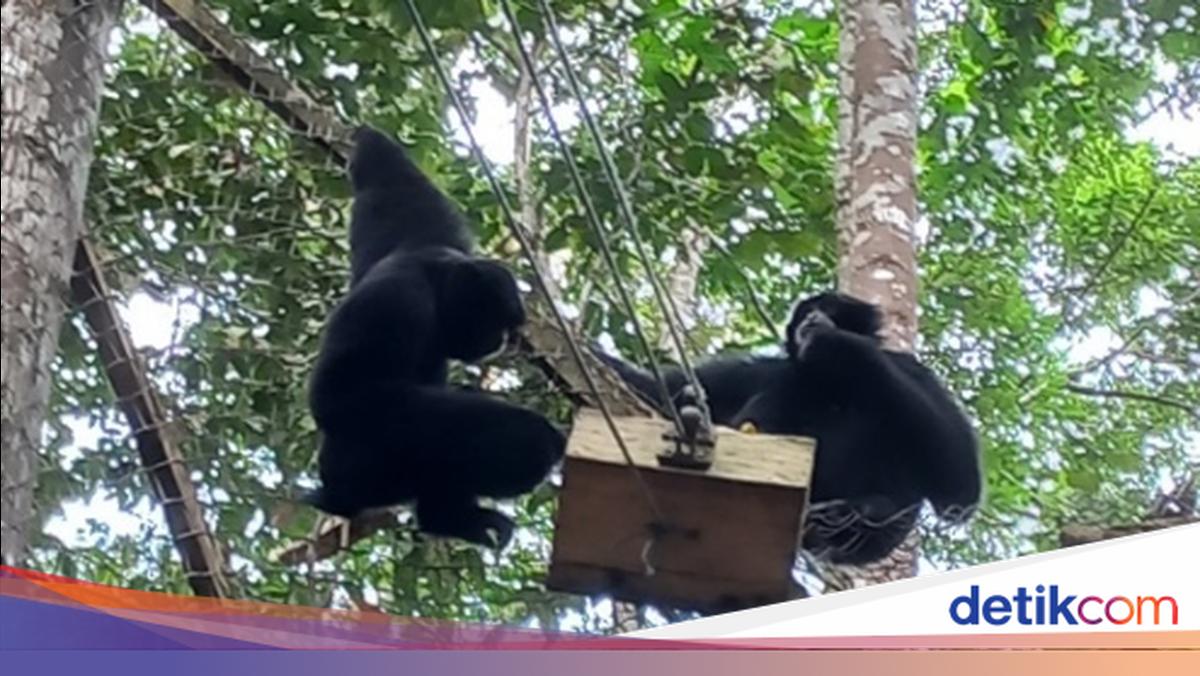
The sounds of animals among the trees are one of the signs that life continues within the conservation area of PT Kencana Sawit Indonesia (KSI) in South Solok, West Sumatra.
Amid the palm oil plantation landscape, a forested area with intact trees provides space for a variety of wild animals, from siamangs moving through the tree canopy to hornbills flying overhead.
There are also various species of mammals, primates, birds and other animals that make the area their habitat.
The High Conservation Value (HCV) area of PT KSI covers approximately 1,760.25 hectares. The area encompasses four rivers and four hills that form part of the conservation area’s ecosystem.
Maintaining habitat is an important part of efforts to sustain the presence of animals in the area, as the survival of siamangs, hornbills and other wildlife depends heavily on forest conditions that provide space for foraging, movement, shelter and reproduction.
Keeping a Home for Siamangs
The siamang is one of the animals receiving special attention in the management of PT KSI’s conservation area. Efforts to protect them are carried out through rehabilitation and release programmes, along with post-release monitoring.
Ityasman, HCV Officer for West Sumatra at PT KSI, said siamang releases in the area have been conducted since 2014 through a collaborative programme.
The release sites are located at Bukit Tengah Pulau and Bukit Saloh. Through the programme, a cumulative total of 25 siamangs have been released to date.
“In our conservation area, there have been siamang releases at Bukit Tengah Pulau and Bukit Saloh. The total is 25 siamangs,” Ityasman said while speaking to journalists recently.
Bukit Tengah Pulau covers roughly 300 hectares, while Bukit Saloh is around 430 hectares. Both form part of the area monitored by the conservation team.
According to Ityasman, before the release programme began, there were no records of siamangs in the conservation area.
Today, the released siamangs live independently in the wild. Their range has expanded so widely that they are not always easy to find during monitoring.
“We went up in the late afternoon around 5pm, so the siamangs had already started sleeping. These released siamangs are now independent — their range is far, their territory is wide — so encountering them is quite difficult, especially in the evening when they start sleeping. They also tend to avoid humans,” Ityasman said.
This situation is itself part of the process as released animals adapt to their natural environment. Even if not always visible, the siamangs’ presence can be monitored through their tracks and activity in the area.
Hornbills and an Interconnected Forest
While siamangs spend much of their time among the trees, the hornbill is another animal that demonstrates how the forest area provides space for wildlife.
Based on survey results, eight hornbill species have been found in PT KSI’s conservation area, including the golden wrinkled hornbill and the rhinoceros hornbill.
“We usually obtain hornbill data from surveys. For hornbills, we have found eight species in our conservation area — among them the white-bellied woodpecker/hornbill, the golden wrinkled hornbill, and most recently last week we encountered the rhinoceros hornbill,” Ityasman said.
Hornbills are not confined to a single location. Their distribution follows habitat conditions, including the availability of trees suitable for nesting.
“Hornbills are more dispersed, depending on where their nests are in our conservation area. Usually from the riverbank areas to the Bukit forest areas. Conditions also depend on the time — sometimes they appear in the morning, midday or afternoon,” he said.
The presence of hornbills illustrates the relationship between animals and their habitat. These large-beaked birds require forest areas that provide trees and food sources to survive.
At the same time, hornbills also play a role in the forest ecosystem, including helping to disperse the seeds of various plants. Their presence is part of the natural process that allows vegetation to regenerate.
Therefore, protecting hornbills does not stop at safeguarding the animals themselves. The habitat in which they live must also be preserved.
Monitoring from Forest Trails to Camera Traps
Maintaining habitat requires routine monitoring. PT KSI’s conservation team conducts patrols while observing animals found along monitoring routes.
Ityasman said the field team usually sets out in the morning and patrols several conservation areas.
“The team usually goes out in the morning, covering several areas — the team is about 12 people. They observe around the conservation area and enter the monitoring routes, observing animals, recording coordinates, taking documentation and then preparing reports,” he explained.
Not all animals are easy to spot directly. For more elusive species, the team uses camera traps installed at various points.
“Yes, one of our wildlife monitoring activities uses camera traps, for animals that are difficult to document directly,” he said.
Various animals have been recorded by the camera traps, including tapirs, mouse deer, muntjacs, deer, wild goats, wild dogs and sun bears.
Primate species recorded include silvered langurs, agile gibbons, long-tailed macaques, slow lorises and pig-tailed macaques.
Several protected bird species have also been recorded, including the crested serpent eagle and the changeable hawk-eagle.
The presence of these animals shows that a single area can serve as a living space for many species with different characteristics.
More Than Just Releases
Efforts to maintain the area also involve cooperation with other parties, including Andalas University, which conducts research in PT KSI’s conservation area.
The research includes studies on agile gibbon habitat and the post-release condition of siamangs in the wild. Collaboration also takes place through student activities and field work placements.
Beyond research cooperation, PT KSI also coordinates with the Natural Resources Conservation Centre (BKSDA) of West Sumatra Province.
“We have worked with Andalas University. They conducted research in our conservation area, including one on agile gibbon habitat, and there was also student research on siamangs after their release into the wild. The collaboration involves research and student internships,” Ityasman said.
Meanwhile, coordination with the government is carried out through reports on flora and fauna identification as well as annual conservation activities.
“With the government, we always coordinate, especially with BKSDA. We routinely submit reports on flora and fauna identification and our annual activities to BKSDA West Sumatra Province, so that developments are recorded,” he said.
When Animals Become Markers of the Forest
In the conservation area, the presence of animals does not stand alone. Siamangs need trees as living space. Hornbills depend on forests that provide trees and food sources. Other mammals and primates also require sufficiently large areas to move and forage.
Therefore, protecting one species also means protecting the environment that supports the lives of other species.
This is evident from the variety of animals still recorded in PT KSI’s HCV area. One of them is the wild dog, last encountered via camera trap in August 2024 at Bukit Tengah Pulau.
“Wild dogs — we last encountered them in August 2024 at Bukit Tengah Pulau,” Ityasman said.
According to him, wild dogs generally live in groups, although camera traps sometimes only record a single individual.
“They usually move in packs, but what is recorded on camera traps is usually a single individual — perhaps the pack leader surveying the area for hunting,” he said.
Among flora, the corpse flower, or Amorphophallus, is still frequently found in the area. Rafflesia was previously discovered but is no longer being recorded.
Protecting Habitat for the Long Term
Ultimately, managing a conservation area is not only about how many animals can be found. More importantly, it is about ensuring the habitat remains available and able to support wildlife in the long term.
This forms part of PT KSI’s commitment to maintaining the HCV area within its plantation landscape.
Hari Purnama, General Estate Manager of PT KSI, said the presence of siamangs and hornbills is part of the ecosystem that continues to be protected in the conservation area.
“Siamangs and hornbills are endemic to Sumatra. Because they live in this 1,700-hectare conservation forest, we care for them and make this area a place for them to breed, including through cooperation with the Kalaweit Foundation. The success of this conservation effort is evident from the preserved environment; local people can still see these animals, fish populations in the rivers remain healthy, and the area has now become a conducive tourist destination for residents,” Hari Purnama said.
For the estate’s management, protecting habitat means giving animals the opportunity to live out their life cycles naturally — from the siamangs growing more independent after release, to the hornbills still crossing the canopy, and the various animals recorded on camera traps.
Hari explained that this hope extends beyond the present day.
“Our hope for the next five to ten years is that the company and the community can remain equally consistent in protecting the conservation areas at PT KSI. We hope this area continues to function and can be cared for as long as the company exists,” Hari said.
The conservation area was also part of Panji Petualang’s visit to PT KSI. Besides observing the palm oil cultivation process, Panji also visited the forest area managed for wildlife conservation.
According to Panji, the visit gave him the opportunity to see directly both the plantation management process and the conservation area, which remains forested.
“Here I learned firsthand how palm oil is planted, cared for and harvested in the proper way. I also saw the conservation area they manage there, which is still forest and serves as habitat for various animals such as siamangs, langurs, hornbills, snakes and other wildlife,” Panji Petualang said.
The experience demonstrates that a conservation area can coexist alongside plantation activities. On one side, the plantation is managed to produce commodities; on the other, areas of conservation value are maintained as living space for wildlife.
In South Solok, this conservation story continues — not only through animal releases and monitoring, but also by protecting the forest to which they return.
For as long as the habitat remains intact, siamangs have trees to swing from, hornbills have a canopy to fly across, and other wild animals continue to have space to live.
Source: jawawa.id (https://jawawa.id/newsitem/protecting-habitat-caring-for-siamang-and-hornbills-in-south-solok-1789469718)
Originally published by detikcom (https://news.detik.com/berita/d-8664058/menjaga-habitat-merawat-siamang-hingga-rangkong-di-solok-selatan), translated from Indonesian