
Protecting Communities: Pegadaian Distributes Earthquake and Tsunami Mitigation Research
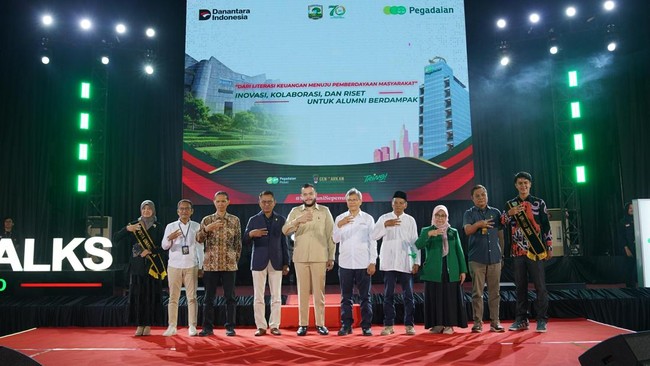
PT Pegadaian (Persero) and Andalas University (Unand) have handed over the results of a comprehensive research project titled ‘Community Empowerment in Self-Preparedness Facing the Threats of the Mentawai Megathrust Earthquake and Tsunami in Padang City’. The collaborative research findings were presented at the Andalas University campus in Padang and received by the Mayor of Padang, Fadly Amran, on Monday.
This step represents the company’s commitment to Environmental, Social, and Governance (ESG) sustainability, specifically regarding the social pillar and community resilience. Through the ‘Pegadaian Peduli’ programme, the company is focusing on safety aspects and long-term social investment for communities in disaster-prone operational areas.
The collaborative research has successfully produced a blueprint for a community-based disaster risk management model. This model integrates five key instruments: independent tsunami early warning technology, community-based evacuation systems, the utilisation of mosques as shelters and disaster information centres, the development of evacuation standard operating procedures (Sectors), and community education accompanied by practical disaster simulation training.
The high potential threat of the Mentawai Megathrust earthquake and the risk of tsunamis along the coast of Padang City necessitate solutions that do not rely solely on large-scale government infrastructure, but also on strengthening the internal capacity of residents as the frontline of rescue efforts.
One breakthrough from this research is the designation of mosques as symbols of emergency preparedness. Under this new model, mosques will be optimised to function as temporary evacuation shelters, information control centres, and primary coordination spaces for residents during a crisis.
Ismail Ilyas, Director of Risk Management, Legal, and Compliance at PT Pegadaian, explained that this sociological approach was carefully chosen because it aligns with the ‘Adat Basandi Syarak, Syarak Basandi Kitabullah’ philosophy in West Sumatra, where mosques hold a central role in the structural and cultural life of the community.
‘The collaboration between Pegadaian and universities such as Andalas University proves that research must not remain merely as academic documents in libraries, but must be converted into applicable solutions that save lives. We hope this self-preparedness model can significantly strengthen the resilience of the Padang community and serve as a national benchmark that can be replicated in other disaster-prone coastal regions in Indonesia,’ he stated.
The research findings are also accompanied by physical assistance in the form of locally-made early warning system components that are easy to maintain. This synergy demonstrates that university research supported by business funding can accelerate the handling of crucial regional issues.
Vice Rector III of Andalas University, Kurnia Warman, expressed his appreciation to Pegadaian for supporting this applied research. ‘We extend our deepest gratitude to PT Pegadaian (Persero) for providing trust, funding support, and full facilities for this research. This cross-sector cooperation proves that the combination of academic expertise and corporate social responsibility can produce innovations that directly impact public safety,’ said Kurnia.
Meanwhile, the Mayor of Padang, Fadly Amran, also expressed his appreciation to Pegadaian and Andalas University for initiating the research. He urged the community to utilise the findings optimally.
‘To the community, especially in Pasie Nan Tigo, I hope that what has been delivered by Pegadaian and Unand can be maintained and utilised to its full potential. Disaster preparedness is our shared responsibility. The more prepared the community is, the greater our chance of surviving and saving more lives when a disaster occurs,’ said Fadly.