
Prospects for Indonesia's Capital Market Following MSCI Review
JAKARTA. Indonesia’s capital market has come under renewed scrutiny after MSCI released its latest Global Market Accessibility Review on Friday (19/6/2026), highlighting several structural barriers that make market access less competitive compared to other emerging markets.
MSCI explicitly downgraded the ‘Information Flow’ assessment from ‘+’ to ‘-’, citing a deterioration in the quality of information and transparency in the Indonesian market. However, Indonesia has fortunately not been relegated to Frontier Market status.
Acting President Director of the Indonesia Stock Exchange (BEI), Jeffrey Hendrik, stated that the noted areas requiring improvement align with the capital market reform agenda currently being pursued by the exchange.
Similarly, Hasan Fawzi, Chief Executive of Capital Market, Derivative Finance, and Carbon Exchange Supervision at the Financial Services Authority (OJK), said the MSCI review reinforces the direction of Indonesia’s capital market reform to continuously strengthen transparency quality, identification of coordinated trading, and market competitiveness.
Capital market analyst from the University of Indonesia, Budi Frensidy, said the MSCI assessment is a signal that must be taken seriously. While Indonesia maintains its Emerging Market status, the downgrade in the Information Flow aspect indicates MSCI sees a decline in the quality of information access, transparency, or certainty required by global investors. He stressed that the issue is no longer about market status, but about market quality and accessibility.
“Therefore, self-regulatory organizations (SRO) need to focus on improving transparency, liquidity, effective free float, and communication with global institutional investors so that market confidence does not continue to erode,” he told Kontan on Friday (19/6/2026).
Capital market analyst Reydi Octa explained that the Information Flow downgrade shows MSCI still sees problems with ownership transparency and free float, making the Indonesian market appear riskier for foreign investors. He said SROs must respond with improvements in disclosure, Ultimate Beneficial Ownership (UBO) transparency, free float, and supervision of unusual transactions.
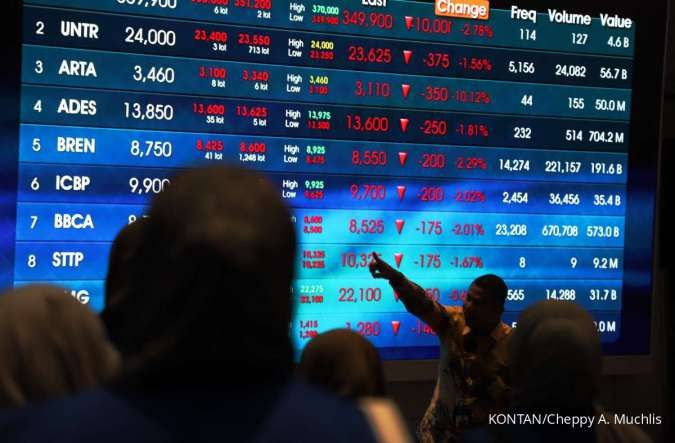
The retention of Emerging Market status was responded to positively by the market, with the Jakarta Composite Index (IHSG) rising 0.08% to 6,177.13 at the close of trading on Friday (19/6/2026). However, foreign fund flows still recorded a net outflow of Rp 3.14 trillion in the regular market and Rp 3.19 trillion across all markets. Year-to-date, accumulated net sell stands at Rp 79.63 trillion in the regular market and Rp 65.05 trillion overall.
This is compounded by the removal of several stocks from global indices, which reduced selling by passive funds even as active funds continued to sell. “This is in line with Indonesia’s fundamental conditions, such as fiscal and exchange rate pressures, as well as concerns over the direction of government policy,” he told Kontan on Friday.
With improvements in several sentiments, particularly the decline in oil prices which will reduce the government’s subsidy burden, the IHSG has the potential to rebound to the 6,500-7,000 level by the end of 2026.
For long-term investors, Wawan advised sticking with large-cap stocks that offer high dividend yields. “This is because selling pressure from passive funds should have eased, especially if Indonesia remains in the Emerging Market category,” he said.
Budi noted that the potential for foreign net selling still exists, although it is unlikely to be as large as in the first half of 2026. The direction of foreign funds in the second half of the year will depend heavily on MSCI developments, rupiah stability, bond yields, and the perception of risk in Indonesia. “If pressure continues, stocks that have historically been the largest holdings for foreign investors, such as major banks and large-cap stocks, could remain the main source of selling,” he said.
According to Budi, the opportunity for the IHSG to recover remains if the rupiah stabilises, foreign fund flows improve, and investor confidence increases again. He estimates the IHSG could potentially reach around 6,500 by the end of 2026, with positive sentiment coming from attractive valuations and negative sentiment from MSCI issues, fiscal concerns, and global uncertainty.
In the current conditions, investors need to focus more on quality than speculation. They should also pay attention to rupiah movements, foreign fund flows, government bond yields, and the regulator’s follow-up on issues highlighted by MSCI. “The most relevant strategy right now is to maintain diversification, retain adequate liquidity, and carry out gradual, selective accumulation of stocks,” Budi said.
Reydi added that the IHSG’s outlook remains volatile. The retained Emerging Market status prevents the worst-case scenario but does not automatically make foreign investors aggressive. A realistic IHSG target for the end of 2026 is in the range of 6,400-6,800, provided the rupiah stabilises and market reforms are trusted. Positive sentiment comes from cheap valuations, potential buybacks, and rupiah stabilisation, while negative factors include continued foreign net selling, ongoing MSCI issues, high interest rates, and domestic policy risks.
“Investors should avoid stocks that rise only on technical sentiment but have weak free float, liquidity, and transparency,” he said.
Harry assessed that in current conditions, investors need to focus more on selectivity, particularly regarding liquidity, governance quality, and foreign exposure of each issuer. The right strategy is gradual accumulation of quality large-cap stocks during corrections, while avoiding stocks with low liquidity or opaque ownership structures. Sector diversification is also important to reduce risk from foreign flow volatility. According to Harry, sectors with the potential to attract foreign inflows are those with heavy weightings, such as Book 4 banks. Harry recommended buying BMRI with a target price of Rp 6,000 per share.
Source: jawawa.id (https://jawawa.id/newsitem/prospects-for-indonesias-capital-market-following-msci-review-1781970630)
Originally published by investasi.kontan.co.id (https://investasi.kontan.co.id/news/begini-prospek-pasar-modal-indonesia-di-tengah-hasil-review-msci), translated from Indonesian