
Prosecutor's Office Reform in the Spotlight
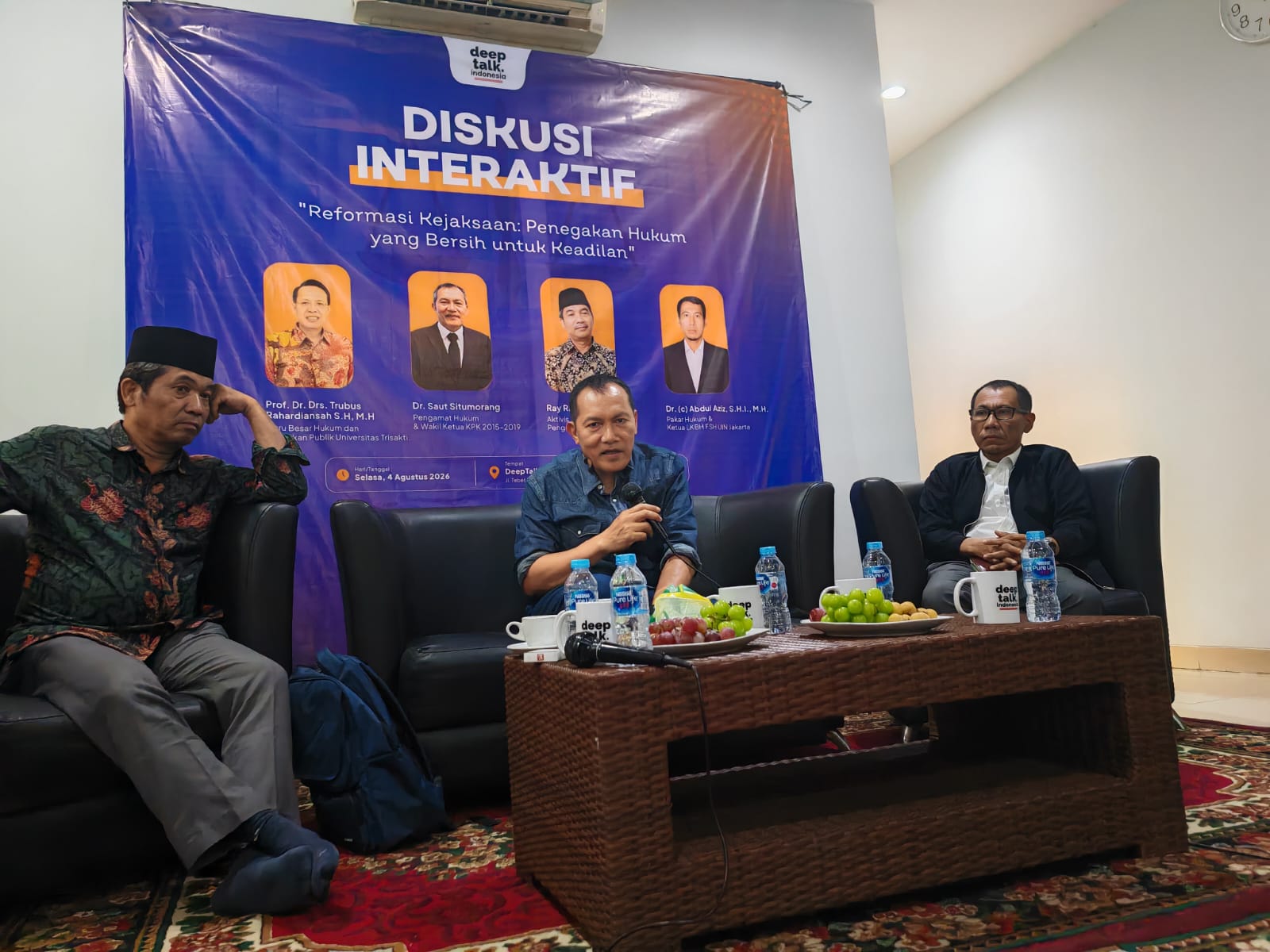
A number of legal experts and political observers are urging a comprehensive overhaul within the Attorney General’s Office. The move is considered important to strengthen the supervisory system while ensuring the law enforcement process is conducted professionally, transparently, and with integrity.
This view emerged during an interactive discussion titled ‘Prosecutor’s Office Reform: Clean Law Enforcement for the Courts’, organised by Deep Talk Indonesia in South Jakarta on Tuesday (4/8). The forum featured former Deputy Chair of the Corruption Eradication Commission (KPK) for the 2015-2019 period and legal observer Saut Situmorang, 1998 activist and Lingkar Madani political observer Ray Rangkuti, and Head of the Legal Consultation and Aid Institute (LKBH) of the Faculty of Sharia and Law at UIN Jakarta, Abdul Aziz.
During the discussion, the panellists agreed that reform within the Attorney General’s Office must be realised immediately. They also urged that the case implicating former Junior Attorney General for Special Crimes (Jampidsus) Febrie Adriansyah be handled thoroughly, including investigating other parties suspected of involvement.
Abdul Aziz highlighted the prosecutor’s position as dominus litis, or the party controlling a case within the criminal justice system. According to him, the significant authority held by prosecutors must be balanced with a truly effective oversight mechanism. ‘When an institution holds great authority from the investigation to the prosecution stage, a supervisory mechanism is needed to ensure every action remains within the legal corridor,’ Abdul Aziz said during the discussion.
He explained that such extensive authority could potentially lead to abuse of power if not accompanied by a strong control system. Nevertheless, Aziz assessed that the oversight issue within the Attorney General’s Office is not solely caused by the absence of supervisory bodies. According to him, the office already possesses internal supervisory tools, ranging from an oversight division to internal audit mechanisms. Additionally, external oversight exists through the Prosecutorial Commission. However, the existence of many supervisory bodies does not necessarily prevent violations from occurring. ‘Reform must be directed at improving the quality and effectiveness of supervision, not merely creating new institutions,’ he stated.
Meanwhile, Saut Situmorang assessed that the case involving Febrie Adriansyah serves as an important momentum to improve evidence management standards across- all law enforcement institutions. He argued that Indonesia requires a regulation governing uniform evidence management standards for the KPK, the National Police, and the Attorney General’s Office. According to Saut, each institution currently uses different internal mechanisms. Therefore, a higher-level regulation is needed so that procedures for seizure and management of evidence have the same standard. He also stressed the importance of optimising the intelligence function and internal oversight. ‘The intelligence function should not only start working after a case emerges. Intelligence must be able to provide early warnings, map risks, and help resolve issues before they develop into larger problems,’ he said.
Furthermore, Saut questioned the effectiveness of the supervisory system if major problems only come to light after they occur. According to him, the success of corruption eradication is not solely determined by institutional structures or legal authority. ‘The main issue in eradicating corruption is not just about institutional structures or legal authority, but also the integrity of the people exercising that authority,’ he said.
On the other hand, Ray Rangkuti assessed that the existence of institutions like the KPK is still needed because it is closely related to the level of public trust in law enforcement, particularly in eradicating corruption. He stated that if the National Police and the Attorney General’s Office were able to carry out their duties optimally, professionally, and with integrity, the need for an ad hoc institution to handle corruption would diminish. Therefore, Ray views reform in both law enforcement institutions as a crucial factor in strengthening the national legal system. He also highlighted the many supervisory bodies that have been established, both at the internal and external levels. According to him, the effectiveness of supervision is not determined by the number of existing bodies, but by the independence, courage, and integrity of the parties carrying out the supervisory function. Ray also cautioned that ethics and supervisory bodies risk losing effectiveness if they cannot maintain independence from political interests or the institutions being supervised.
For context, former Jampidsus Febrie Adriansyah has been named a suspect by investigators from the Police’s Corruption Eradication Corps (Kortastipidkor). The case was subsequently transferred to the Attorney General’s Office. On 17 July 2026, the Attorney General’s Office declared Febrie Adriansyah a suspect in a case of alleged corruption and money laundering related to PT Asuransi Sosial Angkatan Bersenjata Republik Indonesia (Asabri) for the 2020-2024 period. In the same case, private party Don Ritto was also named a suspect for alleged money laundering. Meanwhile, the Attorney General’s Office stated that investigations into other related cases involving PT Krakatau Steel and PT PLN are still at the general investigation stage by police investigators.