
Prosecutors: Nadiem Employed White Collar Crime Strategy
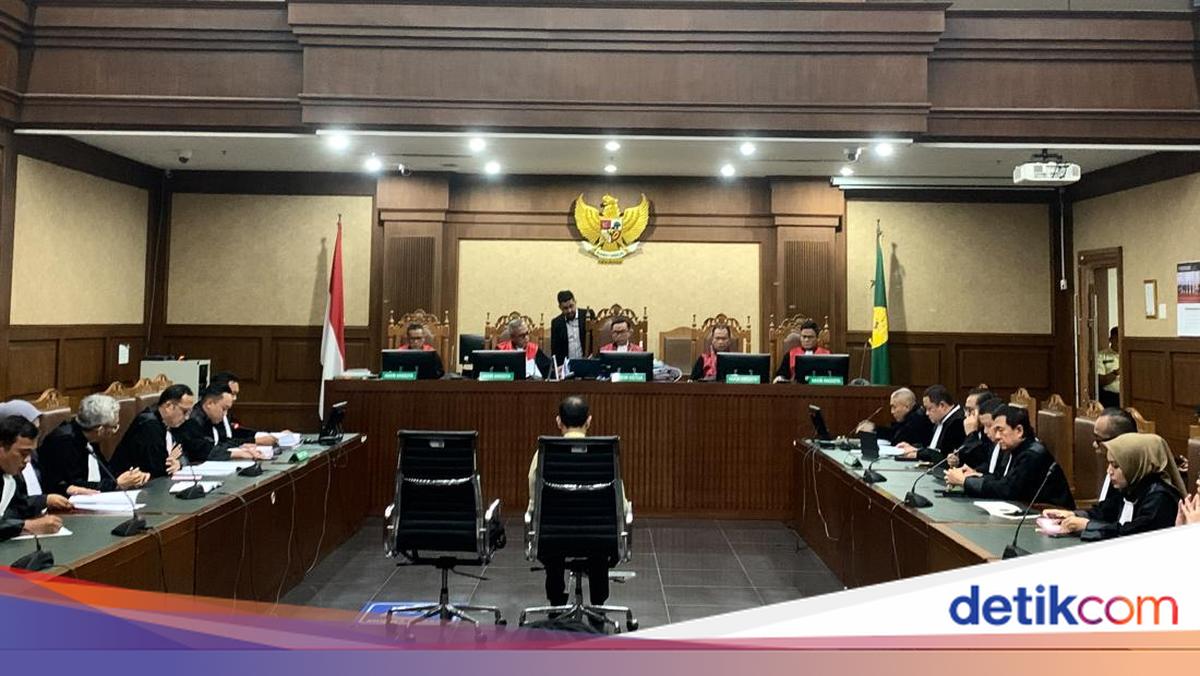
Public prosecutors have explained why they believe former Education, Culture, Research, and Technology Minister Nadiem Makarim employed a white collar crime strategy. The prosecutors are convinced that Nadiem manipulated the recording of monetary transactions from Google to PT Aplikasi Karya Anak Bangsa (AKAB).
“The defendant carried out a white collar crime strategy, in this case fraud, whereby after PT AKAB received money transferred by Google, the defendant agreed to manipulate the records to not match the actual transaction,” the prosecutor stated while reading the replication at the Central Jakarta Corruption Court on Tuesday (9/6/2026).
The prosecutors assessed this as corporate fraud, which was one of Nadiem’s methods to evade tax and disguise transactions. The prosecutors highlighted the discrepancy between the total incoming funds and the recorded amount. “The total incoming funds amounted to approximately Rp 11 trillion, whereas only Rp 72 billion was recorded by the notary,” they said.
The prosecutors stated that Nadiem could not explain the origin of the assets acquired in 2022 from lawful income. They believe Nadiem’s wealth originated from a fraud scheme at PT AKAB with investment sourced from Google Asia Pacific and is linked to the Chromebook procurement project at the Ministry of Education.
“The defendant’s admission that his sole source of wealth came from AKAB or GoTo, mutatis mutandis, constitutes wealth originating from the PT AKAB fraud scheme with investment sourced from Google Asia Pacific,” the prosecutor said. “Since the defendant’s assets are disproportionate and he could not prove they were not derived from lawful proceeds, the public prosecutor considers this legal fact to be part of the profits or self-enrichment of the defendant as a Minister within the corruption scheme of this case.”
The prosecutors noted that PT AKAB’s financial reports were loss-making, contrasting sharply with the increased wealth of Nadiem as the CEO and founder of PT AKAB. They view the management of PT AKAB, Gojek, and other affiliated companies as a scheme to enrich Nadiem through white collar crime.
“There is a profit or enrichment for the defendant from his decision to choose Chrome OS amounting to Rp 809,597,125,000, which was disguised through PT Gojek Indonesia. Furthermore, there is an unexplainable increase in assets compared to his income as a Minister, reaching Rp 4,871,469,603,758 (Rp 4.8 trillion). Among these are placements of funds at the Bank of Singapore and other investments in Planet Ocean Pte Ltd,” the prosecutor stated.
The prosecutors claimed Nadiem was unable to state his initial number of shares and could not explain the increase in his shareholdings. They also mentioned that data on securities in Nadiem’s State Officials’ Wealth Report (LHKPN) only listed a share value of Rp 5,590,317,273,184.
“However, the actual number of share lots owned, the defendant could not prove. Subsequently, the change in the total number of shareholdings after the stock split was also something the defendant could not explain regarding the event and its accountability. Thus, the defendant’s reasoning actually strengthens the existence of efforts to enrich the defendant Nadiem Anwar Makarim from the proceeds of crime,” the prosecutor added.
The prosecutors said Nadiem also could not answer when asked about his salary as a Minister. They are convinced the series of corrupt acts committed by Nadiem constitutes a crime by a person of high social status, or white collar crime.
“Regarding these eight factual conclusions, they demonstrate that the series of actions by the defendant in committing the corruption offence of Chromebook procurement in the Ministry of Education and Culture’s education digitalisation programme from 2019 to 2022 is a form of crime committed by someone with high ability and social status in their occupation, which in criminology is also known as white collar crime,” the prosecutor stated.
The prosecutors also accused Nadiem of turning the facts upside down as if he were innocent through his plea. The prosecutors affirmed they stand by their sentencing demands against Nadiem. They also touched upon Nadiem’s malicious intent through a series of unlawful acts in the Chromebook procurement. They stated Nadiem’s actions violated Presidential Regulation Number 16 of 2018 on Procurement of Goods and Services by instructing Hamid Muhammad to ‘Go ahead with Chromebook’.
“And instructing defendants Mulyatsyah and Sri Wahyuningsih through Jurist Tan to state that Chromebook no longer needed to be debated because it was a final order from the defendant as minister,” the prosecutor said. “Even the defendant personally conveyed directly to Sri Wahyuningsih and Mulyatsyah after they were appointed as officials of the Director of Elementary Education and Director of Junior Secondary Education the instruction: ‘The education digitalisation programme must use Chrome OS and do not forget that this device uses Chrome Device Management’.”
The prosecutors also dismissed Nadiem’s argument claiming that the Chromebook procurement saved the state Rp 3.9 billion. They called the claim an empty assumption. “That the argument of Chromebook being beneficial and saving state finances by Rp 3.9 trillion is an empty assumption deliberately constructed to shape opinion because it is not based on legal facts, and even contradicts the legal facts,” the prosecutor said.
The prosecutors refuted the defence argument from Nadiem’s lawyers which claimed the Rp 809,596,125,000 (809 billion) was merely a corporate action. The prosecutors see characteristic signs of a disguised transaction related to the matter. “The series of changing, receiving, and restoring the status of this company is an undeniable indication of intent that the transaction was deliberately designed to channel profits to the defendant,” they stated.
Regarding Nadiem’s sentencing demands, Nadiem Makarim was previously sentenced to 18 years in prison, a fine of Rp 1 billion, subsidiary to 190 days of imprisonment. Additionally, the prosecutors demanded Nadiem pay compensation amounting to Rp 809,596,125,000 (809 billion) and Rp 4,871,469,603,758 (4.8 trillion), totalling Rp 5,681,066,728,758.