
Prosecutors Demand 18-Year Prison Sentence: The Corruption Case Against Nadiem Makarim
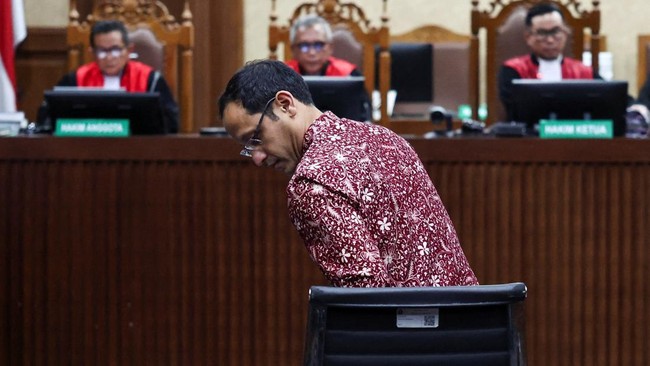
Former Minister of Education, Culture, Research, and Technology Nadiem Makarim has been demanded an 18-year prison sentence in a corruption case concerning the procurement of Chromebook laptops worth Rp 9.3 trillion. Prosecutors assessed that Nadiem continued to promote the project despite knowing the devices were problematic for 3T regions.
“Impose a prison sentence on the defendant Nadiem Anwar Makarim of 18 years,” stated prosecutor Roy Riady while reading the indictment at the Corruption Court in Central Jakarta on Wednesday (13/5/2026).
Nadiem is demanded to pay a fine of Rp 1 billion, subsidiary 190 days’ imprisonment. Prosecutors also demand Nadiem pay restitution of Rp 809.5 billion and Rp 4.87 trillion, totalling Rp 5.68 trillion in obligations.
Prosecutors stated that Nadiem’s assets may be confiscated and auctioned to cover the restitution. If insufficient, it would be replaced with 9 years’ imprisonment.
Prosecutors believe Nadiem is guilty of violating Article 603 in conjunction with Article 18 of the Corruption Offences Law in conjunction with Article 20 letter c of Law No. 1 of 2023 on the Criminal Code.
Case Origins
Nadiem was officially named a suspect in the case on 4 September 2025. Previously, Nadiem had been examined twice by investigators from the Deputy Attorney General for Special Crimes on Monday (23/6/2025) and Tuesday (15/7/2025) regarding alleged corruption in the procurement of Chromebook laptops that consumed a state budget of Rp 9.3 trillion at the Ministry of Education, Culture, Research, and Technology (Kemendikbudristek) during the 2019-2022 period.
Head of the Special Crimes Investigation Directorate of the Attorney General’s Office, Nurcahyo, stated at the time that Nadiem’s actions included, in February 2020, holding a meeting with parties from Google Indonesia to discuss Google’s products in the Google for Education programme using Chromebooks that could be used by the Ministry, particularly for students.
“In several meetings conducted by NAM with Google parties, it was agreed that Google’s products, namely Chrome OS and Chrome Device Management or CDM, would be made into an Information and Communication Technology (TIK) procurement project,” said Nurcahyo.
Subsequently, to realise the agreement between NAM and Google Indonesia, on 6 May 2020, NAM invited his subordinates via Zoom Meeting and mandated the procurement or provision of TIK equipment using Chromebooks.
Nurcahyo explained that at that time, the TIK equipment procurement had not yet begun. “Whereas previously, the letter from Google was not responded to by the previous Minister, ME, who did not respond because the 2019 Chromebook procurement trial had failed and could not be used in schools in 3T regions,” said Nurcahyo.
Following Nadiem’s orders to implement the 2020 TIK procurement using Chromebooks, SW as Director of Primary Schools and M as Director of Secondary Schools created guidelines and technical specifications with specifications already testing Chrome OS.
Nadiem, through other defendants, conducted a review of the analysis related to the programme and directed it towards Chromebook laptops along with CDM, not based on Indonesia’s educational needs.
State Losses
According to prosecutors, the laptop procurement via e-Catalogue was also conducted without evaluation and price references. This caused the programme to fail, especially in 3T regions.
The Prosecutors’ Team also highlighted that Chromebooks must be connected to the internet. If not, the software cannot be used, whereas network issues are a problem in 3T regions.
Additionally, prosecutors mentioned that knowledge of Chromebook usage is very minimal. Including applications in the Google ecosystem, such as Google Docs, Google Sheets, Google Slides, Google Meet, to Google Classroom.
Prosecutors stated that Nadiem knew Chromebooks could not be used. However, he still implemented it for business purposes for Google’s investment in PT Aplikasi Karya Anak Bangsa (AKAB).
Nadiem is also charged with enriching himself by Rp 809 billion. Finally, Nadiem and other defendants are charged with causing state losses of Rp 2.1 trillion, including procurement of unnecessary and unbeneficial devices worth around Rp 600 billion.
“1,159,327 Chrome Device Management or Chrome Education Upgrades distributed in schools across Indonesia do not function, especially in 3T areas, so the computer-based national assessment objectives are not achieved, and students and teachers cannot use them for the teaching and learning process,” explained the prosecutors.
Nadiem’s Defence
In his defence, Nadiem included several points of the indictment that confused him. Here are some points read by Nadiem:
- Enriching Himself
He said he was confused by the statement that he received Rp 809 billion from the project. Additionally, it was mentioned that he enriched himself based on 2022 LHKPN data showing securities of Rp 5.5 trillion.
“First, I am confused because in one part of the indictment it says I received fund flows, and in another part of the indictment, the evidence of enrichment is the increase in securities. Is the accusation that I received money or received securities?”
He explained that his wealth comes from only one main source, namely his shares in PT AKAB. The increase in wealth also stems from the rise in GoTo share prices during the IPO, which became Rp 4.8 trillion, but in 2023 when shares fell, his wealth automatically dropped to Rp 906 billion in 2023, and Rp 600 billion in 2024.
- Google’s Investment in Gojek
He also said that Google’s investment seemed to occur when the ChromeOS policy was taken. However, Nadiem said the majority of the US$450 million investment occurred in 2017-2019, before he became minister.
Meanwhile, the remaining investment in 2020-2022 of US$230 million was Google’s prerogative to avoid dilution. Nadiem also said that the tech giant’s investment was only a small portion, 4% of PT AKAB at IPO from all incoming investments.
“Invest