
Prophet's Warning Echoes as Scientists Uncover Origins of the Euphrates River
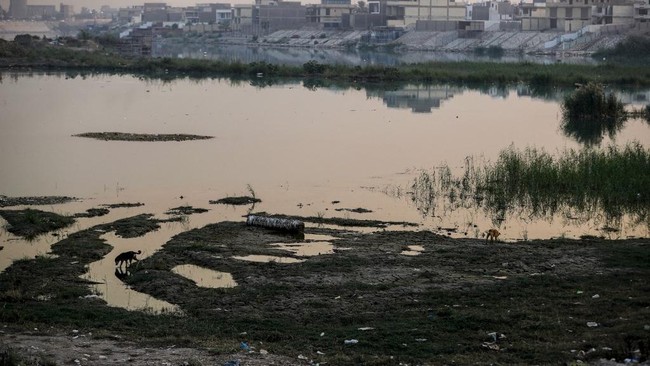
A team of scientists has uncovered the origins of the Euphrates River, one of the most influential waterways in human history. New research published in the journal Nature Geoscience reveals the modern Euphrates was formed by the merging of two ancient rivers millions of years ago. Around 5.4 million years ago, two ancient rivers, the Paleo-Karasu and the Paleo-Murat, flowed across what is now Turkey and Syria towards the Mediterranean Sea. The researchers found that both rivers continued to empty into the Mediterranean until about 5.33 million years ago. However, tectonic shifts occurring millions of years later altered their courses. The Paleo-Murat was the first to change its path around 3.6 million years ago, while the Paleo-Karasu shifted direction approximately 800,000 years later. Eventually, the two rivers merged and flowed southeast towards the Persian Gulf around 1.6 million years ago, forming the Euphrates River known today. Lead study author Andrew Madof stated that traces of the ancient Euphrates can still be found. “The modern landscape on land, along with sediments buried offshore, still hold clear signs of the ancient Euphrates River,” Madof said. He added that the merging of the two ancient rivers was likely a key factor in shaping the Fertile Crescent, the region that became the cradle of early human civilisation. “If the Paleo-Murat and Paleo-Karasu rivers had not shifted course and merged at that time, it is unclear whether the Fertile Crescent would have formed as we know it,” he noted. The Fertile Crescent is a boomerang-shaped region in West Asia stretching from Egypt to southeastern Iraq. Its eastern part, known as Mesopotamia, is home to the Tigris and Euphrates rivers, which created exceptionally fertile land in an otherwise arid environment, allowing ancient civilisations like Sumer and Assyria to flourish around 6,000 years ago. Despite its central role in human history, the Euphrates’ origins remained a mystery. Previous theories suggested it developed from a single river flowing into the Mediterranean or ancient lakes in Turkey, or that it ended in the Arabian Peninsula. The new research refutes these theories, concluding the Euphrates was born from the merging of two ancient rivers, not a single stream. To uncover its geological history, scientists used seismic data, land surface maps, and satellite imagery. They also analysed river deposits aged 5 to 6 million years buried off the coast of Lebanon and compared them with similar deposits off the Turkish coast. The analysis revealed the existence of two ancient river channels, the Paleo-Karasu and Paleo-Murat. Both rivers flowed into the Mediterranean during the Messinian Salinity Crisis, a period of about 700,000 years when tectonic processes caused much of the Mediterranean Sea to dry up. When the Mediterranean refilled around 5.33 million years ago, the river channels and sediments left by the two ancient rivers were submerged, only to be rediscovered in the latest research. “An easy way to understand it is that we traced the ‘footprints’ of the ancient Euphrates buried offshore and connected them to where those footprints appear on land,” Madof explained. The team also found that tectonic shifts, including mountain formation, faulting, and earthquakes, altered the paths of the Paleo-Karasu and Paleo-Murat around 3.6 million years ago. “At the location where these ancient river channels cross faults, the landscape behaves like a conveyor belt shifting sideways,” Madof clarified. By measuring how far the rivers shifted and how fast the faults moved, the researchers could estimate when the shifts occurred. Additionally, the team conducted sediment transport modelling to estimate the size of the two ancient rivers. The results showed the Paleo-Karasu was even larger than the modern Nile River before it eventually merged with the Paleo-Murat to form the Euphrates around 1.6 million years ago. The research also indicates that while parts of the ancient river channels remained almost unchanged, other sections underwent drastic directional changes. According to Madof, the rivers’ positions likely influenced the migration routes of mammals leaving Africa for the Levant by determining the availability of water sources. He emphasised that understanding these formations can help scientists comprehend how major changes in water distribution can transform landscapes and create conditions that support life. This is particularly urgent as the twin Euphrates and Tigris river system, the lifeblood of human civilisation for millennia, is reportedly beginning to vanish and is predicted to dry up completely by 2040. This alarming phenomenon aligns with a warning delivered by the Prophet Muhammad 14 centuries ago regarding the signs of the end times. In a hadith narrated by Imam Muslim, the Prophet specifically said: “The Hour will not come before the Euphrates River dries up and reveals a mountain of gold, causing people to fight and kill each other to obtain it.”