
Promoting the Downstreaming of Innovation Through the Riset Expo and LPPM Award 2026
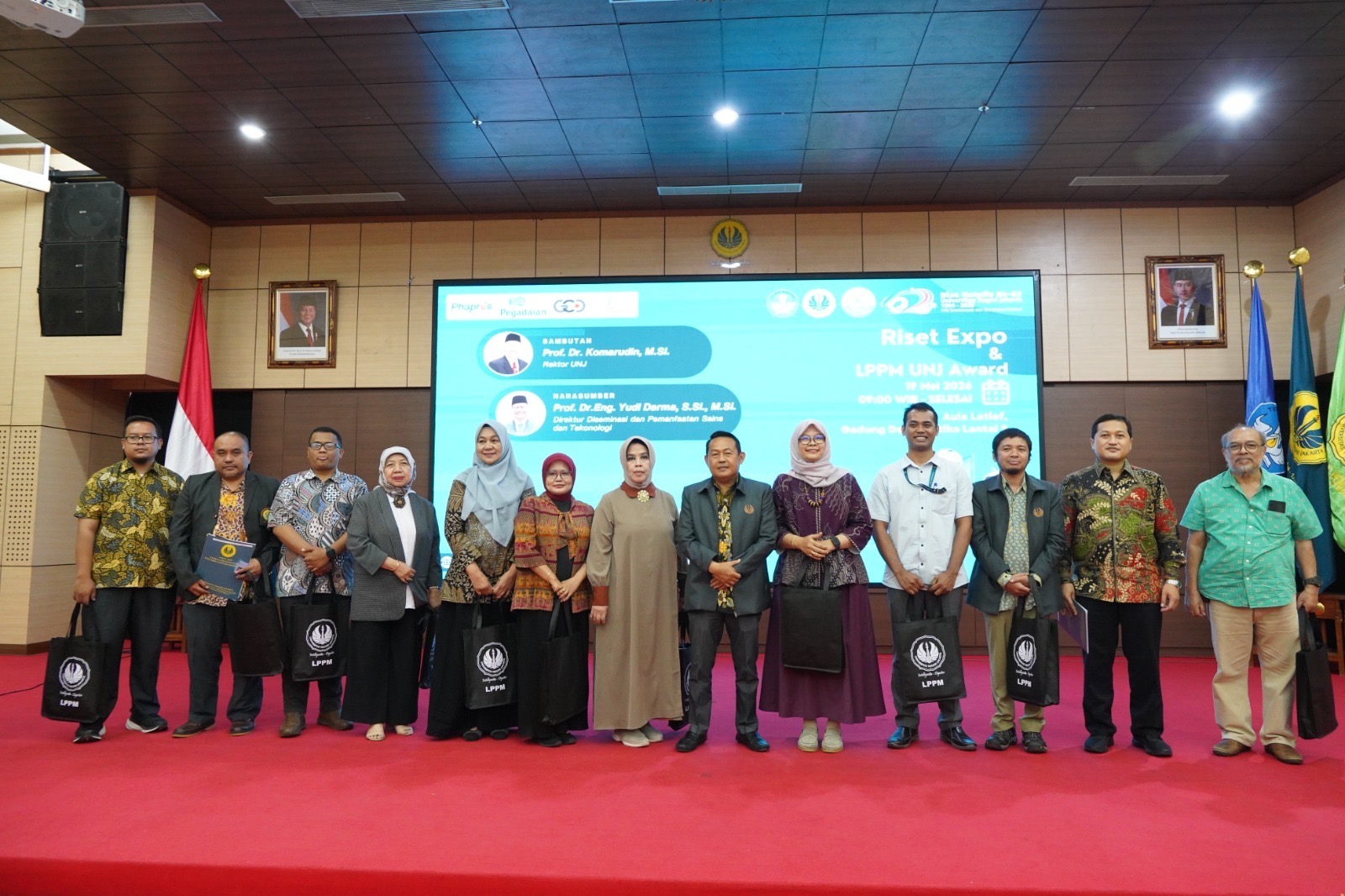
State University of Jakarta (UNJ), through its Institute for Research and Community Service (LPPM), organised the Riset Expo and LPPM UNJ Award 2026. The event took place at the Latief Hendraningrat Hall, Raden Dewi Sartika Building, 2nd Floor, Campus A, UNJ, on 19 May 2026. This year’s theme was ‘Globalisation of UNJ Research to Increase Impact and Competitiveness’, closely aligned with and integral to the 62nd Dies Natalis celebrations, encapsulating the spirit of ‘UNJ With Global Impact and Prestige’. The head of LPPM UNJ, Prof. Iwan Sugihartono, in his activity report, stated that in the current global era, research must not only generate scholarly publications but also provide tangible solutions for society and industry. ‘Riset Expo 2026 is attended by nine booths comprised of eight faculties and one Graduate School. There are also booths from LPPM, the Directorate of Innovation, the Business Management Agency (BPU), and collaboration with partner campuses such as Universitas Terbuka (UT) and UPN Veteran Jakarta,’ Prof. Iwan said. He also expressed appreciation to industry partners supporting the event, including PT Pegadaian, PT Phapros, Radio GCD FM, and PT Rejoso Manis Indo. Regarding the LPPM Award, he explained that the award seeks to spur the competitive spirit among the academic community, with nominations covering categories such as the number of Scopus-indexed publications, H-index, citations, Intellectual Property Rights (IPR)/patents, and recognition of journal governance. The event was also attended by Yudi Darma, Director of Dissemination and Utilisation of Science and Technology at the Directorate General of Science and Technology, Ministry of Education, Culture, Research and Technology (Kemdikbudristek), as the main speaker. Leaders from the State University of Jakarta were also present. Representing the Rector of UNJ, the University Secretary, Prof. Suyono, attended to give a speech and formally open the event. In his address, Prof. Suyono reaffirmed the essence of the theme amid a highly dynamic and competitive global ecosystem: ‘Globalisation of research is not merely about increasing foreign collaboration or chasing international indices. Globalisation of research is about ensuring our findings are globally recognised for quality while delivering real benefits to society.’ He added that UNJ has great potential to become an internationally reputable university through cross-disciplinary collaboration, downstreaming of innovation, and contributions to solving global problems, and congratulated the award recipients while motivating researchers to continue their work. The programme then featured the main speaker, Yudi Darma, presenting on ‘Accelerating the Globalisation of Higher Education Research Through Strategic Partnerships’. In his presentation, he challenged universities to align their research agendas with Indonesia’s real potential and to focus on outputs oriented toward tangible impact. Yudi stressed the importance of bridging the gap between academic research and global market needs. Although Indonesia ranked 55th in the Global Innovation Index (GII) 2025, knowledge diffusion outcomes such as the monetisation of intellectual property, exports of high‑tech goods, and ICT services exports still require improvement. ‘A radical transformation is needed from research based solely on publications to research that adds economic value and exports high‑tech technology,’ he stated. He also outlined the challenge for higher education to shift from quantity to real impact. Indonesia currently dominates Scopus‑indexed journal publications in Southeast Asia with a 33.9% share, yet quality remains a major challenge, particularly in the STEM cluster within the Ministry of Education, Culture, Research and Technology’s scope, which has only 2 Q1 journals, compared to 10 Q1 journals in the Social Sciences and Humanities cluster. To address these challenges, Yudi urged higher education to support Indonesia’s nine Priority Investment Sectors through strategic innovation. Campuses are required to participate in building innovation sovereignty by mastering the value chains of strategic commodities such as critical minerals (nickel, tin, bauxite), bioeconomy (palm oil, rubber), blue economy, and energy security. ‘The utilisation of science and technology opens a golden opportunity for higher education to lead applied research, create import-substitution technologies, and provide a skilled workforce. This is part of the national roadmap to convert natural resources into high-value research outputs, projected to yield macroeconomic effects on a mass scale by 2040,’ concluded Yudi Darma. Through the organisation of the Riset Expo and LPPM Award 2026, UNJ reaffirmed its commitment to strengthening the research ecosystem, not only excelling academically but also delivering real impact for society, industry, and national development. The event represents an important milestone for UNJ in strengthening downstreaming of innovation, strategic collaboration, and internationalisation of research to realise a globally reputable campus contributing to advances in science, technology, and national competitiveness.
Source: jawawa.id (https://jawawa.id/newsitem/promoting-the-downstreaming-of-innovation-through-the-riset-expo-and-lppm-award-2026-1779546185)
Originally published by Media Indonesia (https://mediaindonesia.com/ekonomi/891691/dorong-hilirisasi-inovasi-lewat-riset-expo-dan-lppm-award-2026), translated from Indonesian