
Promoting Gender-Responsive Inclusive Economy and Finance for Subsistence Business Groups
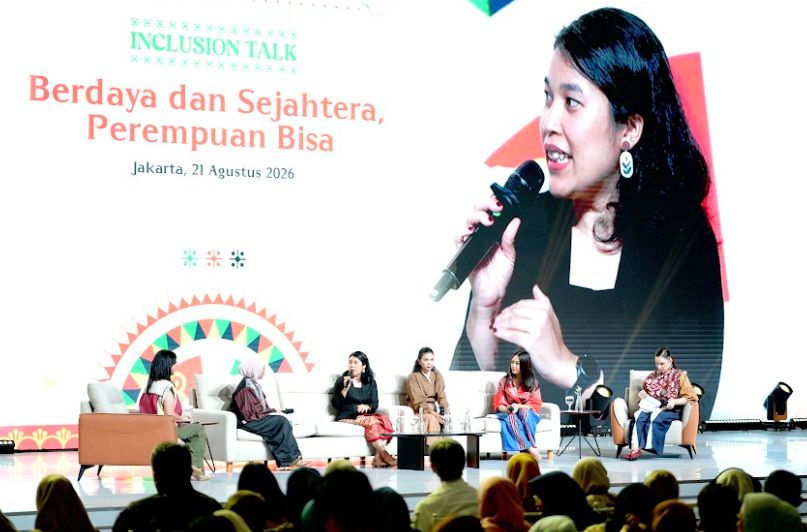
Bank Indonesia (BI), together with Women’s World Banking and the Ministry of Women’s Empowerment and Child Protection (Kementerian PPPA), launched the study “Towards a Gender-Responsive Inclusive Business Model: Lessons from Subsistence Groups in Indonesia” alongside the Inclusion Talk “Berdaya dan Sejahtera, Perempuan Bisa” on Friday (21/8) as part of the Karya Kreatif Indonesia 2026 series. The study is the result of collaboration between Women’s World Banking and Bank Indonesia in 2025, examining in depth the dynamics of subsistence business groups, including factors affecting the quality of participation and benefits received by members, particularly women.
“This study recommends strengthening the Inclusive Economy and Finance Programme for Subsistence Groups that Bank Indonesia has implemented since 2021. The programme is designed to reach communities that have been difficult to reach with formal financial services, through a group approach that builds togetherness, trust, and independence,” said Bank Indonesia Deputy Governor Filianingsih Hendarta.
Filianingsih added that the programme has been replicated across all Bank Indonesia domestic representative offices, with the majority of members being women. Through a gender-perspective approach, the study provides recommendations for three main stages of empowerment. First, the preparation stage uses the principles of equality of Access, Participation, Control, and Benefits as the basis for mapping conditions affecting women’s participation. Second, the implementation stage encourages women’s representation and leadership to build solidarity and self-confidence.
The use of digital technology needs to be carried out adaptively and inclusively, taking into account the literacy gap between men and women. Third, the monitoring and evaluation stage explicitly measures changes and impacts from a gender perspective.
Using a Women-Centered Design approach, the study was conducted on nine BI-assisted groups in DKI Jakarta, Bangka Belitung, Central Sulawesi, and Bali. The study explores how gender norms, group structure and leadership, and access to training and financial services affect the quality of participation and economic benefits received by micro-entrepreneurs, particularly women.
One of the main findings of the study is that gender norms affect women’s space and time to participate actively in group activities and develop their businesses. The findings also confirm that the success of mentoring is determined by ecosystem support, both from family and the surrounding environment, which enables women to obtain optimal programme benefits.
“Many women face a very large care workload within the household. Various time-use surveys show that women still spend far more time than men on unpaid domestic and care work, such as caring for children, the elderly, sick family members, and persons with disabilities. Yet this care work is the foundation that underpins all economic activity. Care is not merely a household matter, but a social investment and an economic investment for the nation,” said Minister of Women’s Empowerment and Child Protection Arifah Fauzi.
Arifah added, “The Ministry of Women’s Empowerment and Child Protection continues to promote Gender Mainstreaming as a development strategy. I express my appreciation to Bank Indonesia and Women’s World Banking for this highly strategic collaboration. The study launched today confirms that women’s empowerment cannot be separated from national economic development. When women gain access to financing, knowledge, technology, markets, and space to make decisions, the benefits are felt not only by women themselves, but also by families, communities, and even the national economy.”
The study also found that group formation patterns, business models, and governance play a role in opening economic opportunities for women. Business groups with leadership that encourages more equal representation of women, transparent business record-keeping, and connections with formal financial institutions play an important role in helping women develop their economic potential.
“In groups with more equal representation of women and men, women have greater space to be involved in planning and decision-making, including in business financial management. For us, this is important because inclusion does not stop at ensuring women have access to financial services alone. What is more important is how that access is translated into control over resources and real economic benefits for them,” said Senior Policy Strategist, Southeast Asia, Women’s World Banking, Desi Vicianna.
As a follow-up to the study results, Bank Indonesia and Women’s World Banking also refined the guidelines for the Development of Inclusive Economy and Finance Based on Subsistence Groups by strengthening a gender-responsive approach. These guidelines are expected to serve as a reference for Bank Indonesia’s 46 domestic representative offices in designing and implementing interventions that are better suited to the needs of women and men in various regions, including through training and mentoring. With this approach, programme implementers can better understand the daily conditions and needs of subsistence group members, particularly women, so that the support provided can open space for them to develop their businesses.
Source: jawawa.id (https://jawawa.id/newsitem/promoting-gender-responsive-inclusive-economy-and-finance-for-subsistence-business-groups-1787557839)
Originally published by Media Indonesia (https://mediaindonesia.com/ekonomi/925292/dorong-ekonomi-dan-keuangan-inklusif-yang-responsif-gender-bagi-kelompok-usaha-subsisten), translated from Indonesian