
Promoting Economic Independence for Islamic Boarding Schools through Sustainable Livestock Farming
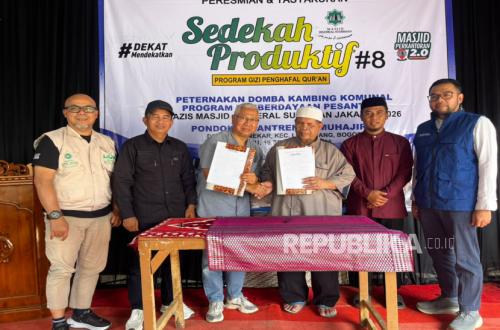
Masjid Jenderal Sudirman (MJS), also known as the 2.0 office mosque, has reaffirmed its commitment to philanthropic programmes that move beyond immediate aid to foster economic independence and sustainability. This commitment was demonstrated through the inauguration of the 8th Batch of the Productive Alms Programme, held at Al Muhajirin Islamic Boarding School, Leuwiliang, Bogor Regency, on Saturday (19/09/2026).
Productive Alms is an economic empowerment programme based on livestock farming, designed to align with the potential, experience, and expertise of the recipient boarding schools. Entering its eighth batch, the programme has now reached eight beneficiaries. Through this productive approach, the assistance provided does not stop at the distribution of assets but is directed towards developing sustainable livelihoods.
In its implementation, beneficiaries receive support in the form of livestock pens and animals, alongside workshops and training in livestock business management. This approach is intended to increase the capacity of beneficiaries to manage their enterprises, ensuring that the provided assets can continue to grow and provide long-term economic benefits.
The implementation of the 8th Batch of Productive Alms also received support from UPZDK Permata Bank Syariah, enabling the smooth operation of this empowerment programme. This support is a vital part of the collaboration between philanthropic institutions, Islamic financial institutions, and Islamic boarding schools in presenting an empowerment model based on local potential.
Attending the inauguration ceremony was Yurandiza Kesuma, Vice Chairman of UPZDK Permata Bank Syariah. He expressed his appreciation for the empowerment approach applied through the Productive Alms Programme, particularly because the programme is designed with the long-term sustainability of the beneficiaries in mind.
“What we see here is a prepared sustainable scheme. This scheme demonstrates an Islamic economic model of mutual assistance, cooperation, sustainability, and synergy,” said Yurandiza Kesuma.
According to him, the collaboration established in the programme reflects the importance of synergy between actors in building an Islamic economic ecosystem. Permata Bank Syariah plays its role through the support of Islamic financial institutions, Masjid Jenderal Sudirman performs the functions of philanthropy and empowerment, while the boarding schools serve as educational institutions and beneficiaries developing productive economic potential.
This collaboration demonstrates that Islamic philanthropy can be directed not only to meet short-term needs but also to build the economic capacity of beneficiaries. Through the provision of productive assets accompanied by capacity building, alms are expected to evolve into an empowerment instrument that creates lasting benefits.
For Masjid Jenderal Sudirman, the Productive Alms Programme is part of an effort to develop productive, collaborative, and sustainable philanthropic practices. The mosque serves not only as a centre for collecting and distributing social funds but also as a space that brings various parties together to transform philanthropic resources into broader benefits.
Entering its eighth batch, the programme is expected to continue growing and reaching more beneficiaries with empowerment models tailored to their respective potentials. By bringing together philanthropic funds, support from Islamic financial institutions, the institutional capacity of boarding schools, and business mentoring and strengthening, Productive Alms serves as an endeavour to present philanthropy that does not merely give, but empowers.
Through collaboration within this scheme, Masjid Jenderal Sudirman and its partners continue to drive the realisation of a mutually strengthening Islamic economic ecosystem, where philanthropy serves as the resource, collaboration acts as the driver, and the independence of beneficiaries remains the ultimate goal.
Source: jawawa.id (https://jawawa.id/newsitem/promoting-economic-independence-for-islamic-boarding-schools-through-sustainable-livestock-farming-1790783634)
Originally published by Republika (https://khazanah.republika.co.id/berita/tm6ltb483/dorong-kemandirian-ekonomi-pesantren-dengan-peternakan-berkelanjutan), translated from Indonesian