
Promoting Digital Sovereignty, Telkom Strengthens Pentahelix Collaboration
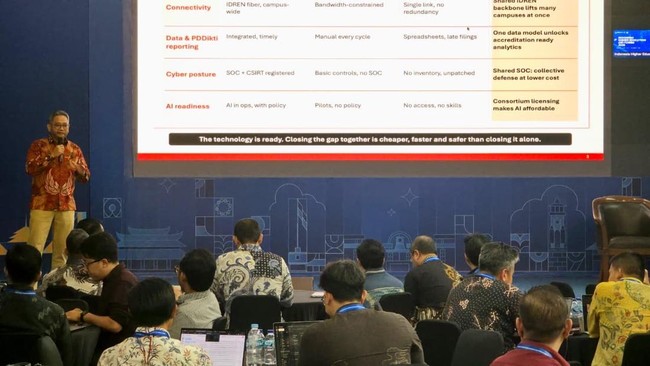
PT Telkom Indonesia (Persero) Tbk (Telkom) is playing a key role in the Indonesia Higher Education CIO Forum 2026, themed “Empowering PDDikti through IDREN Collaboration: Advancing IT Governance, Cyber Resilience, and Operational Excellence”. The event took place at the West Hall of the Bandung Institute of Technology from 31 August to 1 September 2026.
The forum brought together Rectors from leading universities, Chief Information Officers (CIOs), and Heads of IT from various institutions within the Indonesia Research and Education Network (IDREN), alongside international university leaders. Organised by the Centre for Data and Information Technology (PUSDATIN) of the Ministry of Higher Education, Science, and Technology, alongside IDREN, the forum served as a strategic momentum to strengthen the integration and quality of reporting for the Higher Education Database (PDDikti).
Key discussions focused on information technology governance, research and education network connectivity, cyber resilience, and the safe and responsible use of artificial intelligence (AI).
Telkom’s Director of Strategic Business Development & Portfolio, Seno Soemadji, stated that the digital transformation of higher education is now an urgent necessity, requiring ecosystem collaboration to face the era of digital computing and quantum computing, while building readiness for technological disruption.
“The technology is already available. The digital gap can be addressed collectively, making it much cheaper, faster, and more secure than acting individually. No single institution can build this alone. This is where pentahelix collaboration becomes key,” Seno said in a written statement on Thursday (3/9/2026).
He noted that the digital readiness of universities now influences accreditation, graduate employability, and research reputation. However, disparities between campuses remain; while some are advanced with IDREN connectivity and integrated systems, many others remain vulnerable due to reliance on single connections without backups and non-standardised reporting.
Through IDREN as a shared foundation, a single national data model, and SOC and CSIRT, these gaps can be closed collectively and more efficiently. The forum also highlighted the urgency of preparing for the quantum era. The “harvest now, decrypt later” threat—where unauthorised parties collect encrypted data today to decrypt it once quantum computers are available—is seen as a danger to student identities, research intellectual property, and the broader national education landscape.
Furthermore, Seno emphasised that the first step is not building quantum laboratories, but rather conducting a cryptographic inventory and preparing a comprehensive Post-Quantum Cryptography (PQC) migration plan before 2030. Telkom is preparing a quantum-safe network architecture that integrates PQC, Quantum Key Distribution (QKD), and Zero-Trust Architecture across access networks, core networks, and data centres. Telkom is also actively involved in the PQC migration task force led by the National Cyber and Crypto Agency (BSSN).
This pentahelix collaboration is directed towards supporting the national Asta Cita agenda and the 2025-2029 National Medium-Term Development Plan (RPJMN) towards Indonesia Emas 2045. To achieve this, all pentahelix actors—government, universities, industry, community, and media—must work together to establish three foundations: governance, digital backbone, and digital talent.
As a concrete commitment, Telkom has positioned itself in three primary roles. First, as the backbone of national connectivity and digital infrastructure, Telkom, through InfraNexia, provides 112,000 kilometres of fibre optic networks, including 26,000 kilometres of domestic Submarine Cable Communication Systems (SKKL) to be managed by InfraNexia. This role is further strengthened by the presence of AI-ready data centres, the NeutraDC cloud, a national LLM and AI platform, and a national SOC.
Second, Telkom orchestrates campus innovation through joint labs, testbeds, and pathways for commercialising research for the market. Third, Telkom provides access to cutting-edge technology through global strategic partnerships, consumption-based investment schemes (OPEX), and research funding exploration.
This commitment is evidenced by several implementations, including the provision of AI products for various universities, the pre-launch of a sovereignty platform combining AI, cloud computing, and cybersecurity, and the Digistar Class programme to accelerate digital transformation in higher education by preparing Indonesian digital talent.
Through its participation in the Indonesia Higher Education CIO Forum 2026, Telkom invites universities to take three collaborative steps: aligning governance by appointing institutional leads, driving innovation through joint labs with Telkom, and strengthening digital asset security through cryptographic inventory.
Ultimately, this collaboration is part of Telkom’s efforts to strengthen the digital foundation of higher education while driving the realisation of a digitally sovereign, secure, and intelligent Indonesia.