
Prolonged Dry Season Threatens Harvests, Crop Insurance Must Be Strengthened
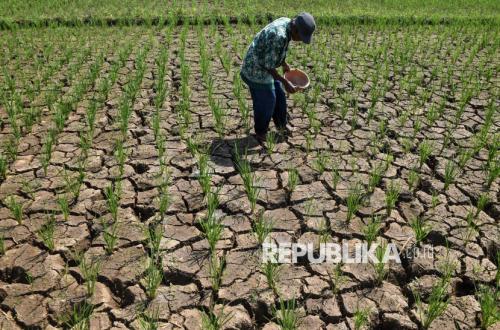
Senior economist from Indef, Bustanul Arifin, believes that the Rice Crop Insurance Programme (AUTP) plays a vital role in protecting farmers from the risk of crop failure. However, low levels of understanding among farmers regarding the benefits of insurance remain a major challenge in increasing participation in the programme.
Bustanul stated that while the AUTP concept is excellent, it has not been fully understood by farmers. According to him, insurance has not yet become a common practice in society, resulting in relatively low uptake of the AUTP.
“Imagine, people do not even insure their own lives; it is somewhat difficult to expect that their farming businesses will be insured,” Bustanul said in a written statement in Jakarta on Friday.
Bustanul noted that he has engaged in direct dialogue with farmers regarding the AUTP and the role of PT Jasindo as the programme’s implementer. He suggested that Indonesia could learn from countries like the United States, where farmers are willing to pay premiums because the protection benefits are clearly proven.
“If farmers experience crop failure during the dry season, the insurance company bears the losses. While there are certain technical requirements, farmers would certainly include this in their business planning for the following year,” he said.
To increase the effectiveness of the AUTerm, Bustanul proposed that the government strengthen the capacity of field agricultural extension officers through tiered training. He noted that these officers also need clear performance indicators to ensure that education for farmers is optimised.
Furthermore, Bustanul encouraged the involvement of universities, particularly agricultural faculties, in providing field assistance for the programme. Synergy between extension officers, lecturers, and researchers is seen as a way to accelerate the dissemination of knowledge regarding farming risk management.
“Involve universities across Indonesia, especially those with agricultural faculties. This will foster better interaction between extension officers and lecturers and researchers in the field,” Bustanul emphasised.
He also cautioned that the implementation of the AUTP should not be uniform across all regions. According to Bustanul, every region possesses a different agro-ecosystem character, meaning cultivation approaches and rice varieties must be adapted to local conditions.
“The point is, everything must be carried out systematically, structurally, and in accordance with respective duties and responsibilities. AUTP is not merely a matter of programmes and projects, but a behavioural change to manage production and food value chain risks,” he said.
Amidst the threat of a dry season expected to last until October or even November 2026, several local governments have begun encouraging farmers to join the AUTP as an effort to mitigate the impact of harvest failures due to drought.
Previously, PT Jasindo, which operates within the Danantara ecosystem through IFG Holding, reaffirmed its commitment to strengthening the implementation of the AUTP to support food self-sufficiency targets. The company is also conducting education for farmers regarding adaptive planting patterns and risk management in the face of climate change.
The AUTP is a protection scheme for farmers against the risks of flooding, drought, as well as pest and disease attacks. The programme is intended for farmers who are members of farmer groups with a maximum land area of two hectares per planting season, in accordance with the mandate of Law Number 19 of 2013 concerning the Protection and Empowerment of Farmers.