
Profit-Taking Activity Leads to Slight Correction in IHSG Morning Session to 7,095
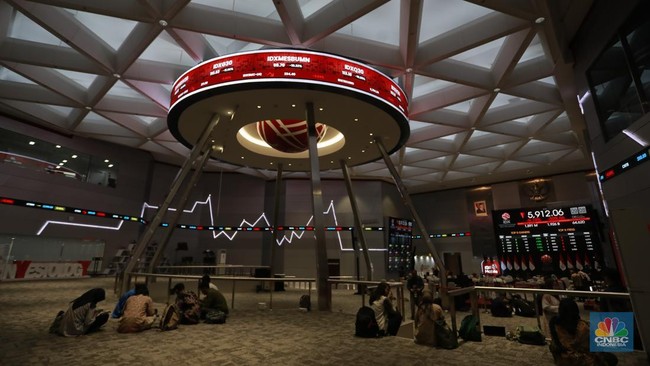
Jakarta, CNBC Indonesia - The Composite Stock Price Index (IHSG) fluctuated between positive and negative territory during trading today, Tuesday (28 April 2026). The IHSG opened with a gain of up to 0.5%. However, during the intraday morning session, the IHSG reversed course and dropped sharply by 1.04% before trimming the correction. At the end of the morning session, the IHSG weakened by 0.15% or 10.94 points to 7,095.58. A total of 312 stocks rose, 340 fell, and 161 remained unchanged. Today’s trading value reached Rp 8.59 trillion, involving 17.17 billion shares in 1.27 million transactions. The market capitalisation corrected to Rp 12,709 trillion. Shares of banking issuers were still actively traded, with transactions in Bank Mandiri (BMRI) and Bank Central Asia (BBCA) exceeding Rp 1 trillion, and Bank Rakyat Indonesia (BBRI) nearly reaching Rp 830 billion. The IHSG declined in line with profit-taking in Amman Mineral (AMMN) shares. The mining issuer’s shares, owned by Agoes Projosasmito and Salim, fell 3.70% to 5,200. For context, AMMN surged 8% to 5,400 in yesterday’s trading. AMMN had previously acted as a buffer preventing the IHSG from collapsing too deeply. This morning, AMMN shares became the main drag on the IHSG with a weighting of -4.56 points. Besides AMMN, nearly all gold mining issuers corrected during today’s trading. Regional markets were mostly correcting as well. Japan’s Nikkei index fell 0.5%, HSI -0.26%, ASX 200 -0.51%. In contrast, Korea’s Kospi rose 0.45%. Entering Tuesday’s trading (28 April 2026), domestic market participants will monitor several important sentiments from home and abroad. Externally, the main focus is on the Bank of Japan’s (BOJ) interest rate decision, which will be announced today. Meanwhile, domestically, market attention will turn to developments in Indonesia’s capital market, from the outcome of the Financial Services Authority (OJK) meeting with MSCI, to the cabinet reshuffle under President Prabowo Subianto, and statements from Finance Minister Purbaya Yudhi Sadewa on IHSG prospects and the government’s economic growth target. Meanwhile, Finance Minister Purbaya Yudhi Sadewa provided an outlook on Indonesia’s economy and stock market. This statement was delivered at the inauguration of the Planned and Periodic Investment Programme (PINTAR) for Mutual Funds and the opening of Mutual Funds Week 2026 at the Indonesia Stock Exchange (BEI) building, on Monday (27 April 2026). Purbaya believes the Composite Stock Price Index (IHSG) has the potential to break through the 28,000 level by 2029-2030. According to him, this projection is not impossible if Indonesia’s economic expansion continues until the end of this decade. “Let’s say it’s now 7,000. Our expansion will continue until 2029-2030. That’s what I say, it could be 4-5 times. It could reach 28,000 at worst. They say Purbaya is crazy,” he said. Purbaya views this projection as not excessive. He compared it to a previous period when the IHSG was at around 400 in 2002 and then rose to about 2,500 in 2009. In that period, the IHSG surged several times over. According to Purbaya, the opportunity for a significant IHSG rise remains open if Indonesia’s economic growth can be maintained at a high level. He had previously believed the IHSG could reach 10,000 by the end of this year, despite ongoing global uncertainties shadowing the financial markets. This optimism is also linked to the growing participation of young investors in the capital market. Purbaya noted that investors from Generation Z have reached around 57%, making them one of the long-term pillars of capital market growth. On the same occasion, Purbaya also emphasised that the government is serious about pursuing the 8% economic growth target by 2029. According to him, the government has begun major reforms, including at the Directorate General of Taxes (DJP) and the Directorate General of Customs and Excise. “What we’re implementing is no joke. Real reforms that we’re fixing, real reforms. In the first three months, my tax growth was 20%, and it will be more later. Customs and excise also have reforms, and the rest we’ll reform quickly,” said Purbaya. On the development spending side, Purbaya mentioned that President Prabowo Subianto has given significant room to Coordinating Minister for Economic Affairs Airlangga Hartarto to accelerate development programmes, one of which is through the Task Force for Accelerating Strategic Government Programmes (Satgas P2SP). With the acceleration of these programmes, Purbaya believes 6% economic growth is already within the government’s reach. This figure is cited as the initial capital to pursue higher growth targets.