
Professor Muradi Warns of Potential Criminalisation to Suppress Political Opponents
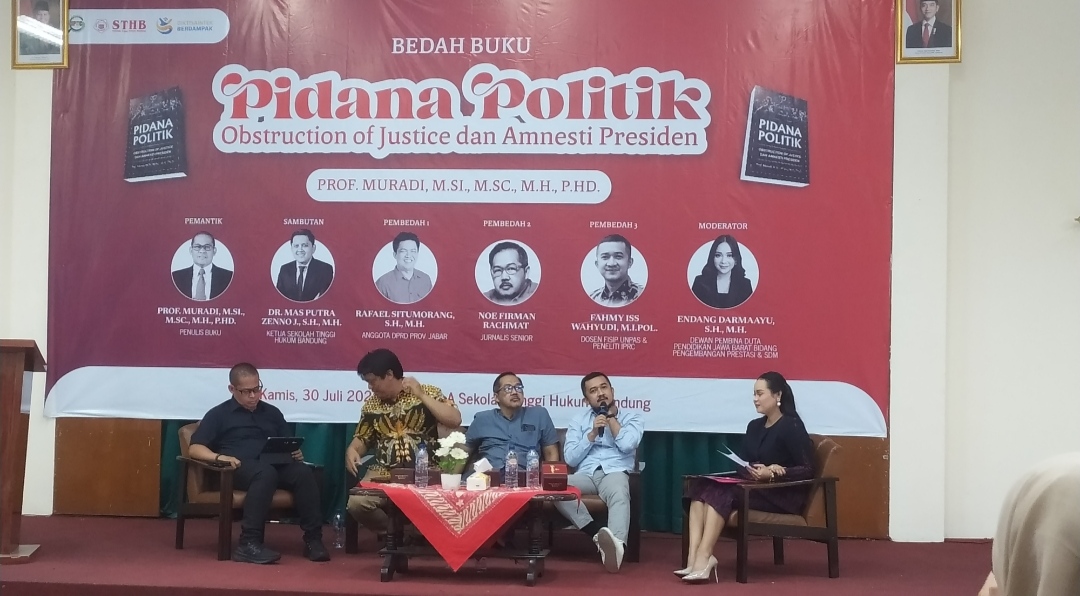
Professor Muradi, a Professor of Political Science and Security at Padjadjaran University Bandung, has alerted the public and the academic community to the potential and existing practices of criminalisation used to ensnare politicians. In his book, ‘Political Crime, Obstruction of Justice, and Presidential Amnesty’, he dissects how legal instruments are often used technically to weaken the mental and psychological state of those holding opposing political views.
He explained that the link between politics and law is incredibly strong; ideally, good governance should be supported by robust law enforcement and compliance. However, Muradi noted that in practice, this connection often shifts into an instrument for bringing down political opponents. “Political crime is essentially synonymous with political criminalisation—the act of ensnaring political rivals. The distinction lies in how law enforcement agencies use specific articles to target those in different political positions,” he stated during a book discussion in Bandung.
He added that political crime is not limited to cases directly intersecting with power, such as abuse of authority or corruption, but also targets other cases involving political elites. One component of this is ‘obstruction of justice’, which often targets not only the primary suspects but extends to lawyers and related parties. Technically, the legal process in political crimes is often prolonged to drain the energy and break the psychology of the targets. Muradi noted that the public often fails to recognise that criminalisation involves these technical, prolonged legal processes.
His book highlights the legal pressures faced by PDI Perjuangan Secretary-General, Hasto Kristiyanto, as a specific case study. Muradi argues that while the underlying issues from the Joko Widodo era were thought to be resolved, the legal pursuit continues into the Prabowo Subianto era through the use of ‘peripheral articles’, including obstruction of justice charges.
Furthermore, Muradi highlighted that the Corruption Eradication Commission (KPK) is within political reach. Despite its mandate for independence, he argues the KPK has transformed into an institution that executes political criminalisation agendas. He urged universities and academics to bridge the gap between political and legal perspectives and advised political elites within the government and bureaucracy to remain cautious to minimise loopholes that law enforcement could exploit.