
Professor: El Nino phenomenon drives wild animals to expand roaming ranges
Interactions between animals can also increase around water sources, potentially heightening competition for limited resources.
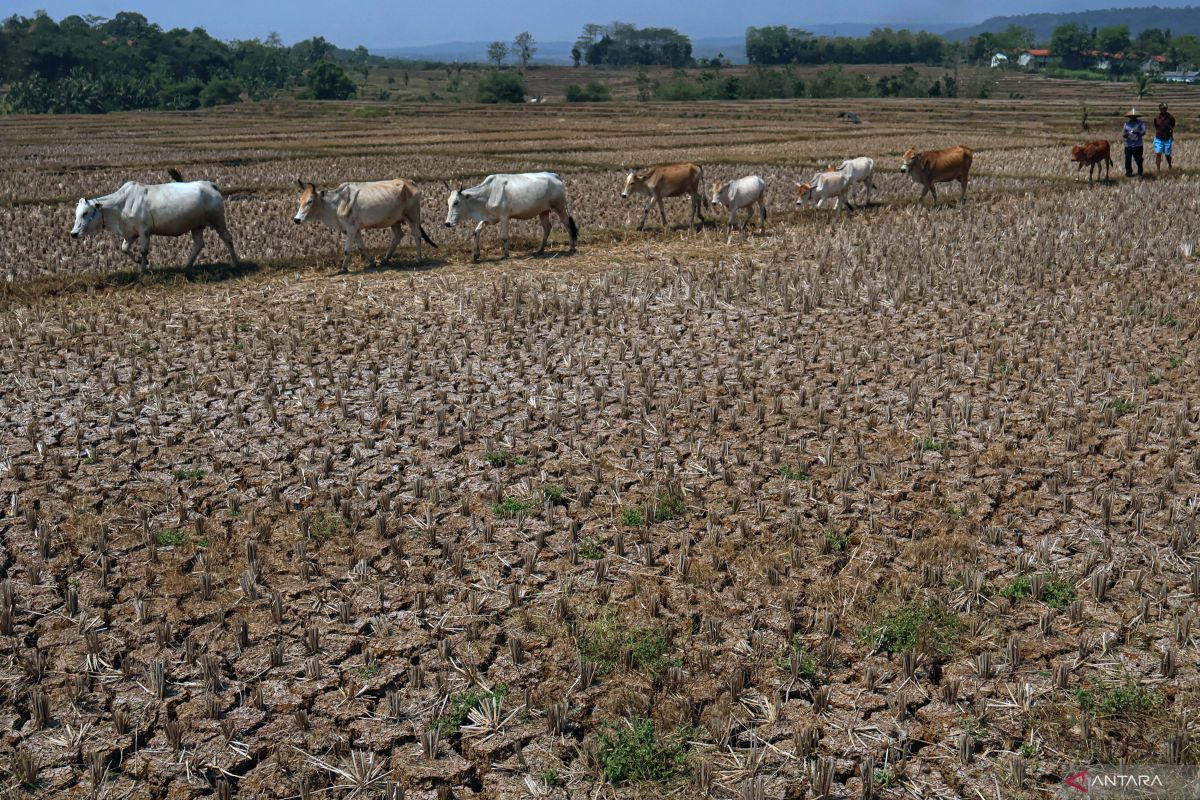
Mataram (ANTARA) - Professor of Animal Ecology at the University of Mataram (Unram), I Wayan Suana, has said that the prolonged dry season accompanying the El Nino phenomenon is driving wild animals to expand their roaming ranges in order to continue finding water and food.
“In extreme conditions, drought pressure can cause the home range to widen, because resources normally available in one location become increasingly scarce,” he said when contacted in Mataram, West Nusa Tenggara, on Tuesday.
Suana said the drought caused by the long dry season forces animals to adjust their behaviour to survive, including changing activity times and increasing movement in search of water sources, food, and shadier areas.
These conditions also affect animals’ feeding patterns, particularly herbivorous groups that feed on grass, leaves, fruit, and seeds. The drought causes undergrowth to dry out and the production of young leaves and fruit to decline, so animals must seek alternative food sources.
“Interactions between animals can also increase around the remaining water sources, which has the potential to intensify competition for limited resources,” said Suana.
According to Suana, the prolonged dry season also affects animal reproduction. When food availability declines and the mother’s physical condition weakens, animals tend to postpone breeding because energy is prioritised for survival.
Groups considered vulnerable to drought include forest-dwelling animals dependent on particular tree species, fruit and seed eaters, amphibians, small animals with limited roaming ranges, and animals living in fragmented forest areas.
Suana reminded that the availability of natural water sources in habitats must be maintained to reduce pressure on animals during the dry season.
If necessary, artificial water sources can be provided on a limited and managed basis so as not to cause excessively high concentrations of animals.
Beyond water sources, large trees, food trees, and trees with nesting holes must be preserved to ensure animals continue to have places for shelter, foraging, and breeding.
Efforts to prevent forest and land fires are also an important step, because vegetation that dries out during the dry season increases the risk of fires that can destroy animal habitat in a short time.
“The point is, do not merely rescue the animals once the dry season has already arrived. We must strengthen ecosystem resilience before the drought comes,” Suana explained.
“Healthy forests with diverse vegetation, sufficient food trees, water sources, and habitat connectivity will give animals a greater chance to adapt to El Nino and climate change,” he concluded.
Source: jawawa.id (https://jawawa.id/newsitem/professor-el-nino-phenomenon-drives-wild-animals-to-expand-roaming-ranges-1789484143)
Originally published by Antara (Indonesian) (https://www.antaranews.com/berita/5742571/guru-besar-fenomena-el-nino-dorong-satwa-liar-perluas-wilayah-jelajah), translated from Indonesian