
Prof. Aswanto: Corruption Hijacks Poverty Alleviation Budgets
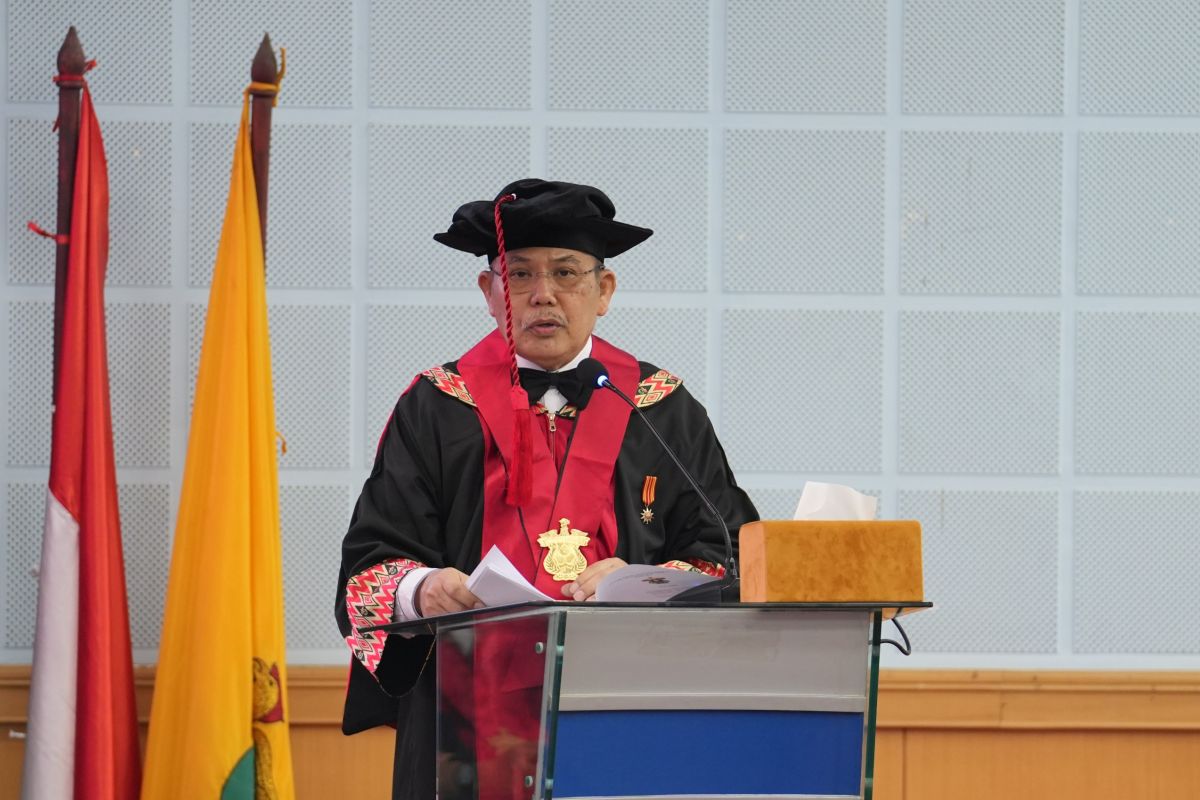
In the economic sector, corruption practices can distort public policy, increase economic costs, and hijack budgets that should be used to alleviate poverty.
Makassar (ANTARA) - Professor Aswanto, a Professor of Criminal Law and Human Rights at Hasanuddin University (Unhas), stated that corruption can hijack budgets intended for poverty alleviation, meaning the issue must also be viewed from a human rights perspective.
Speaking in Makassar on Monday, Prof. Aswante noted that corruption can no longer be viewed merely as the theft of state funds, as its impact extends to development, democracy, and the lives of the poor.
“In the economic sector, corruption practices can distort public policy, increase economic costs, and hijack budgets that should be used to alleviate poverty,” he said.
These remarks were made by Aswanto during a speech for the induction of members into the Board of Professors at Hasanuddin University.
According to him, corruption can be regarded as a violation of human rights due to its destructive power over various aspects of community life.
He added that practices such as gratification and various forms of fraud could become normalised if law enforcement does not function effectively.
Based on the 2025 Corruption Perceptions Index (CPI) released by Transparency International in February 2026, Indonesia obtained a score of 34 on a scale of 0-100, ranking 109th out of 182 countries.
This achievement represents a decline compared to the 2024 CPI, when Indonesia scored 37 and ranked 99th out of 180 countries. Transparency International uses a scale where 0 indicates a perception of very high public sector corruption, while 100 indicates a very clean sector.
For the Asia-Pacific region, Indonesia’s score of 34 also sits below the regional average of 45. Transparency International noted that most countries in the region remain below the global average of 42.
He described criminal law as having the character of a double-edged sword.
On one hand, criminal law provides protection to the public and can create a deterrent effect against perpetrators of crime.
On the other hand, the significant repressive powers held by the state mean that the application of criminal law must be placed within a human rights protection framework.
According to him, such an approach is necessary to ensure that the state’s authority in law enforcement does not transform into an instrument of oppression and arbitrariness.