
Producers Without Bargaining Power
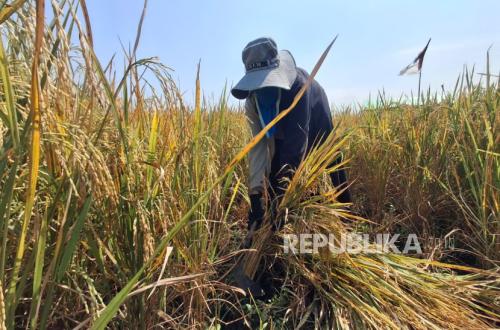
A bottled water factory or a shoe manufacturer can freely determine the price label on its products. They calculate raw material costs, break down operational expenses, add a profit margin, then release the product to the market. Farmers, however, are different. They are also producers: they till the soil, prepare seeds, plant, tend crops and harvest, yet they are powerless to determine the selling price of their produce. Mighty in the realm of production, but weak in the sphere of commerce. The price is not born from the calculation of the farmer’s hard work, but is instead determined by a single buyer or middleman. An irony that continues to repeat itself to this day.
The bargaining position of Indonesian farmers is so weak in the face of the market because: First, the majority of our farmers operate individually on a very small scale. The 2023 Agricultural Census revealed that the number of smallholder farmers, or those controlling less than 0.5 hectares of land, reached 16.89 million, or more than 60 percent of all farmers in Indonesia. Narrow landholdings and fragmented production mean farmers have no bargaining power when dealing with large traders.
Second, Farmer Groups (Poktan) and Combined Farmer Groups (Gapoktan) have so far been unable to serve as effective marketing vehicles. Various agricultural economics studies show that more than 80 percent of Poktan and Gapoktan in Indonesia merely function administratively as channels for distributing government assistance such as subsidised fertiliser allocations and agricultural machinery aid, without any effort to transform into collective and aggressive marketing forces.
Third, limited access to formal banking or responsive microcredit schemes forces farmers to turn to middlemen to borrow working capital. These loans become a psychological shackle that indirectly dictates that farmers sell their entire harvest to the lender at a unilaterally determined price.
Fourth, the absence of agricultural corporations capable of consolidating farmers on the downstream side. Without a corporate entity acting as a marketing conduit and creator of added value, farmers’ harvests are directly sucked into the raw market, which is vulnerable to price manipulation.
Looking at World Agricultural Corporations
The absence of connecting corporations in Indonesia is the opposite of the agricultural landscape in developed countries. There, farmers are not left to fight alone in the free market because they are fortified by corporations that control the value chain from upstream to downstream.
For example, CBH Group (Co-operative Bulk Handling) in Australia. CBH is a giant agricultural corporation fully owned by around 3,700 wheat farming families in Western Australia. The corporation professionally manages the supply chain from receiving, storage, processing, logistics transport, to export marketing abroad. As a result, dividends and added value from the supply chain flow back into farmers’ pockets. Each member also receives guarantees or insurance if they experience crop failure due to natural disasters or pest and disease attacks, and the annual meeting is packaged as a gathering to exchange information on the latest applicable agricultural technology. Other examples can be seen in CHS Inc. in the United States or Zen-Noh in Japan. These global-scale corporations are rooted in the aggregation of farmer consortiums managed in a modern way, financially robust, and highly competitive in the global market.
Seeing the success in developed countries, the orientation of agricultural development in Indonesia should not only focus on self-sufficiency that emphasises increasing productivity alone, but should intensively initiate the formation of agricultural corporations. In several places, agricultural corporation initiatives have been proposed by various institutions but often do not run as they should. The main cause is imprecision in structural execution that begins with role disruption: farmer group administrators are suddenly required to become business managers, marketing directors, and even financial experts. This double burden creates a clash of competencies where the focus on farming is disrupted, while the desired market segment drifts further away.
The Ideal Agricultural Corporation
This systemic deadlock can only be unravelled by establishing a firm demarcation of roles. Traditional farming institutions (on-farm) and modern business entities (off-farm) must be separated, yet strongly bound through a capital ownership structure. Poktan or Gapoktan institutions are returned to their primary purpose in the on-farm area. Farmers focus fully on applying precision cultivation techniques, water use efficiency, soil health, and product quality standardisation. Farmers are freed from the burden of thinking about where to sell or what the market price will be tomorrow morning, so that production capacity can be optimally boosted.
Outside the Poktan structure, an independent business entity is formed, whether a limited liability company (PT), CV, or cooperative, whose board of directors and management are filled by non-farmer professionals (accountants, operational managers, and marketing experts). This corporation manages post-harvest facilities (such as modern rice milling plants, drying machines and packaging houses), builds brands, handles product certification, and negotiates directly with retail markets, manufacturing industries, and government institutions.
The crucial point of this corporation lies in the position of farmers as majority shareholders, not merely product suppliers. The land area and potential production capacity owned by farmers are appraised and converted into share participation units in the corporation. This share participation does not transfer the farmer’s land ownership certificate, but the productive use rights and supply commitment are integrated into the corporate ecosystem.
Next, to break the shackles of capital loans