
Processor Makers Step Up Development of AI-Powered Computers
BANDUNG — Computer processor makers are under pressure to deliver devices capable of running artificial intelligence (AI) applications without compromising performance for other tasks. Competition is no longer limited to CPU speed and graphics capabilities; it also centres on on-device AI processing capacity.
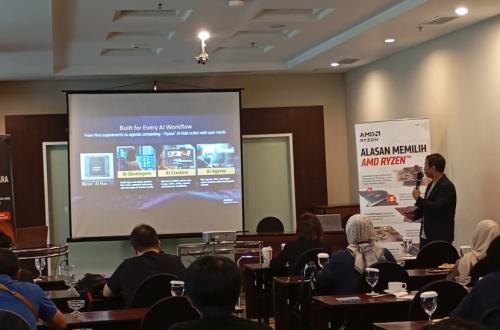
AMD is responding to this competition by introducing its Ryzen AI and Ryzen AI Max Series in Bandung on Wednesday (4 November 2026). The products target laptop and personal computer users who need devices for productivity, gaming and content creation.
AMD Indonesia Consumer Business Development Manager Armawati Cen said that developing personal computers required more than simply increasing processor speed. Devices also needed to support users’ activities while using power efficiently.
“Users need devices that are not only fast, but also able to help them work more productively, create, learn and enjoy entertainment more fully,” Armawati said.
The Ryzen AI range combines a central processing unit (CPU), graphics processing unit (GPU) and neural processing unit (NPU). This combination enables AI tasks to be processed on the device itself or through cloud computing.
Local AI processing allows certain tasks to be carried out without sending data to external servers. Assigning workloads to the NPU also leaves the CPU and GPU available to handle other computing tasks.
AMD also introduced the Ryzen AI 400 Series, along with the Ryzen AI Max+ 392 and Ryzen AI Max+ 388. The Ryzen AI 400 Series uses Zen 5 architecture with a second-generation AMD XDNA 2-based NPU. Its NPU delivers AI processing performance of up to 60 trillion operations per second (TOPS), exceeding the requirements for Copilot+ PCs.
In Indonesia, Ryzen AI processors are used in several laptop ranges from Asus, Acer, Lenovo, Gigabyte, HP and MSI. Devices based on the Ryzen AI 400 Series are available from Asus, Lenovo and HP.
Integrating AI processing into processors is creating a new competitive front for the computer industry. Technological capability, power efficiency, software compatibility and price will determine how the market responds to AI-powered computers.