
Processed Matoa Opens New Income Source for Hundreds of Prafi Residents
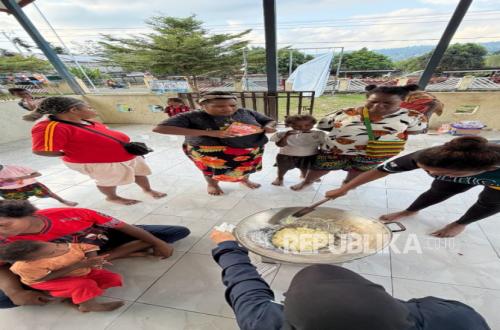
MANOKWARI – Matoa fruit, which previously was often left to rot, has now become a new source of income for hundreds of residents in the Prafi Transmigration Area of Manokwari, West Papua. Through mentoring by the Patriot Expedition Team (TEP) of Airlangga University, residents have been equipped with skills to process matoa into commercially valuable products, whilst also being encouraged to enter supermarket chains, digital trade and export markets.
The programme has reached 17 indigenous Papuan (OAP) mothers through direct training, 104 local residents through learning modules, and more than 200 transmigrants originally from Java. With these skills, residents can start home-based businesses and earn additional income rather than depending solely on selling raw garden produce.
Until now, the economic potential of matoa in Prafi has not been optimally utilised. The trees were more often felled for their timber as building material, whilst the fruit was largely left to waste.
“Matoa fruit has actually been developed in various parts of Indonesia. However, we want the development of this commodity, which is a source of pride for Papua, to start from Papua itself through the Patriot Expedition Team in Manokwari,” said the head of TEP UNAIR, Zamal Nasution, on Wednesday (2/9/2026).
During the training, the OAP mothers and Javanese transmigrants learned to process matoa into a variety of ready-to-sell products. These include original matoa dodol and a pineapple blend, jam, red sambal, green sambal and bajak sambal, fruit sticks, original and herbal matoa tea, ice cream made with local coconut, and matoa nut snacks.
Not stopping at production training, TEP UNAIR has also prepared market access through supermarkets, e-commerce platforms and reseller networks. The processed products are subsequently being directed towards the national market through a network of ten state universities, and towards the international market through the ASEAN University Network.
“The next target is to break into the national market through cooperation with ten state universities and open up international market access through the ASEAN University Network,” said Zamal.
For the community, the programme provides concrete benefits in the form of production skills, opportunities to open home businesses, expanded market access and increased matoa selling prices. Fruit that was once worthless can now be processed into products with a longer shelf life and a higher selling price.
Eta, a resident of Dindey Village, said the skills have opened opportunities for local mothers and the younger generation to develop their own businesses.
“We are grateful to the mentors who came from far away to teach us in Warmare District how to make ice cream, sambal and dodol. With that, the mothers and young women can better understand how to process them so that our businesses can grow,” said Eta on Thursday (3/9/2026).
The matoa processed products developed by TEP UNAIR were introduced at a West Papua-wide MSME exhibition on 10 August 2026. The ventures have also obtained a Business Identification Number (NIB) presented by the Governor of West Papua. This legal status is an important asset for expanding marketing, as well as making processed matoa an affordable signature souvenir of West Papua.
The development of matoa products is a form of downstream processing at the community level. Residents are no longer merely producers of raw materials, but are involved in processing, packaging, marketing and business development, thereby obtaining a larger share of the local commodity value chain.
This step aligns with President Prabowo Subianto’s Asta Cita in promoting equitable development and improved community welfare. The programme also reflects a new paradigm of transmigration that is no longer oriented towards population relocation, but towards creating economic growth centres that deliver real benefits to local communities and transmigrants.
Minister of Transmigration M. Iftitah Sulaiman Suryanagara affirmed that the development of transmigration areas must connect local potential with the entire economic chain, from production to global marketing.
“We must not stop at planting and exporting raw commodities. We must build the entire economic ecosystem in Indonesia, from research and seed cultivation through to farming, processing, logistics, downstream products and global marketing,” said Minister Iftitah recently.