
Prison Audits Must Not Stop at Luxury Cells!
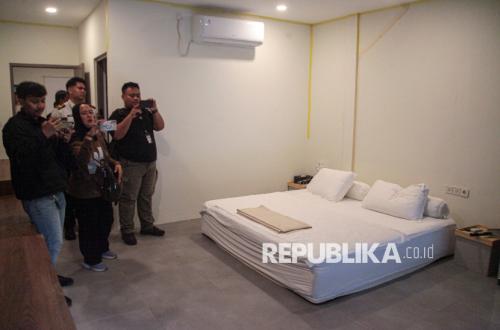
Findings by the Indonesian Ombudsman at the Class IIA Cibinong Prison in Bogor Regency should not be treated merely as an issue of luxury facilities for inmates. More importantly, this case serves as an alarm regarding how the systems of supervision, internal control, and prison governance are functioning.
With the discovery of living quarters resembling apartments—equipped with sofas, televisions, refrigerators, living rooms, fitness facilities, and other unusual amenities for inmate housing—the question should not stop at who occupies them. A more substantial question is how such facilities came to exist, who knew about them, who authorised them, who funded them, and why the oversight mechanism failed to detect them earlier.
During a spot inspection on 23 September 2024, the Ombudsman team discovered several buildings described as a ‘cluster’ with facilities similar to houses or apartments. The team also found more than 10 buildings, luxury vehicles, gym facilities, a golf simulator under construction, and security loopholes deemed potential access points for unauthorised entry and exit.
The Ombudsman team also previously experienced resistance when attempting to enter residential blocks and faced obstacles when trying to communicate with an inmate encountered in the area.
Simultaneously, the West Java Directorate General of Corrections stated that these buildings need further investigation and that inspections are ongoing. Therefore, the status, function, legality, and identity of the facility users must be proven through an objective examination.
This is where the idea of conducting a prison audit becomes vital. An audit is not intended merely to find fault or identify who should be punished. An audit must be used to identify systemic weaknesses. What must be performed is a governance audit. If the issue is resolved only by removing or suspending officials while the procedures allowing special facilities to persist remain unchanged, the same case is likely to emerge elsewhere.
Legality and Facility Status
If the discovered buildings are official residences, assimilation houses, or part of a specific programme, this must be proven with clear documentation. What is the land status, the building status, when were they built, with what budget, what was the original purpose, who is authorised to use them, and has the usage ever changed? If they are indeed intended for assimilation activities, what is the procedure for inmates to occupy such buildings?
These questions are crucial because a building does not become legal simply because it was administratively referred to as an official residence or a specific facility. The legality of a building must go hand-in-hand with the legality of its usage. Even a legitimate building can become problematic if used for purposes other than its intended use.
Equality of Treatment
Inmates do possess rights that must be respected. Prison does not mean the removal of human dignity. However, respect for rights cannot be measured by the provision of extraordinary facilities outside of regulations. The principle of corrections actually requires rehabilitation that is humane, yet orderly, measurable, and based on rules.
Therefore, an audit must compare the facilities received by inmates. Are certain facilities provided based on objective criteria? Does every inmate meeting the criteria have the same opportunity? Or are these facilities accessible only to a specific group?
This is where the concept of ‘special treatment’ must be distinguished from ‘preferential treatment’. Special treatment can be justified if it has a legal basis and a legitimate purpose. Conversely, preferential treatment becomes problematic when granted based on social status, economic capability, connections, influence, or specific payments.
Resident Administration
An audit must be able to answer who occupies each building or special room, since when, based on whose decision, and in what capacity. All of this must have an administrative trail. There must be no occupants who are factually present in a facility without a clear basis for their placement.
Consequently, inspections need to cross-reference inmate data with placement data, registration, room transfers, activity permits, entry/exit logs, and other relevant documents. If discrepancies exist between administrative data and field conditions, these differences must become objects of further investigation.
Budget and Assets
This is a component that must not be overlooked. Luxury facilities cannot exist without resources. If there are buildings, renovations, furniture, televisions, refrigerators, fitness facilities, vehicles, or other means, the source of funding must be identified.
Does it come from the State Budget (APBN)? Was it through official procurement? Is it a government asset? Does it come from donations? Was it built or provided by a third party? Is there a contribution from inmates?
Therefore, the audit must trace the source of funds, procurement documents, contracts, work value, payees, and asset status. An asset audit is also essential to ensure that state assets are not being used for the personal interest of individuals or specific groups.
Transactions and Levies
It is premature to conclude from the outset that these facilities were definitely obtained through payment. However, such allegations cannot be ignored. Indeed, the audit must prove it.
Was money paid to obtain a specific room? Are there levies for certain facilities? Is there an intermediary involved? Are there transactions between inmates’ families and officers or other parties? Is there a pattern of payment linked to the provision of facilities?
If there are indications of transactions, the investigation must be expanded to include fund flows and relationships between parties.