
Primary School Students Learn to Recognise Emotions Through Wellbeing Kit
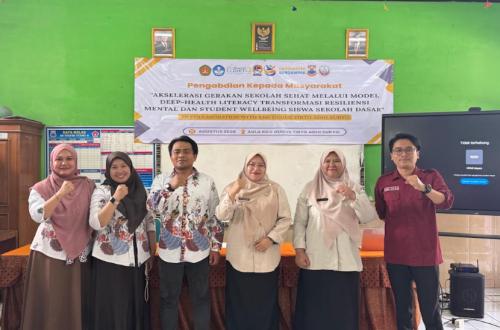
Primary school students in Cimahi City are receiving guidance to recognise and manage emotions through the Deep-Health Literacy: Strengthening Student Resilience and Wellbeing programme. Conducted by a research and community service team from Bhayangkara University of Jakarta Raya (Ubhara Jaya), the programme targets teachers and students across five primary schools within the KKG Gugus Tirto Adhi Suryo cluster.
The programme is led by Faridatul A’la, alongside Dian Anggraeni Maharbid and Ditta Febrieta, with assistance from students Rifqah Nur Alvisyahri and Michelle Miranda.
The activities commenced with a workshop on the 6C pedagogical approach—comprising Character, Citizenship, Collaboration, Communication, Creativity, and Critical Thinking—as well as emotion management training for teachers. The training employs an andragogical approach to equip educators with the skills to assist students in managing emotions within the classroom environment.
Faridatul A’la, the lead proposer of the Ubhara Jaya Community Service programme, stated that the ability to recognise emotions is a vital aspect of building child resilience. “Until now, handling emotional outbursts or conflicts between students in class has often been limited to verbal reprimands from teachers,” Faridatul noted in a press release on Friday (11/9/2026).
The programme utilises a ‘Wellbeing Kit’ consisting of the ‘Ning’ Emotion Cards and the ‘Among’ Reflection Journal. These tools are based on the principles of Cognitive Behavioural Therapy (CBT), with materials specifically adapted for children.
The ‘Ning’ Emotion Cards—an abbreviation for ‘Hening’ (Quiet) and ‘Bening’ (Clear)—use metaphorical visuals to help students identify emotions such as anxiety, sadness, and anger. The cards also include an ‘Emotional First Aid’ guide to help students respond to emotional states independently.
Meanwhile, the ‘Among’ Reflection Journal—standing for ‘Anak Mandiri, Optimis, dan Tangguh’ (Independent, Optimistic, and Resilient Child)—is used to help students periodically reflect on the experiences and challenges they encounter.
Kamaludin Gumilar, Chairman of KKG Gugus Tirto Adhi Suryo, stated that these tools can assist teachers in addressing students’ psychological well-being during learning activities. “The Deep-Health Literacy programme and the Wellbeing Kit have arrived at a very opportune time,” said Kamaludin.
Parida Daniati, Head of SDN Utama 6, mentioned that the training provides teachers with additional understanding regarding student guidance. The school also plans to integrate these tools into morning routines and advisory periods. “The ‘Among’ Journal provides a medium for students to engage in ‘meaning-making’ regarding the problems they face,” Parida emphasised.
Following the training, the programme entered the implementation and classroom observation phase. The Ubhara Jaya team, along with assisting students, conducted monitoring using a Fidelity Checklist to observe the programme’s application in teaching activities.
This community service programme received funding through the 2026 Community-Based Empowerment Scheme from the Directorate of Research, Technology, and Community Service (DRTPM). Its implementation was also facilitated by the Institute for Research, Community Service, and Publication (LPPMP) of Ubhara Jaya.