
Prices Rise by Up to Rp50,000: Indonesian Residents Begin to Skimp on Oil Changes
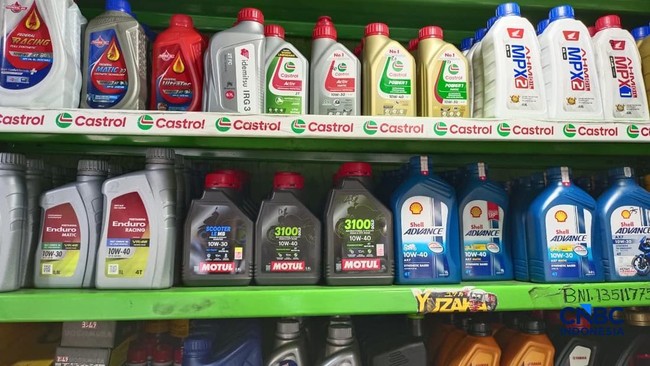
Jakarta, CNBC Indonesia - Ongoing tensions in the Middle East are raising concerns regarding a continuous surge in global oil prices, with Brent crude predicted to potentially soar to US$200 per barrel. If oil prices continue to climb, the ripple effects are unavoidable, including the impact on lubricant prices for motor vehicles. As reported by the Indonesian Central Statistics Agency (BPS), engine oil prices experienced an inflation rate of 3.85% in May 2026, becoming a contributor to price increases within the transport sector.
Price hikes are predicted to persist. Observations at several workshops in the Mampang area, South Jakarta, on Friday (5/6/2026), show that oil prices, which previously included installation services for around Rp60,000 to Rp65,000, have now reached Rp75,000. This price increase is causing distress for workshop owners and mechanics, who must also manage customer inquiries. According to workshop owners, customer visits have dropped by approximately 50%; where there were typically 10 customers, only about 5 have visited over the past three months.
Yusuf Rendy Manilet, an economist from the Centre of Reform on Economics (CORE) Indonesia, explained that the rise in oil prices is inseparable from the surge in production costs experienced by the lubricant industry. He noted that the pressure faced by producers stems not only from the rising cost of primary raw materials but also from the industry’s dependence on imported components, making production costs vulnerable to exchange rate fluctuations.
Yusuf explained that the near-term direction of oil prices will be heavily determined by external dynamics and domestic economic stability. “As long as these two factors do not show significant improvement, the possibility for further price increases remains open,” he told CNBC Indonesia on Friday (5/6/2026). “If tensions ease and oil prices drop, the pressure on oil prices will decrease. Conversely, if the conflict continues and energy prices remain high, oil prices are likely to continue adjusting before finally stabilising,” he added.
This is because lubricants are petroleum derivatives, meaning any increase in crude oil prices directly raises production costs. “At the same time, the supply of base oil, the primary raw material for lubricants, is also limited, causing its price to rise significantly,” he said. Global and domestic factors are forcing the lubricant industry to face cost pressures, which are ultimately passed on to consumer retail prices.
Nevertheless, Yusuf noted that the price increases in the market are not entirely uniform, as they depend on the product type and raw materials used. “However, it should be noted that the increase in oil prices in the market generally ranges from Rp10,000 to Rp20,000 per bottle, or about 15 to 20 per cent. If you encounter a price increase from Rp70,000 to Rp120,000, that is far above the market average. This likely occurs with premium synthetic oils or products with a higher dependency on imported raw materials,” said Yusuf.
Differences in product characteristics mean that the scale of price adjustments varies across brands and market segments. “Premium products that rely on imported raw materials tend to be more sensitive to global price volatility and the Rupiah exchange rate,” he noted.
Looking ahead, the public may need to prepare for potential further price hikes, as pressures from the global energy market have not yet fully subsided. “In the short term, oil prices still have the potential to rise. Industry players even estimate a further increase of around 15 to 20 per cent in the next one to two months,” said Yusuf. “The direction of movement depends on two main factors: the development of the conflict in the Middle East affecting global oil prices, and Bank Indonesia’s ability to maintain the stability of the Rupiah.”