
Prices Fall: Bahlil May Cut Indonesia’s Nickel Production in 2027
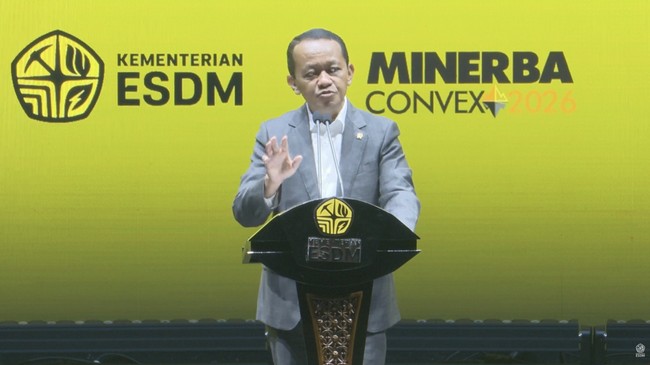
Jakarta, CNBC Indonesia – Coordinating Minister for Downstreaming and Energy Transition and Energy and Mineral Resources Minister Bahlil Lahadalia said the government may cut nickel ore production quotas under the 2027 Work Plan and Budget (RKAB).
The possibility is being considered in response to nickel prices falling again, to around US$15,400 per tonne.
Bahlil said a cut in nickel ore output would follow the example of restrictions on coal production, which had successfully driven up coal prices.
“For the 2027 RKAB, we will continue to take supply and demand into account. Coal is doing well now; ideally, prices are good and production is high. We have a framework for coal. Now it is nickel: prices are falling,” Bahlil said on the sidelines of the 2026 Minerba Convention & Exhibition (Convex) at JIExpo on Monday (2 November 2026).
“Global nickel consumption is 3.5 million tonnes. Our production capacity is now in oversupply by 700,000 to 800,000 tonnes. If we keep this up, prices will certainly fall further,” he said.
“We will therefore adjust production to total demand. That is how much we will produce. Indonesia supplies 65 per cent of the market, so why should prices be set by others?” he said.
Asked whether that meant he would cut nickel ore production in 2027, he replied: “It could be lower or higher. If prices are good, production can be higher. But if prices are low, why would we produce a lot?”
Possible smelter moratorium
Opening Convex 2026, Bahlil said the government was studying a possible moratorium, or restrictions on permits, for new refining and processing facilities (smelters) that produce only semi-finished goods.
The aim is to encourage domestic industry to make finished products, thereby ensuring Indonesia captures the full added value.
Bahlil said downstream projects in Indonesia, including nickel projects, are still dominated by semi-finished goods, processed to around 50 to 60 per cent of the way towards a finished product. He said he had instructed the Directorate General of Minerals and Coal to assess whether permits for smelters producing semi-finished goods should continue to be issued.
“To be honest, our downstream industries still mostly produce goods that are only halfway there – around 50 or 60 per cent processed – and this is now expanding rapidly. We may need to study whether we should still allow smelters that produce only semi-finished goods, or whether we should impose a moratorium,” he said at Convex 2026 in Jakarta on Monday (2 November 2026).
He said the main reason for considering a moratorium was to ensure that semi-finished materials were not all exported, but instead processed further into finished goods in Indonesia.
“For smelters making semi-finished products, what we need to promote is the final product. The aim is to stop all these semi-finished raw materials from being exported, so Indonesia can truly capture the full benefit. This is what we are studying,” he said.
Another concern is that an oversupply of commodities in global markets could put further pressure on prices. Global nickel demand is currently about 3.5 million tonnes a year, while excess supply has reached nearly 800,000 tonnes due to high production.
“Why are prices falling? Because we are producing on such a large scale. Global demand is only 3.5 million tonnes a year. There is now an oversupply of almost 800,000 tonnes. How could prices possibly be good?” he added.
Indonesia floods global nickel market
The Indonesian Nickel Industry Forum (FINI) recorded domestic refined nickel production of 2.5 million tonnes in 2025. This made Indonesia the leading supplier, accounting for up to 60 per cent of global nickel demand.
FINI chairman Arif Perdana Kusumah said national nickel refining capacity reached 2.7 million tonnes of nickel in 2025. Production came from domestic pyrometallurgical and hydrometallurgical processing.
“In 2025, national nickel production reached 2.5 million tonnes in the form of intermediate products, including 2.05 million tonnes of NPI, FeNi and matte, and 450,000 tonnes of nickel in the form of MHP and nickel sulphate,” Arif told CNBC Indonesia on Wednesday (14 October 2026).
FINI estimates that Indonesia’s refined nickel production will fall by 3.5 to 4 per cent in 2026 compared with 2025. However, output is projected to rise again in 2027 as new projects add capacity.
“2027 will see additional production capacity from HPAL-based hydrometallurgical projects. Their construction will be completed, and they will soon enter commissioning and full operation,” he said.
The additional HPAL capacity is focused on processing nickel for electric vehicle battery materials. National MHP production capacity, which stood at 450,000 tonnes in 2025, is expected to exceed 900,000 tonnes of nickel by the end of 2027.
“That level of production has made Indonesia the world’s largest nickel supplier, with around 60 per cent of the market,” he said.
Source: jawawa.id (https://jawawa.id/newsitem/prices-fall-bahlil-may-cut-indonesias-nickel-production-in-2027-1793627490)
Originally published by CNBC Indonesia (https://www.cnbcindonesia.com/news/20261102170744-4-781639/harga-jatuh-siap-siap-bahlil-pangkas-produksi-nikel-ri-di-2027), translated from Indonesian