
Preventing Stunting with Local Food: UNISA Bandung Introduces OMEGA Innovation
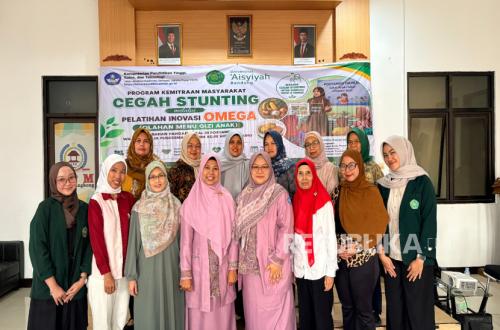
Efforts to prevent stunting do not always have to begin with foods that are difficult to obtain. Through the OMEGA innovation (Olahan Menu Gizi Anak, or Processed Nutritious Children’s Menus), Mulyanti, a lecturer at Universitas ’Aisyiyah (UNISA) Bandung, and her team are strengthening the capacity of Posyandu cadres in Cibangkong Urban Village, Batununggal District, Bandung City, so that they are able to process local food into nutritious menus as well as educational media for families.
The programme, titled ‘Preventing Stunting through OMEGA Innovation Training (Processed Nutritious Children’s Menus) Using Local Food at Posyandu in the Working Area of the Ibrahim Adjie Community Health Centre, Bandung City’, is a Community Partnership Programme (PKM) with 2026 funding from the Ministry of Higher Education, Science, and Technology of the Republic of Indonesia (Kemdiktisaintek RI).
The programme, which runs for approximately four months, not only provides education on toddler nutrition but also invites cadres to learn through direct practice. The series of activities began with coordination and needs analysis together with the UPTD Ibrahim Adjie Community Health Centre and the Chair of Working Group 4 of Posyandu Dahlia. The programme then continued with nutrition seminars and education, provision of educational media, handover of supporting assets, and cooking classes.
Mulyanti, Head of the OMEGA PKM Team, said that the local food-based approach was chosen so that nutrition education is easier to apply in daily life. According to her, cadres do not only need to understand the concept of nutritious food, but also need to have the skills to process and explain these menus to families.
“OMEGA positions local food not only as food ingredients, but also as a learning tool so that cadres and families are able to select, process, serve, and explain children’s menus practically,” said Mulyanti.
Mulyanti explained that the programme targets 10 Posyandu cadres representing each Posyandu in the Cibangkong urban village area. In the initial stage, the team conducted a needs analysis to map issues related to stunting, fulfilment of toddler nutrition, food processing, Supplementary Feeding (PMT), and nutrition education needs at Posyandu. The results of this mapping then became the basis for preparing seminar materials, pocket books, leaflets, posters, and practical activities for processing nutritious children’s menus.
“In the education provided, cadres receive reinforcement on the principles of nutritious, balanced, diverse, safe, and appealing food by utilising food ingredients available in the surrounding environment. One area of attention is also directed at strengthening the function of Table 4 of the Posyandu as a space for Communication, Information, and Education (KIE) for mothers of toddlers and families,” she said.
Mulyanti said that the OMEGA innovation is designed as a package that can be reused in Posyandu activities. The package includes standard menus and PMT recipes, nutrition education materials, toddler-friendly local food processing techniques, and educational media in the form of pocket books, leaflets, and posters.
“What we hope is not only that cadres understand the material during training, but that they are able to pass it on to families and use it in Posyandu activities. Therefore, mentoring and direct practice are important parts of this programme,” said Mulyanti.
One of the main tools in this programme is the OMEGA Pocket Book given to cadres. OMEGA also targets at least five menu variants that can be tested and developed according to the availability of local food.
In order to support the sustainability of the programme, the team also handed over equipment for processing nutritious children’s menus to partners at each Posyandu.
“This mentoring does not stop at seminars or the handover of equipment. Cadres need to be continuously accompanied so that they are able to use educational media, practise the menus, and apply this knowledge in Posyandu activities sustainably,” she said.
The OMEGA PKM programme is designed with an approach of training, direct practice, and mentoring over six effective months, carried out from April until September 2026. The improvement in cadre capacity will be monitored through knowledge measurement, observation of skills, increase in the number and variety of PMT menus, and the frequency of serving innovative PMT.
Cadres are also expected to be able to use the pocket book and educational media in Posyandu activities, demonstrate menus to families, help families arrange menus based on ingredients available at home, and coordinate with midwives, nutrition officers, and the Community Health Centre if growth problems, eating difficulties, or conditions requiring follow-up are found.
This programme confirms that stunting prevention efforts can be strengthened through an approach that is close to community life, utilising local food, improving cadre skills, and providing education that can be directly applied by families.
The implementing team for this activity consists of Mulyanti, S.ST., M.Keb., Bdn. as chair, together with Muhammad Syakib ’Asqalani Rifai, A.Md.Par., S.ST.Par., and Nurhayati, S.ST., M.Kes., Bdn. as members, as well as students Annisa Rahma Fadlillah and Yosa Canla Dwiba.