
President's Speech on the 2027 State Budget Bill and Financial Note, Part 1
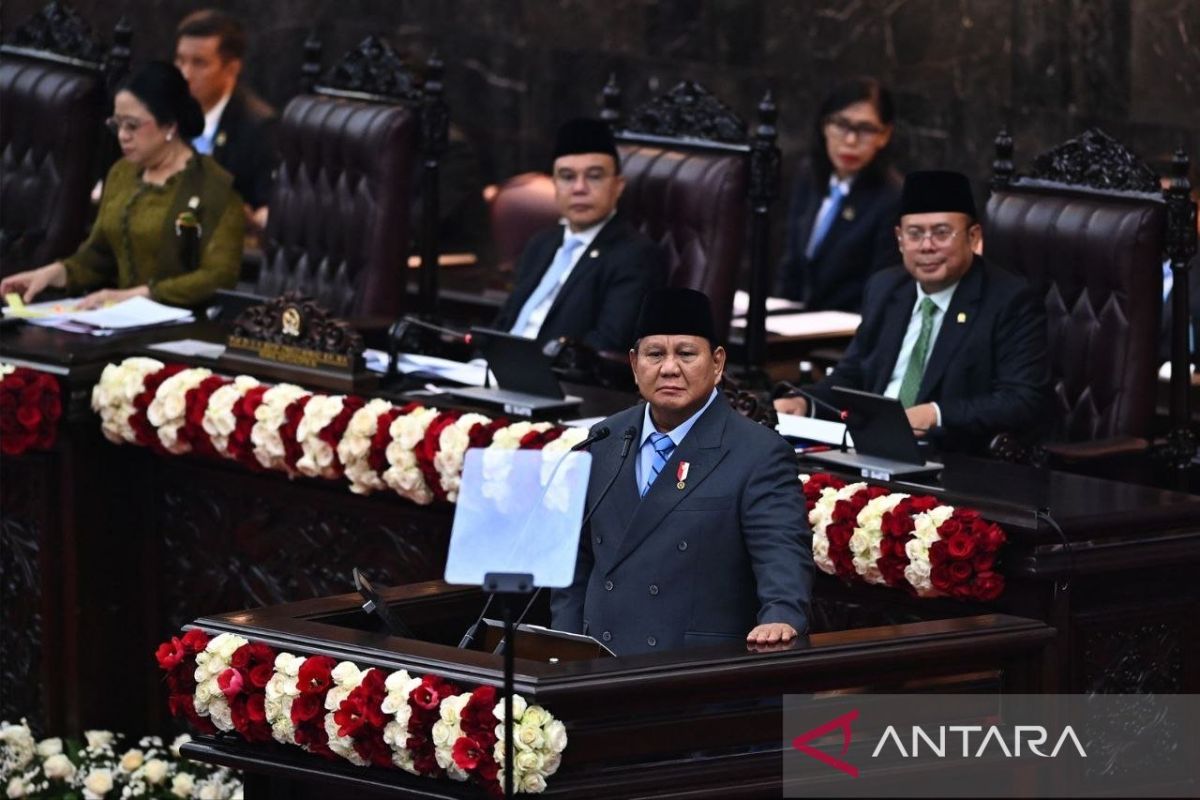
First, as people of faith, let us offer praise and gratitude to the presence of God Almighty, the Lord of all worlds. It is only to Him we pray and only to Him we seek help. By His grace and blessings, today we can attend the Session for the Government’s Statement on the Draft Law concerning the 2027 Fiscal Year State Budget and its Financial Note in good health, peace, and with a spirit of dedication and love for our homeland.
Honourable Leaders and Members of the Council.
Firstly, I express my appreciation to the Leaders and all Members of the DPR RI for their cooperation, oversight, and support in the formulation and implementation of the State Budget.
The State Budget is not merely a state financial document. The State Budget is our instrument of struggle. The State Budget is a tool to protect the people. A tool to strengthen the nation. A tool to realise the ideals of independence in achieving a better life.
If in the past our heroes fought so that the Indonesian nation would have a state, today our collective task is to ensure our state succeeds, that our state can improve the quality of life for our people, and that our state is present in the lives of every citizen.
Our state is present when farmers need fertiliser and technology. The state is present when fishermen need boats and cold storage for their catch. The state is present when workers need protection in their work and creativity.
The state must be present when children need nutritious food and good schools. The state must be present when families need housing, clean water, electricity, jobs, health services, and protection during difficult times.
That is the meaning of the State Budget as an instrument of struggle: every Rupiah collected by the state must return as tangible hope for our people.
Fellow countrymen and compatriots,
We are entering 2026 in a state of global uncertainty and difficulty. Energy prices worldwide are rising due to war, global interest rates are high and may increase further, various national currencies are under pressure, and geopolitical tensions are disrupting world trade.
However, amidst these global pressures and uncertainties, we are grateful that our economy remains standing tall. Our economy grew at its highest rate in 13 years during the first half of this year. Inflation remains under control. Domestic demand remains strong.
More importantly, our State Budget is working optimally. By the end of July 2026, state revenue grew significantly by 21.3 percent compared to the same period the previous year. This is a considerable improvement.
State expenditure grew strongly by 18.2 percent. Our spending is directed towards protecting the people’s purchasing power, strengthening public services, and driving the economy.
We do not choose between growth and prudence. We choose both. We do not choose between helping the people and safeguarding the State Budget. We do both.
Honourable and respected Leaders and Members of the Council.
The world is watching and observing our stance. On 13 July 2026, a renowned international rating agency, Standard & Poor’s (S&P), maintained Indonesia’s credit rating at BBB with a stable outlook. This is global recognition of the robustness of the Indonesian economy. Indonesia remains in the investment grade category.
S&P even assessed that Indonesia has solid economic growth prospects, generally prudent macroeconomic policies, and a debt burden that is relatively prudent and sustainable compared to peer countries. This is not the government’s statement, nor is it mine; this is their assessment of us.
They also assessed that the Government’s efforts to centralise management and close leakages in the natural resources and minerals sector could increase state revenue and export proceeds.
They specifically viewed positively the role of Danantara and the potential of PT Danantara Sumberdaya Indonesia (DSI) in eradicating under-invoicing and transfer pricing practices, which are essentially fraudulent practices. That is the view of Western experts and observers.
From the East, the Chinese rating agency China Lianhe Rating gave an AAA/Stable rating, the highest level, for Indonesia’s Panda Bonds issuance.
They assessed that Indonesia’s economic fundamentals are solid, our government policies are effective, our economy is resilient to external shocks, and our inflation is under control.
We accept these assessments as a reminder that credibility is built through consistent hard work and sincerity. The world does not only judge what we announce. The world judges what we actually implement.
Honourable and respected Leaders and Members of the Council.
The achievements of the first half of 2026 are our foundation for formulating the 2027 Draft State Budget.
Therefore, the architecture of the 2027 Draft State Budget is designed to remain expansive in a collaborative, targeted, and measured manner to drive ‘Higher Economic Growth and Faster Prosperity’.
The synergy of fiscal, monetary, financial sector, and Danantara policies must work in concert and become increasingly solid. Economic transformation towards high-value-added activities must continue to be strengthened. Our flagship programmes must run effectively. Social protection programmes must be reliable. Empowerment of MSMEs must continue to be stimulated.
Support for farmers, fishermen, teachers, and vulnerable workers must also be strengthened. The harmonisation of central and regional policies must become better and more robust.
The eradication of corruption and law enforcement must continue to be upheld without discrimination.
The 2027 Draft State Budget is focused on eight National Priority Work Programmes, namely: food sovereignty; energy and water independence; education; health; downstreaming and industrialisation; infrastructure, housing, and disaster resilience; strengthening the people’s economy and village development; and poverty reduction.
These eight priorities are supported by