
Presidential Staff Office prepares steps to accelerate development in 30 disadvantaged regencies
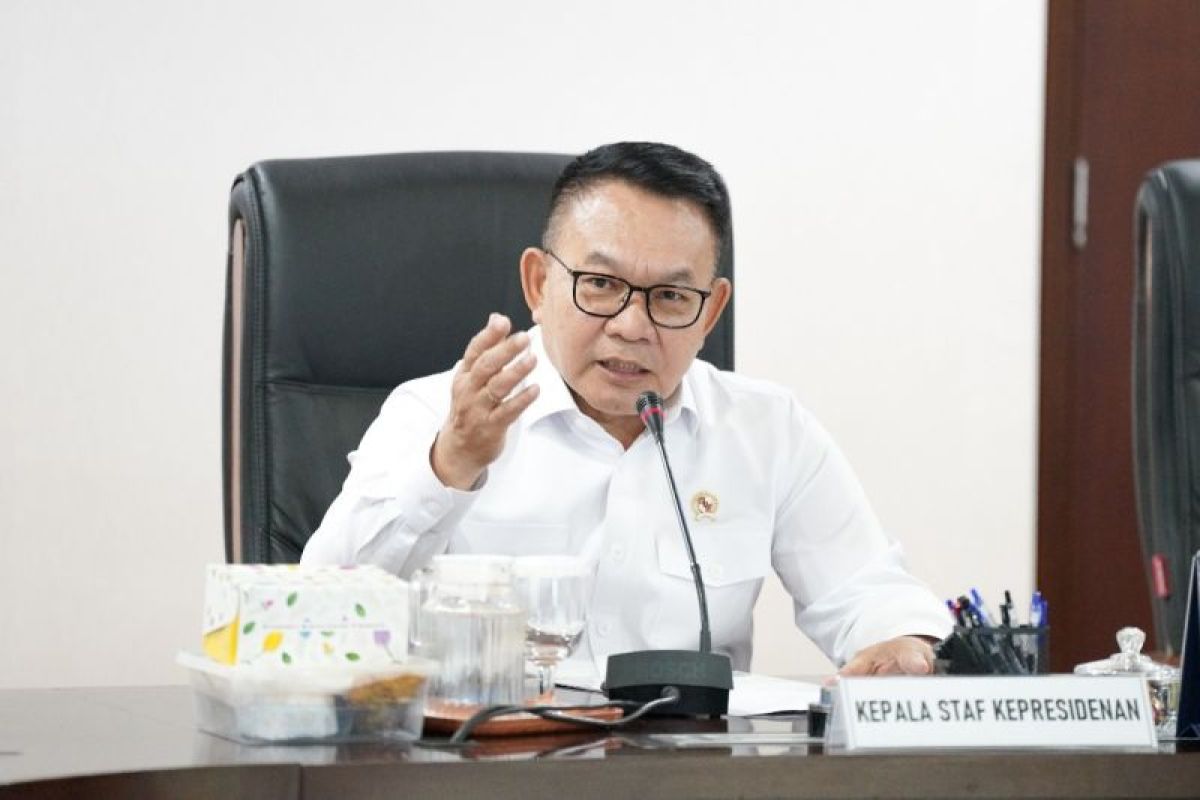
Jakarta (ANTARA) - The Chief of Staff to the President (KSP), General TNI (Ret.) Dudung Abdurachman, is preparing strategic steps to accelerate development in 30 disadvantaged regencies. This was announced by Dudung while presiding over a Coordination Meeting for the Acceleration of the Development of Disadvantaged and Highly Disadvantaged Regions at the Bina Graha Building, Jakarta, on Monday.
According to the briefing, the meeting aims to map out strategic steps that will be reported to the President to eradicate the backwardness in these 30 priority regencies. Dudung emphasised that even as Indonesia approaches its 80th year of independence, citizens in remote areas remain significantly behind in terms of health, education, transport, and lighting.
He noted that the poor condition of healthcare facilities has even resulted in fatalities. “These issues must be resolved immediately. In the near future, I will report to the President so that this matter becomes a priority. We will also invite the heads of these 30 regions to meet with the President directly,” said Dudung.
Present at the meeting were four regional heads, namely the Regent of Intan Jaya, Aner Maisini; the Regent of North Nias, Amizaro Waruwu; the Regent of Central Sumba, Paulus S.K. Limu; and the Regent of Lanny Jaya, Aletinus Yigibalom, alongside 26 other regional heads who joined virtually.
Meanwhile, the Minister for the Development of Disadvantaged, Frontier, and Remote Regions (Mendes PDT), Yandri Susanto, revealed that out of Indonesia’s 416 regencies, 30 regencies are the primary contributors to disadvantaged and highly disadvantaged villages. In these areas, the main challenges include electricity access, with approximately 5,000 villages still lacking power. Additionally, there are regions without signal coverage, low-quality healthcare and education facilities, and difficult access to clean water.
Yandri explained that out of a total of 9,300 disadvantaged and highly disadvantaged villages across Indonesia, 6,000 villages—nearly 75 per cent—are concentrated within these 30 regencies. “Therefore, if we resolve the issues in these 30 regencies, God willing, we will have comprehensively addressed the problem of disadvantaged villages. We want to act as effectively and swiftly as possible so that these 3T (disadvantaged, frontier, and remote) regions can be resolved,” Yandri asserted.