
Presidential Staff Office Appreciates Role of Ministry of Public Works' Directorate General of Strategic Infrastructure in Building 101 People's Schools Phase II
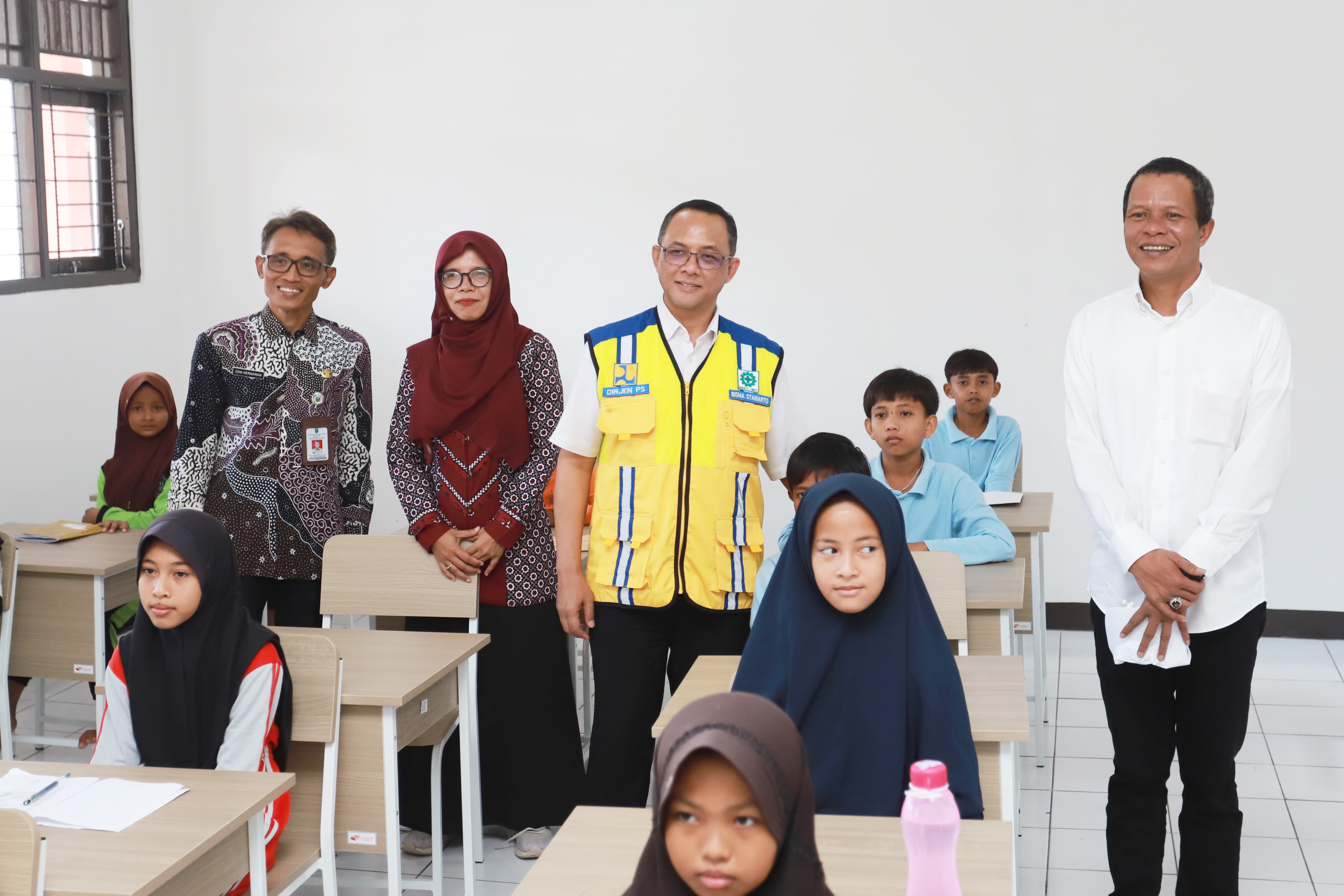
The government prioritises maintaining the quality of education. Head of the Presidential Staff Office, Muhammad Qodari, expressed appreciation for the performance of the Director General of Strategic Infrastructure at the Ministry of Public Works, Bisma Staniarto, in supporting the acceleration of the construction of People’s Schools Phase II, which is currently showing significant progress in various regions. According to Qodari, the technical and coordinative role played by the Directorate General of Strategic Infrastructure at the Ministry of Public Works has been a key factor in keeping the construction rhythm on track amid various on-site challenges, from land readiness to access constraints in several areas. ‘We appreciate the hard work and leadership of the Director General of Strategic Infrastructure at the Ministry of Public Works, Mr Bisma Staniarto, who continues to ensure that the People’s Schools Phase II construction process runs in a measured, coordinated manner and is able to resolve various on-site obstacles,’ said Qodari on Thursday (26/3). He explained that based on the latest data, the construction of People’s Schools Phase II is showing positive development. At the beginning of 2026, 101 out of a total of 104 locations across Indonesia have entered the construction phase. These projects are targeted for completion on 20 June 2026, so they can be immediately utilised to support the implementation of the new academic year 2026/2027 in July. ‘People’s Schools are a long-term investment for the nation. Therefore, the speed and quality of construction are crucial. This is where the role of the Directorate General of Strategic Infrastructure is very determining, not only in physical construction but also in ensuring school readiness for operation at the start of the 2026/2027 academic year,’ he continued. To ensure the target is achieved, Qodari emphasised that the Presidential Staff Office (KSP) together with the Directorate General of Strategic Infrastructure at the Ministry of Public Works continues to take concrete steps through a series of intensive coordination meetings. On 27 February 2026, KSP along with the Directorate General of Strategic Infrastructure at the Ministry of Public Works held a coordination meeting with several state-owned construction enterprises and construction service providers. This forum resulted in a comprehensive mapping of issues, from technical constraints and land readiness to logistical aspects, which then became the basis for more directed follow-up handling. ‘Through this coordination meeting, we not only identify problems but also ensure that every obstacle has a clear and measurable resolution path. This is important so that the construction process does not run partially but is integrated from the centre to the regions,’ said Qodari. Coordination was then expanded on 5 March 2026 by involving the Ministry of Social Affairs, the Ministry of Home Affairs, the Forest Area Regulation Task Force, and the Army Engineering Corps. This cross-sectoral synergy is considered effective in accelerating the resolution of various strategic obstacles, including the provision of road access and the settlement of land issues in several areas. Through that forum, several concrete solutions were agreed upon, such as accelerating infrastructure access construction in several priority locations and making quick decisions regarding land in various regions. ‘The key to this acceleration lies in collaboration. When ministries, regional governments, and service providers move in the same orchestration, previously complex obstacles can be resolved more quickly,’ he said. From the results of these acceleration efforts, significant progress is beginning to be seen in several regions, including South Kalimantan (30.85%), South Sulawesi (30.22%), and West Java (28.07%). Nevertheless, the government continues to pay special attention to several locations with low progress so they can be caught up through more structured and massive acceleration steps. ‘We continue to conduct tight monitoring of all locations, especially those with low progress. Interventions will be carried out more intensively so as not to hinder the overall completion target,’ Qodari stressed. Furthermore, Qodari also expressed appreciation for the role of various parties that have contributed to driving the acceleration of People’s Schools construction, from technical ministries and regional governments to construction service providers. According to him, the success in maintaining the construction rhythm to date is the result of solid collective work and shared commitment to providing equitable education access for the community. ‘This acceleration is the result of joint work. We appreciate all parties that have contributed, especially the Ministry of Public Works through the Directorate General of Strategic Infrastructure, which continues to be the engine in ensuring construction runs according to the set targets and standards,’ he concluded.