
Presidential Chief of Staff Reveals Origins of Nickel Export Halt Due to Rare Earth Metals
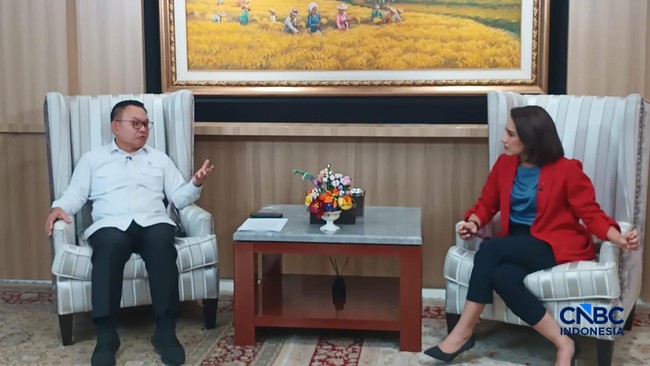
Head of the Presidential Staff Office (KSP) Dudung Abdurachman has revealed how exports of nickel and other strategic minerals came to a halt in recent weeks.
The standstill was caused by business concerns over law enforcement action relating to rare earth element (REE) content in mineral commodities.
Dudung explained that the issue originated from the arrest around two months ago of a company, PT Putraprima Mineral Mandiri (PMM), which was caught exporting tin with indications of REE content.
According to him, the case created fear among exporters of nickel, alumina and tin, because these commodities naturally contain traces of REEs.
“From that process, business actors began to have doubts and fears, so the export of anything in mineral form — such as alumina and tin, which certainly contain rare earth elements — came to a halt,” he said on the Mining Zone programme broadcast by CNBC Indonesia, quoted on Tuesday (4/8/2026).
The arrest, carried out by the Illegal Mining Eradication Task Force (Satgas PKH), prompted reactions from business actors who then reported the matter to the KSP in search of a way out.
The KSP gathered all stakeholders, from technical ministries and Customs to law enforcement officials from the Attorney General’s Office and the National Police Criminal Investigation Division, to agree on a solution.
“Then I called everyone involved — lawyers, Customs, regional governments, including the Task Force itself, and the Indonesian National Armed Forces Headquarters. The results of our coordination were communicated, and because this has entered the legal process, we will continue while awaiting the court’s decision,” he explained.
Dudung noted that the export ban remains strictly in force for REE products as the main commodity, as these concern mastery of high technology and national security. However, for minerals that contain only trace amounts of REEs as accompanying elements at very low concentrations, the KSP has facilitated an agreement to allow exports to resume.
“Indeed, rare earth content does exist, but the export ban on rare earth metals as a primary product remains unregulated to this day and is prohibited because it is very dangerous — this is not merely an economic issue, but if exploited by outside parties, it relates to very high-technology interests,” he added.
He therefore pledged to guarantee the safety of business actors from the risk of uncoordinated law enforcement in the field following the inter-agency agreement.
Dudung asked entrepreneurs to report immediately any law enforcement actions deemed excessive or carried out in the name of the law without proper procedure.
“I want to say that if anyone claims to act in the name of law enforcement, they must report to us so that we can protect them — we must not allow rogue law enforcement without coordination,” Dudung concluded.
Revision of Trade Ministerial Regulation No. 6 of 2026
Previously, Coordinating Minister for Economic Affairs Airlangga Hartarto addressed the polemic over mineral exports hindered by REE content.
He said the government would revise Trade Ministerial Regulation (Permendag) Number 6 of 2026, the Fourth Amendment to Trade Ministerial Regulation No. 22 of 2023 concerning Goods Prohibited from Export.
“(On) rare earth elements, it has already been discussed at the Ministry of Energy and Mineral Resources and the Ministry of Trade. There will be no new regulation — only a revision of the Permendag,” Airlangga explained when met at the Coordinating Ministry for Economic Affairs office on Monday (3/8/2026). The revision is targeted for completion within a week.
Recently, mining business players in commodities such as tin, nickel and bauxite have complained that their export activities have stopped because they must satisfy a new requirement concerning the REE content in their goods.
Airlangga acknowledged that, chemically, REEs are often found combined with mining commodities and are difficult to separate entirely. “REEs exist within chemical elements. That is nature. They cannot be separated 100% — that is impossible. There are always accompanying traces,” he said.
The Permendag revision will be drafted on the basis of technical recommendations issued by the Ministry of Energy and Mineral Resources (ESDM).
Nevertheless, the regulation being finalised concerns determining the threshold of chemical content that will serve as a reference for surveyors and Customs in conducting export oversight.
“In accordance with the thresholds. Yes. The Permendag based on ESDM’s recommendations,” he stated.
It should be noted that this Permendag was signed in Jakarta on 17 March 2026 by Trade Minister Budi Santoso and promulgated on 26 March 2026. Permendag No. 6 of 2026 took effect on 1 April 2026.
Among the goods prohibited from export under Permendag No. 6 of 2026 are rare earth elements comprising 17 elements contained in rare earths at below 99% purity:
Scandium below 99% purity
Yttrium below 99% purity
Lanthanum below 99% purity
Cerium below 99% purity
Praseodymium below 99% purity
Neodymium below 99% purity
Promethium below 99% purity
Samarium below 99% purity
Europium below 99% purity
Gadolinium below 99% purity
Terbium below 99% purity
Dysprosium below 99% purity
Holmium below 99% purity
Erbium below 99% purity
Thulium below 99% purity
Ytterbium below 99% purity
Lutetium below 99% purity
This provision is set out in the Mining Sector Annex, item 257, of Permendag No. 6 of 2026.
Source: jawawa.id (https://jawawa.id/newsitem/presidential-chief-of-staff-reveals-origins-of-nickel-export-halt-due-to-rare-earth-metals-1785819089)
Originally published by CNBC Indonesia (https://www.cnbcindonesia.com/news/20260804105815-4-756342/kepala-ksp-beberkan-awal-mula-polemik-ekspor-nikel-cs-setop-gegara-ltj), translated from Indonesian