
Presidential Chief of Staff Dudung: Nickel and Other Mineral Exporters Can Resume Shipments
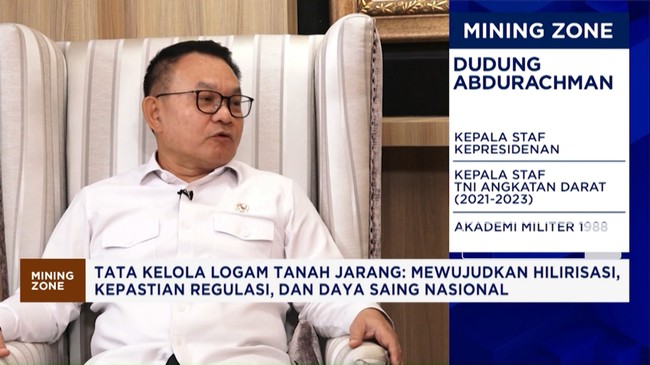
Jakarta, CNBC Indonesia – The Presidential Staff Office (KSP) has confirmed that businesses dealing in nickel and other minerals that have undergone the downstream processing stage have been granted permission to export again.
This follows the temporary disruption of nickel and other mineral exports because they contain rare earth elements (REE).
Presidential Chief of Staff Dudung Abdurachman revealed that the export tap was reopened after a cross-ministerial and institutional agreement was reached several days ago.
He said the agreement is expected to prevent an economic slowdown and minimise the social impact caused by mining companies halting operations in various regions.
“After it was communicated and everyone agreed and signed so that no party was disadvantaged, exports were finally able to resume that very night,” he said on the CNBC Indonesia Mining Zone programme, quoted on Tuesday (4/8/2026).
According to him, the halt on nickel and other mineral exports was triggered by business players’ concerns about law enforcement action over REE content that occurs naturally as accompanying minerals. He guaranteed that as long as operational procedures are followed and the results of checks by an official surveyor institution are satisfied, export activities must not be obstructed by any authority.
“It will be Sucofindo that checks it. So an official institution carries out the check — if the content is 0.00-something, that is already permitted under the agreement,” he explained.
Dudung also instructed law enforcement officials not to take actions without coordination that could affect the investment climate. The government will continue to monitor implementation on the ground while awaiting the completion of the revision to the Minister of Trade Regulation (Permendag) governing export rules.
“I have said that if anyone claims to act in the name of law enforcement, they must report to us so we can protect them, so that there is no rogue law enforcement acting without coordination,” he asserted.
Previously, Coordinating Minister for Economic Affairs Airlangga Hartarto addressed the polemic over mineral exports that had been obstructed due to REE content.
On that matter, the government confirmed it would revise Trade Ministerial Regulation Number 6 of 2026, the Fourth Amendment to Trade Ministerial Regulation No. 22 of 2023 concerning Goods Prohibited from Export.
“Regarding REEs, it has been discussed at the Ministries of Energy and Mineral Resources and Trade. There is no (new regulation). Just a revision of the Permendag,” Airlangga explained when met at the Coordinating Ministry for Economic Affairs office on Monday (3/8/2026). The revision is targeted to be completed within a week.
Recently, there have been complaints from mining businesses dealing in minerals such as tin, nickel and bauxite that their export activities were halted because they had to meet a new requirement concerning the REE content in their goods.
Airlangga acknowledged that, chemically speaking, REEs are often found fused with mining commodities and are difficult to separate entirely.
“REEs exist in chemical elements. That is nature. So they cannot be separated 100 per cent — that is impossible. There are always accompanying others,” he explained.
The Permendag revision will be drafted based on technical recommendations issued by the Ministry of Energy and Mineral Resources (ESDM).
Nevertheless, the rule being deliberated centres on determining the threshold levels of the chemical elements that will serve as the reference for surveyors and Customs in conducting export supervision.
“In accordance with the limits. Yes. The Permendag upon the recommendation of the ESDM Ministerial Regulation,” he concluded.