
President Xi Jinping Attends Opening of CPPCC Session in Beijing
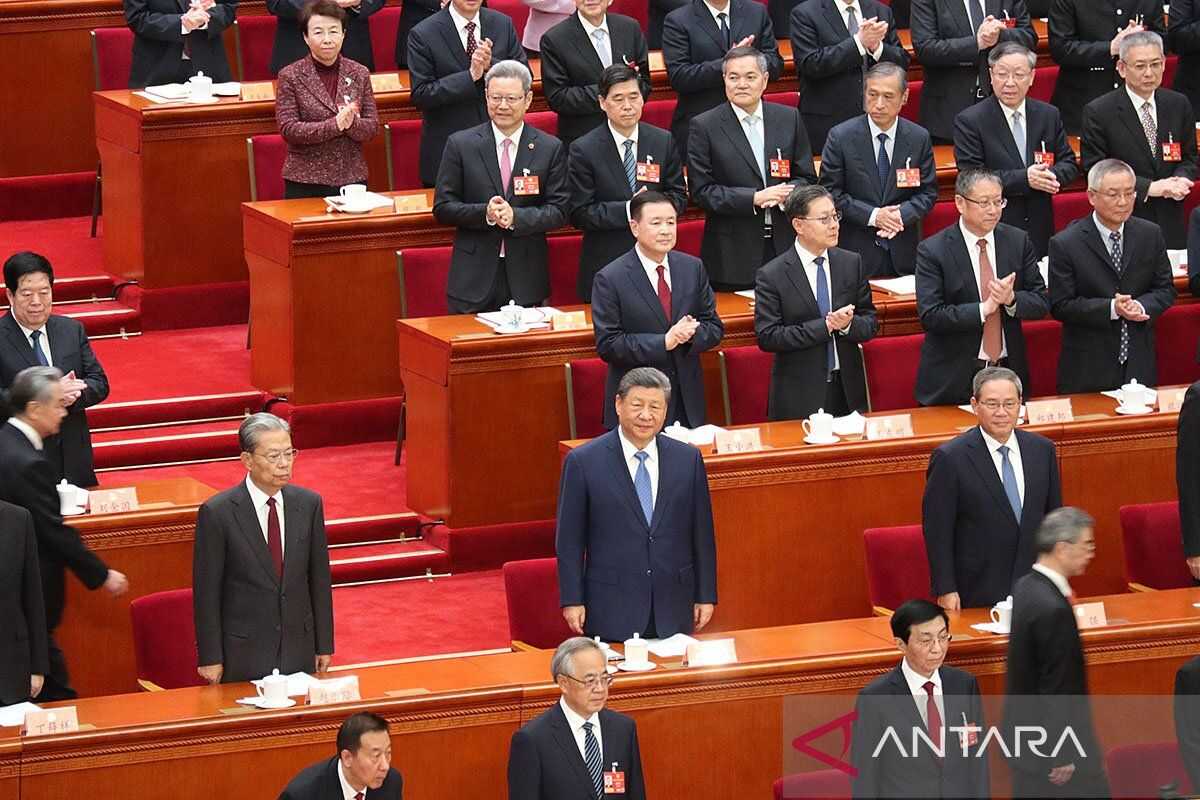
Beijing (ANTARA) - President Xi Jinping attended the opening of the Chinese People’s Political Consultative Conference (CPPCC) session held at the Great Hall of the People, Beijing. In the session which began on Wednesday afternoon, CPPCC Standing Committee Chairman Wang Huning delivered the CPPCC work report to be attended by 2,078 CPPCC members. “The year 2026 is the first year of the implementation of the 15th Five-Year Plan. The CPPCC must remain guided by Xi Jinping Thought on Socialism with Chinese Characteristics for a New Era,” Wang Huning said during his remarks at the opening ceremony in the Great Hall of the People, Beijing, on Wednesday. The CPPCC session is part of the annual Chinese parliamentary session commonly known as the ‘Two Sessions’, which runs from 4 to 12 March 2026. Also present at the opening, besides President Xi, were senior figures in the Chinese Communist Party (CCP) including Premier Li Qiang, Standing Committee Chairman of the National People’s Congress (NPC) Zhao Leji, Chief of the Presidential Office Cai Qi, Vice Premier Ding Xuexiang, Vice President Han Zheng and other relevant officials. “The CPPCC will carry forward the spirit of the 20th National Congress of the Communist Party and the 20th Central Committee Plenum and continue to improve the system of political consultation and democratic oversight under the leadership of the Communist Party of China,” added Wang Huning. The CPPCC, Wang Huning revealed, will also mobilise strength, consensus, aspirations and wide support from various social groups to ensure a good start for the implementation of the 15th Five-Year Development Plan. Throughout 2025, Wang Huning noted, 1,290 members conducted inspections and field studies, 506 participated in theoretical research, 1,965 members submitted proposals, 1,443 members provided information on public opinion, 365 members delivered speeches in plenary sessions, 343 participated in CPPCC overseas activities and 33 members received exceptional annual performance awards. “Let us unite closely with the CPC Central Committee with Xi Jinping at the core, work together with strong resolve and courage to advance, promote high-quality development of the CPPCC and contribute wisdom and strength to the construction of a modern socialist country with Chinese characteristics,” concluded Wang Huning. There are two major bodies in China’s legislative framework. The first is the Chinese People’s Political Consultative Conference (CPPCC). CPPCC members are not politicians but representatives of the people, including businesspeople, religious groups, ethnic minority delegates and celebrities, totalling 2,078 people. The CPPCC does not have authority to enact laws but can offer advice, serve as a source of ideas and social glue. It provides guidance to the Chinese parliament known as the National People’s Congress (NPC). The second is the NPC, the legislative body consisting of politicians elected by the people from provinces and regions in China and various government departments. NPC members are referred to as “deputies” with a five-year term. There are 2,773 NPC deputies reported for attendance at the NPC session; deputies work part-time and serve as a channel for the public to convey its aspirations to the government. The NPC also has a Central Committee comprising 152 members based in Beijing as the “engine” that runs daily governance and legislation and works year-round to ensure the state continues. The duties of this Standing Committee are to draft and supervise laws, oversee the functioning of the government, appoint and remove state officials, decide on important issues, handle internal NPC deputy affairs, conduct parliamentary diplomacy and lead special committees. Under the Chinese constitution since September 15, 1954, the NPC Congress has been the most important and supreme moment in China’s domestic politics.